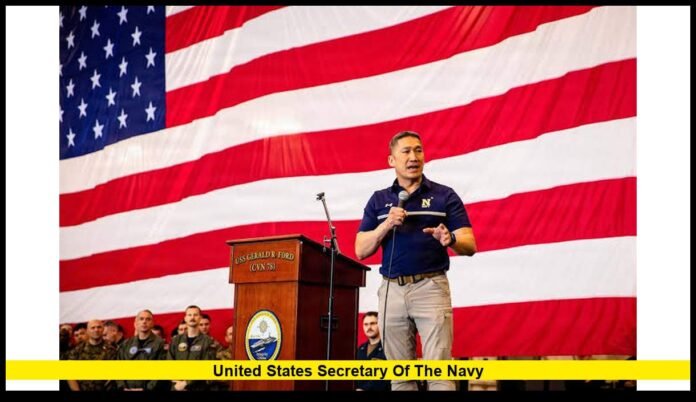

The United States Secretary of the Navy is currently Hung Cao, who has served in an acting capacity since April 22, 2026, and is now awaiting Senate action on his nomination for the permanent position. The latest development comes after the White House formally submitted Cao’s nomination to the Senate in September.
Cao’s potential move from acting secretary to the permanent position comes during a major period for the Department of the Navy. Shipbuilding, fleet modernization, acquisition reform, artificial intelligence, industrial capacity and personnel readiness remain central issues for the department.
For now, Cao continues to perform the duties of the civilian leader of the Department of the Navy. His formal nomination means the Senate confirmation process will determine whether he moves from the acting position into the permanent office.
Hung Cao Remains the Acting Navy Secretary
Hung Cao assumed the responsibilities of acting secretary on April 22, 2026. He took over after John Phelan’s departure from the position.
The transition immediately placed Cao at the center of major Navy and Marine Corps decisions. He had already served as Under Secretary of the Navy, giving him experience inside the department before taking on the acting secretary role.
The Navy’s current leadership information continues to identify Cao as acting secretary. The department’s historical records also list him as holding the acting position from April 2026 to the present.
That status has now gained another layer of significance because President Donald Trump announced plans in September to nominate Cao for the permanent job.
The White House subsequently sent the nomination to the Senate. Until the confirmation process is completed, Cao remains the acting secretary rather than a Senate-confirmed secretary.
Hung Cao’s Background Before Becoming Secretary
Cao’s career gives him a background that is closely connected to military operations and national security.
He entered the Navy as a Seaman Recruit in 1989. He later received his commission from the U.S. Naval Academy in 1996 as a Special Operations Officer.
During his military career, Cao served as a Navy Diver and Explosive Ordnance Disposal Officer. His assignments included missions connected to Special Warfare and Special Forces.
His service included deployments to Iraq, Afghanistan and Somalia. He also worked on counter-drone operations, counter-messaging and other sensitive activities during his final period of active duty.
Cao retired from active service in October 2021 with the rank of captain.
His education includes a bachelor’s degree in Ocean Engineering and a master’s degree in Applied Physics. His professional experience also includes work in the private sector on defense-related technologies.
Before taking over as acting secretary, Cao served as Under Secretary of the Navy. That position gave him direct exposure to the department’s civilian leadership structure and major policy responsibilities.
The Senate Nomination Is the Latest Major Development
The most important leadership development in September is Cao’s formal nomination.
President Trump announced on September 1 that he intended to nominate Cao for the permanent position. The White House formally transmitted the nomination to the Senate later in the month.
The Senate process is important because the permanent secretary position requires Senate confirmation.
Until that process concludes, Cao’s official status remains acting secretary.
The nomination also means the Senate will have an opportunity to review Cao’s record, qualifications and plans for the department before deciding whether to confirm him.
For readers searching for the current secretary, the distinction between “acting” and “confirmed” is important. Cao is currently performing the duties of the office, but the permanent appointment remains subject to the confirmation process.
What the Secretary Oversees
The secretary is the senior civilian official overseeing the Department of the Navy.
The department includes both the Navy and Marine Corps. Its responsibilities extend across personnel, equipment, acquisition, construction, modernization, budgets and readiness.
The secretary does not replace the military chain of command. Instead, the position provides civilian leadership and oversight for the department.
That makes the office important to virtually every major program involving Navy and Marine Corps resources.
The secretary also works with the administration, Congress, military leadership and the defense industry on matters affecting the department’s long-term capabilities.
The position therefore involves much more than overseeing ships and sailors.
It covers the broader system required to maintain and modernize the nation’s maritime forces.
Shipbuilding Is a Central Priority
Shipbuilding is one of the biggest issues facing the department as Cao seeks permanent confirmation.
The Department of the Navy released its Fiscal Year 2027 Shipbuilding Plan earlier this year. The plan calls for expanding fleet capacity while rebuilding the maritime industrial base.
The plan also emphasizes shipyard capacity, workforce development and greater accountability for delivering ships.
The department has described the effort as part of its broader plan to build a larger and more capable fleet.
A major element involves balancing traditional manned platforms with emerging capabilities.
The plan includes investments across multiple categories of naval platforms. It also looks beyond individual ship programs toward the industrial infrastructure required to build and maintain them.
That means the secretary’s responsibilities extend to questions about shipyards, suppliers, skilled workers, production schedules and acquisition processes.
For Cao, shipbuilding is therefore likely to remain one of the central issues during the Senate confirmation process and beyond.
The Navy’s Industrial Base Remains in Focus
The ability to build ships and other military systems depends on the broader U.S. industrial base.
The Department of the Navy has been working to increase manufacturing capacity and address production challenges.
Cao has emphasized the need for greater speed and accountability in delivering capabilities to sailors and Marines.
The department has also taken steps to strengthen leadership connected to industrial-base issues.
These efforts matter because major naval platforms can require years of design, construction and testing.
Increasing production cannot happen simply by placing additional orders. Shipyards need facilities, equipment, workers and suppliers capable of supporting sustained production.
The same applies to components and specialized technologies.
The secretary’s office therefore has a major role in coordinating the policy and budget decisions that support the industrial base.
Technology and Artificial Intelligence Are Expanding Priorities
Technology is another major part of the department’s current agenda.
In July 2026, Cao signed a Department of the Navy strategy focused on data and artificial intelligence.
The strategy establishes a framework for using data and AI to improve decision-making and support military operations.
The department has described the effort as part of building an AI-enabled force.
Technology is also becoming increasingly important in areas such as unmanned systems, software, cybersecurity and information management.
In August, Cao appointed M. Barry Tanner as the department’s permanent Chief Information Officer.
The position oversees a Department of the Navy information technology portfolio worth more than $12 billion.
That appointment highlights the growing importance of digital infrastructure to Navy and Marine Corps operations.
Modern naval power now depends on networks, software, data and communications as well as physical platforms.
Unmanned Systems Are Part of the Modernization Effort
The Navy is also expanding its use of unmanned systems.
One major example is the MQ-25A Stingray program, designed to provide carrier-based aerial refueling and other capabilities.
The Navy reported a significant milestone for the program in 2026 with its first flight and Milestone C approval.
Unmanned aircraft are part of a wider effort to increase the capabilities available to carrier strike groups while changing how naval aviation operates.
The development of unmanned systems is closely connected to the department’s broader modernization strategy.
For the secretary, these programs create long-term questions involving acquisition, testing, production and integration with existing forces.
Personnel and Readiness Remain Major Responsibilities
Technology and ships receive substantial attention, but personnel remain a fundamental responsibility of the department.
The secretary oversees policies affecting sailors, Marines and civilian employees across the Department of the Navy.
Cao has continued visiting Navy organizations and meeting with personnel during his time as acting secretary.
In September, he visited Navy Personnel Command in Tennessee. The organization supports personnel assignments and other workforce functions across the service.
Personnel readiness is especially important when the Navy faces lengthy deployments and demanding operational schedules.
Recent attention surrounding the USS Abraham Lincoln deployment has also placed sailor welfare and mental health in the public spotlight.
Cao disclosed in a letter to Sen. Kirsten Gillibrand that eight personnel assigned to the carrier strike group attempted suicide during its lengthy deployment. He also stated that no service member died by suicide during that deployment.
The disclosure has added personnel welfare to the list of issues receiving attention around the current leadership of the department.
International Engagement Is Another Part of the Job
The secretary also represents the Department of the Navy in international engagements.
Cao has traveled overseas and participated in meetings involving U.S. partners.
In June, he participated in events connected to Pacific Partnership and Pacific Friendship in Vietnam.
More recently, Cao met with Vietnamese leader To Lam in New York during the United Nations General Assembly period.
Such engagements demonstrate that the secretary’s role extends beyond Washington and domestic Navy policy.
International relationships are important to maritime operations, exercises, disaster-response cooperation and broader defense partnerships.
The secretary can therefore serve as a senior civilian representative for the department in discussions with foreign governments and military officials.
What Happens Next for Hung Cao
The immediate question surrounding Cao is the Senate confirmation process.
The White House has formally submitted his nomination. The Senate must now consider the nomination through its established process.
Until confirmation occurs, Cao remains acting secretary.
A successful confirmation would change his status from acting secretary to the Senate-confirmed holder of the office.
The process also gives senators an opportunity to examine his record and priorities.
Issues likely to remain important include shipbuilding, acquisition reform, industrial capacity, technology, personnel readiness and fleet modernization.
The timing comes as the Department of the Navy continues implementing its Fiscal Year 2027 priorities.
Why the Leadership Update Matters
The secretary’s position carries responsibility for a department with two major military services and a large civilian workforce.
Leadership decisions can affect procurement, shipbuilding, technology programs, personnel policy and long-term force planning.
Cao already has experience inside the department. His previous role as Under Secretary means his current position represents a continuation of his involvement in Navy civilian leadership rather than an entirely new assignment.
His nomination also creates a clear path toward a permanent leadership decision.
For now, however, the distinction remains important: Cao is acting secretary while his nomination awaits Senate consideration.
The department continues its work regardless of that distinction. Shipbuilding programs move forward, technology initiatives continue, personnel policies remain active and acquisition decisions proceed.
Latest Status of the Navy Secretary Position
As of September 24, 2026, Hung Cao is serving as Acting Secretary of the Navy.
He assumed the acting role on April 22 after John Phelan left the position. President Trump announced Cao as his choice for the permanent position in September, and the White House subsequently transmitted the nomination to the Senate.
That makes the current leadership situation different from earlier in 2026.
Cao is no longer simply an interim official with no announced path to the permanent job. He is now the administration’s nominee for the position, while continuing to perform the duties of acting secretary.
The Senate confirmation process will determine the next stage of his tenure.
Meanwhile, the Department of the Navy remains focused on expanding shipbuilding capacity, improving acquisition, developing new technologies, strengthening the industrial base and maintaining readiness across the Navy and Marine Corps.
The leadership picture is continuing to develop, so share your thoughts in the comments and stay informed as the Senate considers the nomination.