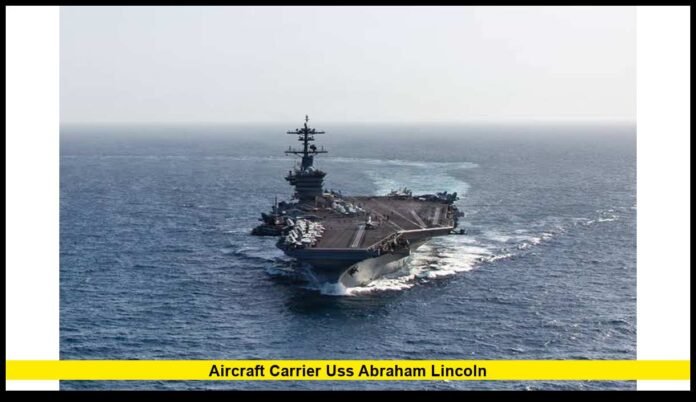

The aircraft carrier USS Abraham Lincoln is nearing the end of an extraordinary U.S. Navy deployment that has lasted more than 300 days. As of September 24, 2026, the carrier is continuing its long journey toward San Diego after months of operations in the Middle East and a return through the Indo-Pacific.
The Lincoln departed San Diego in November 2025 and later shifted from the Pacific to the Middle East as U.S. military operations involving Iran intensified.
For much of the deployment, the carrier operated far from its homeport with limited opportunities for sailors and Marines to go ashore.
That changed in September.
The carrier made a port visit to Thailand before reaching Guam on September 19. The Guam stop gave members of the crew their first opportunity to step onto U.S. soil in roughly nine months.
The carrier then resumed its journey toward California.
The deployment has also generated new attention because of the strain associated with such a long mission. On September 24, Acting Navy Secretary Hung Cao disclosed that eight service members across the Abraham Lincoln Carrier Strike Group attempted suicide during the deployment. The Navy said no service member died by suicide during the mission.
The disclosure adds another significant chapter to one of the longest U.S. carrier deployments of the post-Cold War era.
Where the USS Abraham Lincoln Stands Today
The USS Abraham Lincoln is currently on its return journey to San Diego.
The carrier reached Guam on September 19 after completing a port visit in Thailand earlier in the month.
The Guam stop lasted only about one day.
During that brief visit, the carrier took on supplies, mail and equipment. Sailors also received access to base services and limited time ashore.
The ship left Guam on September 20 and continued toward the U.S. West Coast.
At that point, the Lincoln had been deployed for more than 300 days.
The carrier’s return is expected to bring the unusually long mission to a close in the coming weeks.
The exact arrival date depends on the ship’s operating schedule and transit requirements.
When Did the Current Deployment Begin?
The Abraham Lincoln began its current deployment in November 2025.
The carrier left San Diego with its associated carrier strike group and Carrier Air Wing 9.
The initial portion of the deployment involved operations in the Indo-Pacific.
The mission later changed as the United States increased its military presence around the Middle East.
The carrier eventually moved toward the U.S. Central Command area of responsibility.
That decision placed the Lincoln in a much more demanding operational environment.
Instead of returning to California after its original mission, the carrier remained deployed and supported operations in the Middle East for several months.
The Carrier Spent Almost Seven Months in the Middle East
The Lincoln spent nearly seven months operating in the Middle East.
During this period, the carrier strike group supported U.S. military operations involving Iran.
The ship operated in the Arabian Sea and surrounding waters while supporting combat missions.
Its presence provided the United States with a mobile aviation platform capable of launching aircraft without relying on an airfield ashore.
The carrier’s aircraft conducted missions associated with the broader U.S. military campaign.
The deployment continued even as the operational requirements changed.
Eventually, another carrier was positioned to help maintain U.S. carrier presence in the region.
The Lincoln then began its journey east toward the Pacific.
USS Abraham Lincoln Left the Middle East in August
The carrier left the Middle East in August 2026 after almost seven months in the region.
It moved into the U.S. 7th Fleet operating area during the next stage of the deployment.
The ship and its escorts traveled through the Indian Ocean before continuing toward Southeast Asia.
By this point, the carrier had already spent months away from its homeport.
The long return journey still required additional stops for supplies and crew support.
The first major scheduled break came in Thailand.
Thailand Provided the Carrier’s First Major Port Visit in Months
The USS Abraham Lincoln arrived at Laem Chabang, Thailand, on September 2.
The visit represented a major milestone for the crew.
The carrier had not made a regular port visit since December 2025.
That meant approximately nine months had passed since the previous major opportunity for sailors and Marines to leave the ship during a port call.
Around 5,000 sailors and Marines are associated with the carrier during a deployment.
For those personnel, the Thailand visit offered time away from the ship after an exceptionally long period at sea.
The carrier remained in the area for several days before departing Thailand on September 6.
The visit was intended to provide rest, recovery and logistical support.
The Crew Had Spent More Than 200 Consecutive Days at Sea
One of the most striking details of the deployment was the length of the crew’s uninterrupted time at sea.
Before arriving in Thailand, the Lincoln had spent 208 consecutive days at sea.
That period included operations in the Middle East.
The lack of regular port visits was unusual for an aircraft carrier.
Carriers normally make periodic port calls for maintenance, resupply and crew rest.
The Lincoln instead remained operational for an extended period while the Navy maintained its presence in the region.
The result was a deployment that placed unusual demands on both the ship and its personnel.
Guam Became the Crew’s First Return to U.S. Soil
After leaving Thailand, the Lincoln continued through the Indo-Pacific.
The carrier eventually reached Apra Harbor in Guam on September 19.
Guam is a U.S. territory in the western Pacific.
For the Lincoln’s crew, the arrival represented the first return to U.S. soil in about nine months.
The visit was not a full recreational port call.
It was primarily a short logistics stop.
The carrier took aboard supplies, mail and equipment before departing the following day.
Sailors also received access to base services during the short stay.
The Navy arranged limited liberty opportunities during the visit.
After approximately one day in Guam, the Lincoln continued toward San Diego.
The USS Abraham Lincoln Is Approaching a Major Deployment Record
The current deployment has become one of the longest involving a U.S. aircraft carrier since the Vietnam War era.
By September 23, the Lincoln had reached 307 days into its deployment.
That placed it only 19 days behind the 326-day deployment completed by USS Gerald R. Ford earlier in 2026.
The Lincoln therefore ranks among the longest carrier deployments of the post-Cold War period.
Its final deployment length will depend on the date it officially returns to San Diego.
The ship is not expected to surpass the historic 332-day deployment of USS Midway, which remains associated with the Vietnam War period.
Still, the Lincoln’s current mission represents an exceptional period away from homeport.
Why the Deployment Became So Long
The length of the mission resulted from changing operational requirements.
The Lincoln began its deployment in the Pacific.
The ship later moved toward the Middle East as tensions involving Iran escalated.
Once the carrier arrived in the region, the United States needed to maintain naval aviation capability there.
The Navy therefore kept the Lincoln in the operational area rather than immediately sending it home.
The carrier eventually supported combat operations for more than 200 days.
The Navy later sent USS George Washington into the region to help replace the Lincoln.
That allowed the Abraham Lincoln to begin its journey back toward the United States.
Carrier Air Wing 9 Remained Central to the Mission
The USS Abraham Lincoln operates with Carrier Air Wing 9.
The air wing provides the carrier’s primary aviation capability.
Its aircraft include F/A-18E and F/A-18F Super Hornets.
The air wing also operates specialized aircraft and helicopters that support different naval missions.
These aircraft allow the carrier to conduct operations while hundreds or thousands of miles from land.
During the Middle East portion of the deployment, the air wing supported the carrier strike group’s military missions.
The ability to move an entire air wing with the carrier is one of the defining advantages of a nuclear-powered aircraft carrier.
The Carrier Strike Group Is Larger Than the Carrier Alone
The Abraham Lincoln does not operate by itself.
A carrier strike group normally includes the carrier, its embarked air wing and several escort ships.
The escorts provide air defense, missile defense, surface warfare and other capabilities.
The current Lincoln strike group included guided-missile destroyers and other supporting personnel.
The carrier also operated with Carrier Strike Group 3 and Destroyer Squadron 21 personnel.
That broader organization matters when evaluating the latest personnel information released by the Navy.
The September 24 disclosure concerning suicide attempts applies to the strike group as a whole rather than only to sailors physically assigned to the carrier.
Navy Discloses Eight Suicide Attempts
On September 24, Acting Navy Secretary Hung Cao disclosed that eight service members across the Abraham Lincoln Carrier Strike Group attempted suicide during the deployment.
The figure covers personnel assigned across the strike group.
That includes the aircraft carrier, its embarked air wing, associated staffs and escorting ships.
The Navy said there were no deaths by suicide during the deployment.
The disclosure followed questions from Sen. Kirsten Gillibrand about the welfare of personnel assigned to the carrier strike group.
Cao’s letter also addressed incidents involving personnel going overboard.
One sailor assigned to the air wing went overboard from the Lincoln in early August and was rescued.
In another incident in March, a service member attempted to go overboard but shipmates intervened.
These details form part of the Navy’s current public account of the human challenges surrounding the long deployment.
Mental Health Support Was Available to the Strike Group
The Navy has said that personnel had access to medical and behavioral health resources during the deployment.
The carrier had chaplains and medical personnel.
The strike group also had behavioral health professionals and other support resources.
Those resources were intended to help personnel manage the demands of extended deployment and combat operations.
The Navy’s disclosure came after public concerns about conditions aboard the carrier.
The new information provides a clearer picture of the mental health incidents that occurred during the mission.
It also shows why the welfare of sailors has become an important part of the discussion surrounding the Lincoln’s return.
Reports About Conditions Aboard the Carrier Drew Attention
The Lincoln’s long deployment generated reports about difficult conditions aboard the ship.
Some family members raised concerns about mental health, food supplies, hygiene products and other quality-of-life issues.
Navy officials disputed some of the reporting and emphasized that the carrier remained capable of carrying out its mission.
The Navy also acknowledged that long combat deployments create significant challenges.
The carrier had been away from San Diego for most of a year.
For sailors and Marines, that meant spending months in a confined environment while operating under wartime conditions.
The length of the deployment made the quality of supplies and access to support services especially important.
The Carrier’s Food and Supply Chain Became Important Issues
A carrier requires an enormous logistical effort to remain at sea.
Food, water, aircraft parts, medical supplies, hygiene products and other materials must reach the ship regularly.
The Lincoln’s extended time in the Middle East complicated those logistics.
The carrier operated far from traditional U.S. homeport facilities.
The Navy had to move supplies over long distances to keep the ship operational.
The lack of regular port visits also limited opportunities to replenish certain supplies directly.
The Navy has since discussed lessons from extended deployments, including the need for stronger logistics planning.
Those lessons could influence how future carrier deployments handle food, hygiene products and other quality-of-life requirements.
The USS Abraham Lincoln Is a Nimitz-Class Carrier
The USS Abraham Lincoln is a Nimitz-class nuclear-powered aircraft carrier.
The ship carries the hull number CVN-72.
It entered active service in November 1989.
The carrier measures about 1,092 feet long.
Its nuclear propulsion system allows it to operate for long periods without conventional propulsion fuel.
That capability gives the carrier exceptional endurance.
However, nuclear propulsion does not eliminate the need for logistics.
The ship still requires food, aviation fuel, spare parts, ammunition and other supplies.
That makes replenishment ships and overseas logistics facilities essential during extended deployments.
A Floating Airfield With Global Reach
The Lincoln essentially functions as a mobile airfield.
Its flight deck allows aircraft to launch and land while the ship moves through international waters.
That capability allows the United States to position military aviation power without requiring access to a foreign airbase.
During the current deployment, the carrier demonstrated that flexibility across two major regions.
It began in the Indo-Pacific, moved into the Middle East and then returned through the Pacific.
The movement covered thousands of miles.
The carrier’s return journey illustrates the mobility built into the U.S. carrier strike group concept.
The Return to San Diego Is Now the Main Focus
After leaving Guam, the Lincoln began the final major portion of its journey.
The carrier still had thousands of miles to travel before reaching San Diego.
The return transit requires careful navigation, replenishment and coordination with other naval forces.
The ship’s arrival will also begin the transition from combat deployment to post-deployment maintenance.
Aircraft will need inspections.
Ship systems will require maintenance.
Sailors will begin returning to normal routines after months away from home.
The Navy will also evaluate the carrier’s operational and maintenance needs before its next major assignment.
What Happens After the Lincoln Returns Home
A carrier does not normally return from a deployment and immediately leave again.
Post-deployment work can include inspections, repairs, maintenance and equipment replacement.
The crew also requires time to recover.
The aircraft assigned to Carrier Air Wing 9 will undergo their own maintenance and inspection schedules.
The carrier’s nuclear propulsion system, aviation systems, weapons systems and other equipment require regular technical attention.
The extended deployment could also increase the amount of maintenance required after the ship reaches San Diego.
The exact maintenance schedule will depend on Navy planning and the condition of the ship.
Why the Current Deployment Matters
The Abraham Lincoln’s current deployment demonstrates both the endurance and limitations of a modern carrier strike group.
The ship remained operational through months of combat activity.
It also moved between the Middle East and Indo-Pacific without returning to its homeport.
At the same time, the deployment highlighted the human and logistical demands of keeping a carrier at sea for such an extended period.
The Navy’s September 24 disclosure about eight suicide attempts has added another documented dimension to the story.
The carrier’s mission was operationally significant, but the experience also placed substantial demands on the people serving aboard the ship and with its strike group.
Latest USS Abraham Lincoln Status as of September 24, 2026
As of September 24, 2026, the USS Abraham Lincoln remains on its journey back to San Diego.
The carrier completed its Thailand port visit on September 6.
It then made a brief logistics stop in Guam on September 19 and departed the following day.
The Guam visit marked the crew’s first return to U.S. soil in approximately nine months.
The carrier has now spent more than 300 days deployed.
Its current mission ranks among the longest post-Cold War U.S. aircraft carrier deployments.
The ship’s return will end a deployment that began in November 2025 and included extensive operations in the Middle East.
The latest Navy disclosure also confirms eight suicide attempts across the broader Lincoln strike group during the deployment, with no reported suicide deaths.
The Lincoln is now in the final stage of its long journey home.
Its eventual arrival in San Diego will close one of the most demanding deployments in the ship’s recent history and begin the next phase of maintenance, recovery and preparation.
What do you think about the USS Abraham Lincoln’s extraordinary deployment? Share your thoughts in the comments and stay updated on the carrier’s return to San Diego.