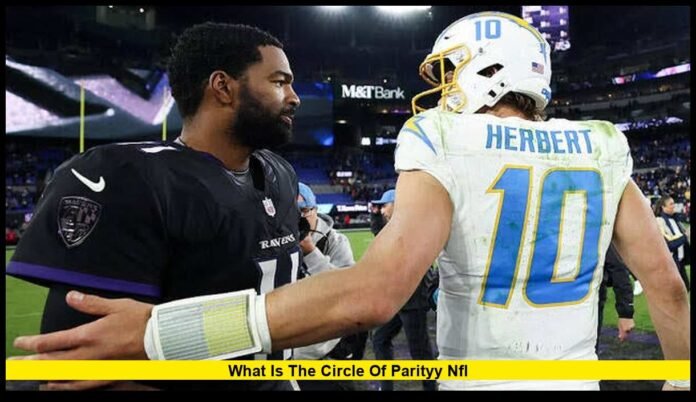

The What Is the Circle of Parity NFL concept has become an interesting subject among American football fans during the 2026 regular season. The unusual statistical pattern connects all 32 National Football League franchises through a continuous chain of victories. Every team defeats another franchise in the sequence, and the final connection eventually returns to the team that started the cycle. The 2026 circle reached completion after the Los Angeles Chargers defeated the Baltimore Ravens 23-20 on November 16, creating a league-wide connection involving teams from both conferences.
The development attracted attention because the Chargers entered the matchup after a difficult stretch without a victory. Their success against Baltimore became the final result needed to close the chain. It also demonstrated how an unexpected outcome can become part of a much larger statistical pattern involving dozens of games.
Unlike traditional NFL rankings, this concept does not measure which franchise has the strongest roster or the best record. Instead, it examines the relationships created by individual victories. A team can struggle throughout the season and still contribute an important result to the completed sequence.
The 2026 development offers an opportunity to examine how the concept works, why it attracts attention, and what the completed cycle reveals about the competitive structure of professional football.
Understanding the Circle of Parity in Professional Football
The circle of parity is a sequence of victories that connects every NFL franchise through actual game results. Each team must have defeated the next team in the sequence. The final team must also have defeated the original starting franchise, creating a closed loop.
The idea is based on the relationship between opponents rather than their overall season records.
Consider a simplified example involving three fictional football teams:
- Team A defeats Team B.
- Team B defeats Team C.
- Team C defeats Team A.
These results create a complete cycle because every team has a direct winning connection to the next franchise.
The NFL version involves all 32 teams. It requires a longer sequence of victories, with each franchise appearing once before the chain returns to its starting point.
The structure is particularly interesting because the NFL does not schedule every team against every other franchise during the regular season.
Instead, teams face divisional opponents, selected conference opponents, and opponents from the other conference. Those different matchups create connections that can eventually link the entire league.
A complete circle therefore represents an interconnected collection of actual results rather than a theoretical comparison.
The Chargers Deliver the Final Result in the 2026 NFL Season
The 2026 circle reached completion on November 16 when the Los Angeles Chargers secured a 23-20 victory over the Baltimore Ravens.
The Monday Night Football matchup carried considerable importance for Los Angeles. The Chargers entered the contest with an 0-8 record and needed a strong performance to change the direction of their season.
Baltimore also entered the game looking to improve its position in the AFC.
Los Angeles eventually controlled the decisive moments and secured the three-point victory.
Justin Herbert completed 12 of 18 passes for 129 yards. He also contributed 51 rushing yards and scored a rushing touchdown.
Running back Omarion Hampton delivered another important performance, recording 105 rushing yards and a touchdown on 22 carries.
Kicker Cameron Dicker added three field goals, helping the Chargers maintain their advantage throughout the contest.
Baltimore received two rushing touchdowns from Derrick Henry. Quarterback Jacoby Brissett completed 33 of 49 passes for 340 yards and threw one interception.
The Ravens remained within reach during the closing minutes, but a critical turnover changed the situation.
With 2:03 remaining, Chargers defender Tarheeb Still forced a fumble from Baltimore wide receiver Zay Flowers. Elijah Molden recovered the loose football, allowing Los Angeles to protect its lead.
The final score was 23-20.
For the Chargers, the victory ended an 11-game losing streak that included the previous season and postseason.
For the league-wide statistical sequence, it provided the final connection. Baltimore had already defeated Tennessee during Week 4, allowing the Chargers’ victory over the Ravens to close the circle.
The Complete 2026 NFL Circle of Parity Featuring All 32 Franchises
The completed sequence contains all 32 NFL teams. Each franchise defeated the team listed immediately after its name.
The 2026 order is:
- Tennessee Titans
- Indianapolis Colts
- Miami Dolphins
- New York Jets
- Cleveland Browns
- Carolina Panthers
- New Orleans Saints
- New York Giants
- Arizona Cardinals
- Los Angeles Rams
- Philadelphia Eagles
- Washington Commanders
- Seattle Seahawks
- New England Patriots
- Buffalo Bills
- Detroit Lions
- Minnesota Vikings
- Green Bay Packers
- Chicago Bears
- Tampa Bay Buccaneers
- Dallas Cowboys
- Houston Texans
- Jacksonville Jaguars
- Cincinnati Bengals
- Pittsburgh Steelers
- Atlanta Falcons
- San Francisco 49ers
- Denver Broncos
- Kansas City Chiefs
- Las Vegas Raiders
- Los Angeles Chargers
- Baltimore Ravens
The final connection returns from Baltimore to Tennessee.
This arrangement includes teams from all eight NFL divisions. It also crosses conference boundaries several times.
The sequence is not a ranking of the franchises. The Tennessee Titans appearing first does not mean they are the best team, and the Baltimore Ravens appearing last does not indicate that they are the weakest.
The order simply illustrates one complete chain of victories.
How the 2026 Winning Sequence Connects Different NFL Teams
The 2026 circle developed through games played across multiple weeks.
The opening connection came from Tennessee’s victory over Indianapolis during Week 6. Indianapolis then supplied the next link by defeating Miami.
Miami had already defeated the New York Jets, while the Jets had beaten Cleveland.
The sequence continued through victories involving franchises from both conferences.
Some important connections included:
| Winning franchise | Defeated franchise |
|---|---|
| Tennessee Titans | Indianapolis Colts |
| Indianapolis Colts | Miami Dolphins |
| Miami Dolphins | New York Jets |
| New York Jets | Cleveland Browns |
| Cleveland Browns | Carolina Panthers |
| Carolina Panthers | New Orleans Saints |
| New Orleans Saints | New York Giants |
| New York Giants | Arizona Cardinals |
| Arizona Cardinals | Los Angeles Rams |
| Los Angeles Rams | Philadelphia Eagles |
| Philadelphia Eagles | Washington Commanders |
| Washington Commanders | Seattle Seahawks |
| Seattle Seahawks | New England Patriots |
| New England Patriots | Buffalo Bills |
| Buffalo Bills | Detroit Lions |
| Detroit Lions | Minnesota Vikings |
| Minnesota Vikings | Green Bay Packers |
| Green Bay Packers | Chicago Bears |
| Chicago Bears | Tampa Bay Buccaneers |
| Tampa Bay Buccaneers | Dallas Cowboys |
| Dallas Cowboys | Houston Texans |
| Houston Texans | Jacksonville Jaguars |
| Jacksonville Jaguars | Cincinnati Bengals |
| Cincinnati Bengals | Pittsburgh Steelers |
| Pittsburgh Steelers | Atlanta Falcons |
| Atlanta Falcons | San Francisco 49ers |
| San Francisco 49ers | Denver Broncos |
| Denver Broncos | Kansas City Chiefs |
| Kansas City Chiefs | Las Vegas Raiders |
| Las Vegas Raiders | Los Angeles Chargers |
| Los Angeles Chargers | Baltimore Ravens |
| Baltimore Ravens | Tennessee Titans |
The table illustrates the entire structure in a straightforward format.
Each row represents a winning connection. The winning franchise appears on the left, while its defeated opponent appears on the right.
The sequence can move between divisions and conferences because the NFL schedule includes interconference matchups.
The Role of Unexpected Victories in Completing the Circle
Unexpected results are an important part of the concept.
NFL teams do not perform identically every week. A franchise with a strong record can lose to an opponent that has struggled throughout the season.
Several factors can influence individual results.
Quarterback performance is one of the most important. A team with a productive passing attack may struggle when its quarterback faces heavy defensive pressure.
Injuries can also change a matchup. Losing a starting offensive lineman, cornerback, linebacker, or quarterback can affect the entire game plan.
Coaching decisions matter as well. Offensive formations, defensive coverage, substitutions, and fourth-down decisions can influence the final outcome.
Turnovers frequently create additional uncertainty. A single interception or lost fumble can change field position and scoring opportunities.
The Chargers-Ravens matchup demonstrated this unpredictability. Baltimore remained competitive, but the late fumble recovery helped Los Angeles protect its narrow lead.
That individual moment became part of a larger league-wide story.
The circle is therefore an interesting illustration of how one game can contribute to a chain involving teams that may not meet directly during the season.
The Mathematical Structure Behind the Circle
The concept also has a mathematical foundation.
It can be explained through graph theory, a branch of mathematics that studies relationships between connected objects.
In this model, every NFL franchise represents a vertex, or point.
A victory creates a directed edge from the winning team to the defeated opponent.
For example, if the Buffalo Bills defeat the Detroit Lions, the connection moves from Buffalo to Detroit.
A complete sequence must visit every franchise once and return to the starting point.
This structure is known as a Hamiltonian cycle.
A Hamiltonian cycle is a closed path through a network that visits every vertex exactly once before returning to the beginning.
The NFL version applies that mathematical idea to football results.
The important requirement is that every connection must be supported by a real victory.
A team cannot simply be placed next to another franchise because their records are similar. The relationship must come from an actual game.
This explains why identifying a complete circle requires more than looking at standings or comparing winning percentages.
Researchers can use computer-based methods to examine game results and identify possible sequences.
Why the Circle Does Not Mean All NFL Teams Have Equal Strength
The word parity can sometimes create confusion.
In football discussions, competitive parity generally refers to the balance of competition across the league. It suggests that teams have opportunities to compete rather than one franchise dominating every season.
However, the circle of parity is a different concept.
It does not prove that every NFL team has the same level of talent or that all franchises have equal chances of winning a championship.
A team can defeat a strong opponent in one game and still finish near the bottom of its division.
Similarly, a playoff contender can lose to a struggling franchise without losing its overall competitive advantage.
The sequence tracks individual victories, not complete season performance.
Several measurements provide a more useful picture of team strength:
- Overall win-loss record.
- Points scored per game.
- Points allowed per game.
- Offensive efficiency.
- Defensive efficiency.
- Turnover differential.
- Strength of schedule.
- Performance against divisional opponents.
These statistics help analysts evaluate franchises more comprehensively.
The circle serves a different purpose by revealing the connections between results.
How the Circle Differs From Official NFL Standings
The NFL standings provide the official record of each franchise’s performance.
They determine division positions and help establish playoff qualification.
The circle does not perform either function.
| Feature | Official NFL standings | Circle of parity |
|---|---|---|
| Purpose | Measure team performance | Connect victories |
| Official league category | Yes | No |
| Based on game results | Yes | Yes |
| Measures winning percentage | Yes | No |
| Determines division leaders | Yes | No |
| Influences playoff qualification | Yes | No |
| Includes all 32 teams | Yes | Yes, in a completed cycle |
This distinction is important because a completed circle does not give any team an additional victory in the official standings.
The Chargers’ November 16 result counts as one regular-season win. Baltimore receives one loss.
The fact that the game completed the cycle does not change the way the NFL calculates its standings.
Playoff positions continue to depend on the league’s established qualification and tiebreaking rules.
Historical Examples of Completed NFL Circles
The circle of parity has appeared in numerous NFL seasons.
Historical tracking of the post-merger league identifies completed circles in different years and at different points in the regular season.
Recent examples include:
| Season | Week of completion |
|---|---|
| 2023 | Week 8 |
| 2024 | Week 11 |
| 2025 | Week 8 |
| 2026 | Week 10 |
The timing can vary because teams do not face the same opponents every week.
Some seasons produce the necessary connections relatively quickly. Other seasons require additional games before a complete sequence appears.
Historical tracking also identifies seasons without a documented complete circle.
Examples include 1972, 1976, 1982, 2007, 2008, 2015, and 2017.
This makes the achievement an interesting part of NFL statistical history.
The 2026 completion in Week 10 places the season among the years in which the full 32-team connection developed before the regular season reached its final weeks.
Why the NFL Schedule Makes the Circle Possible
The NFL’s scheduling structure creates the conditions for these connections.
Each team plays 17 regular-season games over 18 weeks.
Franchises play divisional opponents twice, while the remaining schedule includes teams from other divisions and conferences.
The schedule rotates opponents over multiple seasons.
As a result, teams build different networks of victories.
An AFC franchise might defeat an NFC opponent. That NFC team may have defeated another AFC franchise. The process creates a connection across the conference divide.
Over time, these individual results can form a continuous sequence.
The 2026 circle includes examples from all four divisions in both conferences.
The chain does not follow the official division structure because the winning connections are determined by game results rather than geographical or organizational arrangements.
The Importance of the Chargers’ Victory Beyond the Statistical Achievement
Although the completed circle attracted attention, the Chargers’ victory also had direct importance for the franchise.
An 0-8 start placed significant pressure on the team.
The victory against Baltimore offered relief after a difficult run and gave the Chargers an opportunity to build momentum.
Herbert’s contribution on the ground was particularly important. His rushing touchdown provided another scoring option beyond the passing attack.
Hampton’s 105 rushing yards also helped Los Angeles establish balance offensively.
The defense made its contribution at the most important moment by forcing and recovering the late fumble.
The result demonstrated that the Chargers could compete effectively against a Baltimore team with significant playoff ambitions.
However, the completed circle should not be mistaken for evidence that Los Angeles had suddenly become one of the league’s strongest teams.
Its significance lies in the actual victory and the connection it created.
The Circle’s Place in NFL Fan Discussions
Football fans often use different statistics to compare franchises.
Some focus on power rankings, while others examine head-to-head results, division records, quarterback statistics, or postseason performances.
The circle offers another way to discuss the season.
It is especially useful for illustrating how teams from different divisions become connected through common opponents.
A franchise does not need to defeat every other team directly. It only needs to defeat the next franchise in the sequence.
That makes the concept easy to understand once the chain is displayed.
It also encourages fans to examine games beyond their favorite team’s schedule.
A victory involving a team in another conference can eventually become an important connection.
This broader perspective is one reason the concept continues to attract interest among football followers.
What the 2026 Circle Means for the Rest of the NFL Season
The completed circle does not end the statistical interest in the 2026 season.
Teams will continue playing regular-season games, changing their records and creating additional winning connections.
New results can produce alternative cycles and different ways of connecting franchises.
The existing completed sequence remains a valid illustration of the results used to construct it.
However, future games may provide additional statistical relationships.
For teams competing for postseason positions, the main priorities remain winning games, improving divisional records, and securing favorable standings.
For fans following the circle, the interesting part is watching how the remaining schedule adds new connections to the league-wide network.
The Chargers’ victory supplied the final link in one complete sequence, but the regular season continues to produce new football results.
Final Thoughts on the 2026 NFL Circle of Parity
The 2026 NFL season has produced an interesting statistical achievement by connecting all 32 franchises through a continuous chain of regular-season victories. The sequence demonstrates how teams from different conferences and divisions can become linked without playing every opponent directly.
The Los Angeles Chargers supplied the final connection with their 23-20 victory over the Baltimore Ravens on November 16. That result ended their extended losing streak and completed the league-wide cycle in Week 10.
Although the circle has no effect on official standings, division championships, or playoff qualification, it provides a fascinating way to examine the relationships created by NFL games.
The achievement also highlights the unpredictable nature of professional football. A single victory can matter beyond the immediate matchup when viewed as part of a larger statistical pattern.
The 2026 circle is another reminder that every NFL game can contribute to a bigger story, making the remainder of the season worth watching closely.