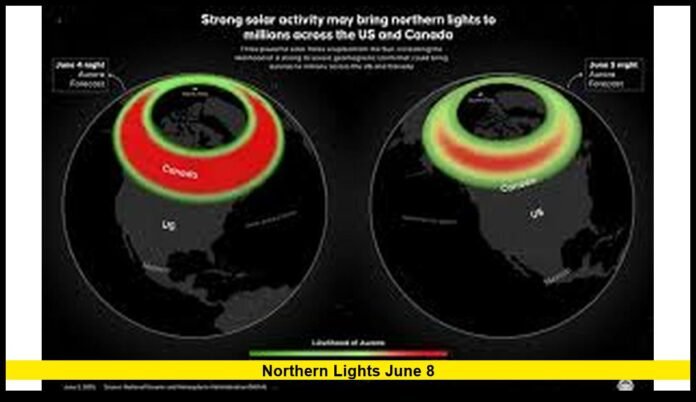

Northern lights June 8 remains one of the most talked-about skywatching topics across the United States as millions of Americans prepare for a potentially impressive aurora event. Increased solar activity has placed space weather in the spotlight, with geomagnetic storm conditions expected to create favorable opportunities for viewing the aurora borealis across several northern states.
The possibility of seeing colorful lights dancing across the night sky has generated widespread interest among photographers, astronomy enthusiasts, and casual observers alike. While auroras are commonly associated with Alaska and northern Canada, stronger solar activity can occasionally push visibility much farther south, allowing residents in parts of the continental United States to experience the phenomenon.
Why the Northern Lights Are Getting Attention on June 8
The northern lights occur when charged particles from the Sun interact with Earth’s magnetic field and atmosphere. These particles travel through space and become concentrated near the planet’s polar regions, where they collide with atmospheric gases and create glowing curtains of light.
Recent solar activity has increased the likelihood of visible auroras. Active regions on the Sun have produced eruptions that sent energy and charged particles toward Earth. As these particles arrive, they can trigger geomagnetic disturbances that strengthen auroral displays.
This combination of solar activity and favorable geomagnetic conditions has made June 8 a significant date for skywatchers throughout North America.
What Is Driving the Current Aurora Activity?
The Sun operates on an approximately 11-year activity cycle. During periods of heightened activity, sunspots become more numerous, and solar eruptions occur more frequently.
When a coronal mass ejection leaves the Sun and reaches Earth, it can disturb the planet’s magnetic field. These disturbances are measured using a geomagnetic storm scale that ranges from minor to extreme.
The June 8 event has attracted attention because forecast conditions suggest stronger-than-average geomagnetic activity. Stronger activity generally increases both the brightness of auroras and the distance from the Arctic where they can be observed.
As a result, skywatchers across numerous U.S. states are monitoring conditions closely.
States With the Best Opportunity for Viewing
Residents in northern parts of the country are expected to have the strongest chance of seeing auroras if local skies remain clear.
The best viewing opportunities are expected across:
- Washington
- Montana
- Idaho
- North Dakota
- South Dakota
- Minnesota
- Wisconsin
- Michigan
- Maine
Several additional states may also experience visibility near the northern horizon, particularly in rural areas with limited light pollution.
These include:
- Oregon
- Wyoming
- Nebraska
- Iowa
- Illinois
- Indiana
- Ohio
- Pennsylvania
- New York
- Vermont
- New Hampshire
The exact visibility area can shift during geomagnetic events, making real-time conditions important throughout the evening.
Why Clear Skies Matter
Even strong auroral activity can go unnoticed if cloud cover blocks the sky.
Weather conditions often become the deciding factor in whether people can successfully observe an aurora display. A powerful geomagnetic storm may create bright lights overhead, but thick clouds can completely hide the event from view.
Observers hoping to maximize their chances should monitor local forecasts and seek locations where skies remain clear after sunset.
Dark conditions also play a major role. Urban lighting reduces contrast and can make faint auroras difficult to detect.
Best Locations for Aurora Viewing
Experienced skywatchers often travel away from cities when aurora conditions improve.
Ideal viewing locations include:
- State parks
- Open farmland
- Lakeshores
- Mountain overlooks
- Rural highways with safe parking areas
The farther a viewer moves away from bright artificial lighting, the greater the chance of seeing subtle auroral colors and movement.
Many successful aurora photographs come from locations that offer both dark skies and an unobstructed northern horizon.
What Time Should People Look Up?
Auroras can appear at any point during the night when geomagnetic conditions remain active.
However, the most favorable viewing period generally occurs between late evening and the early morning hours.
Many skywatchers begin monitoring conditions shortly after darkness falls and continue checking the sky through midnight.
Auroras sometimes intensify unexpectedly. A location showing little activity one hour may display vibrant lights the next.
Patience often becomes one of the most important factors in successful viewing.
Read More – Is There a Full Moon Tonight
What the Northern Lights May Look Like
Many people expect bright green ribbons stretching across the sky.
Green remains the most common aurora color because oxygen atoms in Earth’s upper atmosphere emit green light when energized by incoming particles.
During stronger geomagnetic disturbances, additional colors can appear.
Observers may see:
- Green curtains
- Red glows
- Purple streaks
- Pink highlights
- White arcs
The appearance varies depending on atmospheric conditions, viewing angle, and the intensity of solar activity.
Some auroras appear as faint glowing bands, while others develop into dramatic displays covering large portions of the sky.
How Smartphone Cameras Help Aurora Hunters
Modern smartphone technology has transformed aurora viewing.
Many phones can capture faint displays that are difficult to see with the naked eye. Night mode photography often reveals colors and structures that may not immediately stand out to observers standing beneath the sky.
Because of this, many people now use their phones as an additional viewing tool.
A quick photo facing north can sometimes confirm auroral activity before it becomes obvious visually.
This approach has become increasingly popular during recent geomagnetic events.
Photography Tips for June 8
Photographers hoping to capture the event can improve their results with a few simple techniques.
Helpful tips include:
- Use a tripod whenever possible.
- Enable night mode on smartphones.
- Avoid bright nearby lights.
- Focus on the northern horizon.
- Take multiple exposures.
- Keep the camera stable.
Longer exposures often reveal richer colors and more detail than what the human eye can detect in real time.
Even beginner photographers can achieve impressive results during strong auroral events.
The Growing Interest in Space Weather
Interest in auroras has increased significantly during recent years.
Advances in forecasting technology now allow people to monitor geomagnetic activity more closely than ever before. Space weather alerts, mobile applications, and online tracking tools have made aurora chasing accessible to a broader audience.
As solar activity continues to remain elevated, more Americans have become interested in understanding how solar eruptions influence Earth’s magnetic environment.
The northern lights have evolved from a rare curiosity into a widely followed astronomical event.
How Geomagnetic Storms Affect Aurora Visibility
Geomagnetic storms occur when solar energy interacts with Earth’s magnetic field.
The stronger the disturbance, the farther south auroras can travel.
Minor storms typically keep auroras confined to high northern latitudes. Moderate storms expand visibility somewhat farther south.
Strong storms can dramatically enlarge the auroral oval, allowing observers across a much wider area to witness the phenomenon.
This relationship explains why certain nights receive national attention from skywatchers.
The June 8 event has drawn interest because conditions may support a broader viewing region than normal.
Why Rural Areas Often See Better Displays
Light pollution remains one of the biggest obstacles to aurora viewing.
City lights brighten the night sky and reduce contrast. This makes faint auroral features harder to detect.
Rural communities often experience much darker skies, allowing subtle colors and movement to stand out more clearly.
Even a short drive away from urban areas can improve viewing conditions substantially.
For many observers, darkness proves just as important as geomagnetic activity.
A Natural Phenomenon That Continues to Fascinate
The aurora borealis has fascinated people for centuries.
Ancient cultures developed stories and traditions around the mysterious lights. Today, scientists understand the physical processes responsible for the phenomenon, yet the visual spectacle remains just as captivating.
Each display is unique.
Patterns shift continuously as charged particles interact with Earth’s atmosphere. No two auroral events look exactly alike.
This unpredictability contributes to the excitement surrounding major viewing opportunities.
What Makes June 8 Stand Out
Several factors have combined to make June 8 an important date for aurora enthusiasts.
Elevated solar activity, favorable geomagnetic forecasts, and widespread public awareness have created strong interest across the country.
Observers from the Pacific Northwest to New England are preparing for potential viewing opportunities, particularly in northern regions where visibility prospects appear strongest.
For many people, this could become one of the most memorable skywatching nights of the month.
Those fortunate enough to experience clear skies may witness one of nature’s most remarkable displays as shimmering colors illuminate the darkness above.
As night falls, skywatchers across the United States will be looking northward, hoping to catch a glimpse of the northern lights and share their experiences with fellow observers.