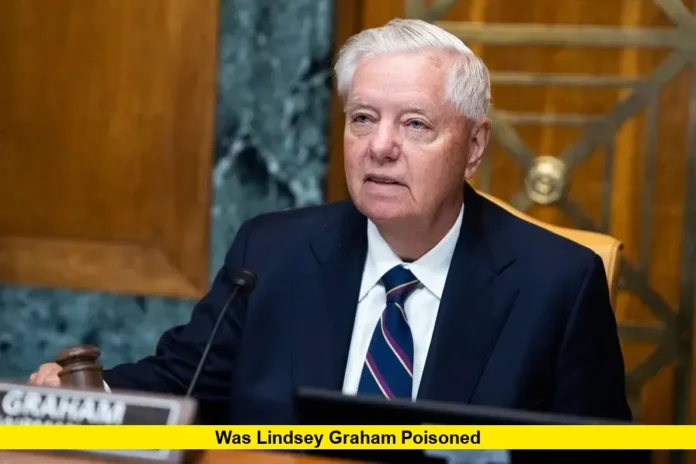

The question of whether Lindsey Graham was poisoned has spread rapidly across social media in the days following the South Carolina senator’s sudden death, fueled by his outspoken criticism of Russia, his recent trip to Ukraine, and a series of unverified claims from online commentators. While the theory has gained significant traction, official findings from medical examiners and statements from senior officials, including President Donald Trump, point toward a natural cardiovascular cause rather than foul play. This article breaks down what has actually been confirmed, what remains unverified, and why the poisoning theory took hold so quickly.
How the Speculation Began
Senator Lindsey Graham, 71, died on Saturday, July 11, 2026, at his Washington, D.C. residence following what his office initially described only as a “brief and sudden illness.” That vague wording, combined with the timing of his death, immediately raised questions among commentators and some members of the public. Graham had returned to the United States less than 24 hours earlier from a high-profile trip to Kyiv, Ukraine, where he met with President Volodymyr Zelensky to discuss additional sanctions targeting Russia.
Given Graham’s long history as one of the Senate’s most vocal critics of Vladimir Putin, and his role as a lead architect of a sweeping Russia sanctions bill, some observers questioned whether his death could be connected to his foreign policy positions. Conservative commentator Laura Loomer was among the most prominent voices pushing the theory, posting extensively on X that Graham may have been “poisoned by a foreign adversary either abroad or upon returning to the US.” She also pointed to comments made months earlier by Russian ideologue Alexander Dugin, who had called for Graham to be “flattened,” and claimed that Iran’s Islamic Revolutionary Guard Corps had issued threats against the senator in the days before his death.
Russian and Iranian state-linked media outlets also amplified the speculation. One Russian outlet reportedly floated the idea that Graham had actually died while still in Kyiv, suggesting the official timeline did not add up, while other coverage focused on his personal health history rather than any external cause. Neither Russian nor Iranian officials have made verified public statements confirming any involvement in Graham’s death, and no evidence has been presented to support the assassination claims circulating online.
What the Medical Examiner Has Confirmed
The Office of the Chief Medical Examiner for the District of Columbia released preliminary findings the day after Graham’s death. According to that statement, Graham suffered an aortic dissection caused by arteriosclerotic cardiovascular disease. An aortic dissection occurs when the inner wall of the aorta, the body’s largest artery, tears, allowing blood to flow between the layers of the vessel. Medical experts describe the condition as a life-threatening emergency that can strike with sudden, severe chest pain and prove fatal within minutes or hours if not treated immediately. Arteriosclerotic cardiovascular disease, the underlying condition cited in the report, refers to a hardening and narrowing of the arteries caused by plaque buildup over time.
Importantly, officials have stressed that these findings are preliminary. Graham’s death certificate remains pending until comprehensive toxicology and microscopic testing is completed, which is standard procedure for autopsies performed in Washington, D.C. Once that testing concludes, the medical examiner’s office is expected to notify Graham’s family before finalizing the official cause and manner of death. As of now, there is no official confirmation of poisoning, and there is also no official ruling that has fully closed the door on the possibility, since toxicology results have not yet been made public.
Reporting on the night of Graham’s death indicates he called Trump around 7 p.m. and later contacted his scheduler to say he was experiencing chest pains, asking her to call for emergency help rather than dialing 911 himself. Emergency responders arrived at his home around 8:30 p.m., performed CPR, and transported him to George Washington University Hospital, where he was later pronounced dead.
Public Officials Respond to the Poisoning Claims
The uncertainty surrounding the toxicology results has prompted several lawmakers to weigh in publicly. Texas Senator John Cornyn was among the most direct, telling reporters that Graham’s toxicology report should be released “to rule out any foul play.” When asked specifically whether he was concerned Graham might have been poisoned, Cornyn said he simply wanted testing completed to eliminate that possibility and address the speculation head-on. His comments drew additional attention after FBI agents were seen outside Graham’s Washington home on multiple consecutive days, a development that further fueled online theories even though the FBI has not stated it is conducting a criminal investigation.
President Trump addressed the poisoning question directly when asked by a reporter whether Russia could have been involved. He responded that Graham had health problems that were “deep-seated and not easy to find,” and said he did not believe the senator was poisoned. Trump added that he believed the FBI was “wasting their time” pursuing conspiracy theories and suggested Graham’s death appeared consistent with a medical event rather than an act of foreign interference. He noted that doctors had described Graham’s underlying condition as almost undetectable prior to his death.
Not everyone has dismissed the calls for scrutiny as overreaction. Bill Browder, the financier known for his advocacy following the death of Russian lawyer Sergei Magnitsky, wrote publicly that Russian operatives have a documented history of using poisons designed to mimic natural causes like heart attacks, and argued that all appropriate testing should be conducted given Graham’s role in pushing sanctions legislation. Others, including former Congressman Max Rose, have pushed back sharply against the speculation, calling some of the commentary “incredibly dangerous” given the serious implications of suggesting a foreign government assassinated a sitting U.S. senator without confirmed evidence.
Career and Political Legacy
Lindsey Graham represented South Carolina in the U.S. Senate for more than two decades, building a reputation as one of Washington’s most influential voices on national security, judiciary matters, and foreign policy. He was widely known for his hawkish stance on Russia and his consistent calls for stronger military and economic support for Ukraine following Russia’s invasion. Graham also played a central role in numerous Senate Judiciary Committee proceedings and was considered a close ally of President Trump in recent years, despite occasional public disagreements between the two on foreign policy matters.
His sudden death leaves a significant gap in the Senate, particularly on issues related to Russia, Ukraine, and broader U.S. global posture. Following his passing, Graham’s sister was appointed to fill his vacant Senate seat on an interim basis, while South Carolina Republicans, including Representatives Nancy Mace and Ralph Norman, have publicly discussed the possibility of running for the seat in a future special election. Former South Carolina Governor Nikki Haley has stated she does not plan to seek the seat herself.
Tributes to Graham poured in from lawmakers across the political spectrum in the days following his death. Senate Minority Leader statements and colleagues from both parties described him as a dedicated public servant, with Senator Mitch McConnell calling him “a good friend and a great American” in an official statement.
Public Interest and Ongoing Scrutiny
The intensity of public interest in whether Lindsey Graham was poisoned reflects both his political prominence and the broader historical context of state-sponsored poisonings attributed to Russia in past cases. The most frequently cited comparison online has been the 2020 poisoning of Russian opposition leader Alexei Navalny, who was confirmed by multiple independent laboratories to have been exposed to a Novichok-class nerve agent. That case, along with other Soviet-era and modern instances of poison being used against political dissidents, has kept theories about state-sponsored assassination attempts firmly in the public consciousness whenever a prominent critic of the Kremlin dies unexpectedly.
However, medical experts have cautioned against conflating those historical cases with Graham’s situation without confirmed toxicology evidence. Aortic dissections, while relatively uncommon, are a recognized and well-documented cause of sudden death, particularly in older adults with pre-existing cardiovascular disease. The condition can occur with little to no warning and is not itself considered unusual or suspicious from a purely medical standpoint.
Given the high public profile of the case, it is likely that any toxicology findings, whether they confirm natural causes or reveal something unexpected, will receive significant media coverage once released.
Latest Updates
As of the most recent reporting, Graham’s death certificate remains officially pending, with the medical examiner’s office reiterating that comprehensive toxicology and microscopic testing are still underway. No results have been publicly released as of this writing, and officials have not provided a specific timeline for when the final report will be completed. FBI Director Kash Patel confirmed the bureau is “assisting local authorities” in the matter, though this has been characterized as standard support rather than confirmation of a criminal investigation. Speculation continues to circulate online, with some accounts linked to Russian and Iranian state media actively promoting unverified theories about Graham’s death, while U.S. officials, including the president, have publicly expressed skepticism toward those claims.
Readers should note that any conclusions drawn before the final autopsy and toxicology report are released remain unconfirmed. Claims that Graham was poisoned, whether by Russia, Iran, or any other party, have not been substantiated by official evidence at this time.
Final Thoughts
The question of whether Lindsey Graham was poisoned has become one of the most closely watched political stories of the summer, driven by his prominent role in Russia sanctions policy, the timing of his death shortly after returning from Ukraine, and the initially vague explanation offered by his office. At present, preliminary medical findings point to a natural cause, an aortic dissection linked to underlying cardiovascular disease, and no official source has confirmed poisoning or foreign involvement. At the same time, the final death certificate remains pending toxicology results, meaning the matter is not entirely closed from an official standpoint.
Until that final report is released, claims about poisoning should be treated as unconfirmed speculation rather than established fact. As more information becomes available, particularly regarding the outcome of the toxicology testing, the picture surrounding Graham’s death is likely to become clearer.
Stay tuned for further updates on this developing story, and feel free to share your thoughts in the comments below.