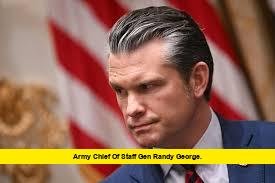

The sudden departure of army chief of staff gen randy george has sent shockwaves through Washington, marking one of the most significant military leadership changes of 2026. The Pentagon confirmed that General Randy A. George is stepping down from his role as the 41st Chief of Staff of the U.S. Army, effective immediately, ending a tenure that began in 2023 and was expected to continue through 2027.
This unexpected move comes amid a broader wave of leadership changes within the Department of Defense, drawing intense attention from policymakers, military personnel, and the public alike.
Stay with us as we break down what this means for the U.S. Army and the future of military leadership in America.
Pentagon Confirms Immediate Retirement
Chief Pentagon spokesperson Sean Parnell announced Thursday that General George would be retiring from his position effective immediately. The statement acknowledged his decades of service but did not provide a detailed explanation for the abrupt timing of his exit.
The decision follows a request from Defense Secretary Pete Hegseth, who has overseen multiple high-level changes across military leadership in recent months. General George’s departure is part of a wider reshaping effort that has affected several top-ranking officials across different branches.
A Career Military Leader Steps Down Early
General Randy George served as the Army’s top uniformed officer after being nominated in 2023 and confirmed by the Senate later that year. A West Point graduate and seasoned combat veteran, he held key leadership roles throughout his career, including deployments in Iraq and Afghanistan.
Before becoming Chief of Staff, George served as Vice Chief of Staff of the Army and worked closely with senior defense officials on strategic operations and modernization efforts.
His leadership focused heavily on preparing the Army for future conflicts, improving force readiness, and advancing modernization initiatives designed to keep pace with evolving global threats.
Unexpected Timing Raises Questions
The timing of George’s departure is notable. His term was originally expected to last four years, meaning he had more than a year remaining in the role. Early departures at this level are uncommon and typically draw significant attention.
While no official reason has been publicly detailed, the move aligns with a broader pattern of leadership changes under the current Defense Department. Multiple senior military leaders across the Army, Navy, and Air Force have either stepped down or been replaced in recent months.
This shift reflects an ongoing effort to realign leadership priorities within the Pentagon during a period of heightened global tensions and evolving defense strategies.
Who Will Lead the Army Next?
Following General George’s exit, Lt. Gen. Christopher LaNeve is expected to step in as acting Chief of Staff of the Army. LaNeve previously served as the Army’s vice chief and has worked closely within the Pentagon’s leadership structure.
His appointment, even in an acting capacity, signals continuity in leadership during a time of transition. However, a permanent replacement has not yet been officially announced.
The selection of the next Army Chief of Staff will be closely watched, as the role plays a critical part in shaping U.S. military readiness, modernization, and global strategy.
Impact on U.S. Military Strategy
The departure of the Army’s top officer comes at a time when the United States is actively managing complex global security challenges. Military readiness, troop deployments, and modernization programs remain central priorities for defense leadership.
General George had been instrumental in advancing initiatives aimed at restructuring the Army, improving efficiency, and integrating new technologies into combat operations. His leadership also emphasized adapting to modern warfare, including emerging threats such as drone technology and cyber operations.
With his sudden exit, attention now turns to whether these initiatives will continue uninterrupted or undergo significant changes under new leadership.
Broader Pentagon Leadership Changes
General George’s retirement is not an isolated event. The Pentagon has experienced a series of high-level leadership changes over the past year, affecting multiple branches of the military.
These changes have sparked discussions about the direction of U.S. defense policy and the long-term implications for military structure and strategy.
The reshuffling of leadership positions suggests a deliberate effort to redefine priorities and ensure alignment with evolving national security objectives.
Reactions Across Washington
The announcement has generated strong reactions across Washington. Lawmakers, defense analysts, and military experts are closely evaluating what this leadership shift means for the future of the U.S. Army.
Some view the move as part of a broader strategy to modernize and streamline military leadership. Others see it as a significant disruption during a critical time for national security.
Regardless of perspective, the sudden nature of the transition has placed a spotlight on the stability and direction of military leadership at the highest levels.
What Comes Next for the Army
As the Army transitions to new leadership, maintaining continuity will be essential. Key priorities such as readiness, recruitment, modernization, and global operations must continue without interruption.
The incoming leadership will face immediate challenges, including managing ongoing military commitments and ensuring the Army remains prepared for emerging threats.
The next Chief of Staff will play a crucial role in shaping the future of the Army, influencing everything from operational strategy to long-term defense planning.
A Defining Moment for Military Leadership
The retirement of army chief of staff gen randy george marks a pivotal moment for the U.S. military. Leadership transitions at this level are rare and often signal broader changes within the defense establishment.
As the Pentagon moves forward, the focus will remain on ensuring stability, maintaining readiness, and navigating an increasingly complex global security environment.
The coming weeks are likely to bring further developments, including the nomination of a permanent successor and additional insights into the direction of U.S. military leadership.
What are your thoughts on this major leadership change? Share your perspective and stay connected for more updates as this story continues to unfold.