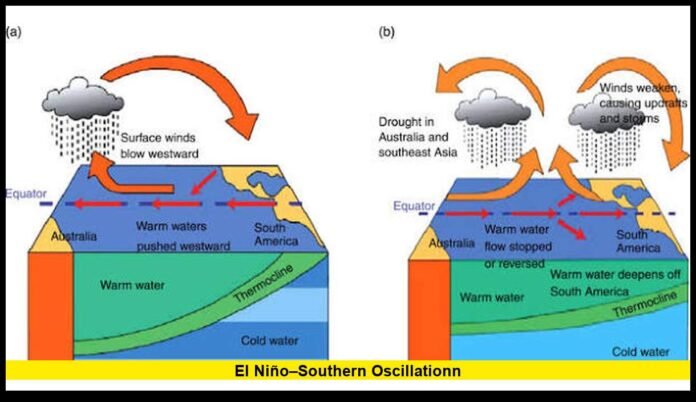

The El Niño–Southern Oscillation remains one of the most closely watched climate systems in the world because of its ability to influence weather patterns across continents. During 2026, meteorologists have been closely monitoring strengthening El Niño conditions in the tropical Pacific, with expectations that the current event will continue shaping seasonal weather through the remainder of the year and into early 2027. From rainfall and drought to agriculture, hurricanes, fisheries, and global temperatures, this natural climate cycle plays an essential role in determining how weather unfolds in many parts of the world.
Key Points Summary
╔════════════════════════════════════════════════════════════════════╗
║ – El Niño conditions strengthened during mid-2026 across the tropical Pacific. ║
║ – Scientists expect the current event to influence global weather into early 2027. ║
║ – ENSO affects rainfall, droughts, hurricanes, agriculture, and marine ecosystems. ║
║ – Governments, farmers, and businesses rely on seasonal outlooks tied to ENSO. ║
║ – Researchers continue studying how climate change may alter future ENSO impacts. ║
╚════════════════════════════════════════════════════════════════════╝
What Is ENSO and Why Is It Important?
The El Niño–Southern Oscillation, commonly referred to as ENSO, is a naturally occurring climate cycle centered over the tropical Pacific Ocean. Although it begins in one part of the world, its influence reaches thousands of miles beyond the Pacific basin, affecting weather systems across North America, South America, Asia, Australia, Africa, and even parts of Europe.
ENSO is considered one of the strongest drivers of year-to-year climate variability. It alters atmospheric circulation, ocean temperatures, and rainfall distribution, leading to significant changes in seasonal weather. These changes can impact food production, water supplies, transportation, energy demand, and public safety.
Because millions of people depend on predictable weather for farming, fishing, and water management, meteorologists continuously monitor ENSO conditions to help governments and industries prepare for potential impacts.
The Three Phases of ENSO
ENSO operates through three distinct phases, each bringing different weather patterns across the globe.
El Niño
El Niño occurs when sea surface temperatures in the central and eastern tropical Pacific become warmer than average for an extended period.
During an El Niño event:
- Trade winds weaken.
- Warm ocean water shifts eastward.
- Rainfall patterns change.
- Atmospheric circulation is altered.
These changes can produce wetter conditions in some regions while increasing drought risks elsewhere.
La Niña
La Niña represents the cool phase of ENSO.
When La Niña develops:
- Ocean temperatures become cooler than average.
- Trade winds strengthen.
- Rainfall shifts toward the western Pacific.
- Different atmospheric patterns emerge.
La Niña often produces weather impacts that contrast with those observed during El Niño, although every event remains unique.
Neutral Conditions
Neutral conditions occur when ocean temperatures remain close to long-term averages.
Even during neutral periods, weather can still be influenced by other climate systems, including regional ocean temperature patterns and atmospheric oscillations.
The Latest Situation in 2026
Climate scientists report that El Niño conditions strengthened during the middle of 2026 as warmer-than-average waters expanded across large portions of the tropical Pacific Ocean.
Ocean observations show increasing heat not only at the surface but also beneath the ocean, suggesting continued support for the current El Niño event. Atmospheric conditions have also become more consistent with a mature El Niño pattern, reinforcing confidence that this event will persist through the latter half of the year.
Although seasonal weather forecasts continue to evolve, forecasters expect this climate pattern to influence temperatures and precipitation across numerous regions well into early 2027.
How Scientists Monitor ENSO
Understanding ENSO requires constant monitoring of both the ocean and the atmosphere.
Sea Surface Temperatures
Scientists measure ocean temperatures using satellites, research vessels, drifting buoys, and specialized observing systems.
The tropical Pacific contains several monitoring regions, with one of the most important being the Niño-3.4 area, where temperature anomalies provide an early indication of changing ENSO conditions.
Trade Winds
Trade winds normally push warm surface water toward the western Pacific.
When these winds weaken, warm water spreads eastward, creating favorable conditions for El Niño.
Conversely, stronger trade winds help maintain or strengthen La Niña conditions.
Atmospheric Pressure
Changes in atmospheric pressure between the eastern and western Pacific help scientists evaluate whether ocean temperature changes are influencing the atmosphere.
This interaction between ocean and atmosphere is essential for confirming an ENSO event.
Subsurface Ocean Heat
Meteorologists also monitor temperatures hundreds of feet below the ocean surface.
Warm water beneath the surface often rises over time, reinforcing developing El Niño conditions.
How ENSO Changes Global Weather
Although ENSO originates in the Pacific Ocean, it modifies the position of jet streams and atmospheric circulation patterns that influence weather worldwide.
Some regions experience heavier rainfall while others become significantly drier. Seasonal temperatures may also shift, leading to warmer or cooler conditions depending on geographic location.
The exact impacts vary with each event, making seasonal forecasting both challenging and essential.
Rainfall Patterns
One of the most noticeable consequences of ENSO involves changing rainfall distribution.
Some areas receive above-average precipitation that can improve water supplies but also increase flooding risks.
Elsewhere, reduced rainfall may contribute to prolonged drought, declining reservoir levels, and increased wildfire danger.
These rainfall changes often have widespread economic consequences because they affect agriculture, drinking water supplies, and hydroelectric power generation.
Temperature Effects
El Niño generally contributes to warmer global average temperatures.
When combined with long-term warming trends, an active El Niño can increase the likelihood of exceptionally warm months across many regions.
However, local temperature outcomes vary considerably depending on regional geography and seasonal weather patterns.
Some locations experience unusually mild winters, while others may observe hotter summers than average.
Agriculture and Food Production
Farmers closely monitor seasonal climate forecasts because planting decisions often depend on expected rainfall and temperatures.
Changes associated with ENSO can influence:
- Crop planting schedules
- Irrigation needs
- Soil moisture
- Harvest timing
- Livestock management
Major agricultural products such as corn, wheat, rice, soybeans, coffee, sugar, and cotton may all experience varying impacts depending on local weather conditions.
In some regions, improved rainfall can boost production, while persistent drought can significantly reduce yields.
Water Resources
Water managers use seasonal climate outlooks to anticipate future supply and demand.
ENSO can affect:
- Reservoir storage
- River flows
- Snowpack accumulation
- Groundwater recharge
- Municipal water availability
Planning months in advance helps communities prepare for potential shortages or flood risks.
Hurricanes and Tropical Cyclones
ENSO also influences tropical cyclone activity.
During El Niño years, stronger upper-level winds over parts of the Atlantic often reduce the number of hurricanes that successfully develop.
Meanwhile, the eastern Pacific may experience more favorable conditions for tropical storm formation.
Despite these general tendencies, individual hurricane seasons remain affected by numerous atmospheric and oceanic factors.
Marine Ecosystems
Marine life responds quickly to changing ocean temperatures.
Warmer waters during El Niño can reduce nutrient-rich upwelling along portions of South America’s Pacific coastline.
This affects the marine food chain by reducing nutrient availability for plankton, which supports fish populations, seabirds, and marine mammals.
Commercial fisheries often monitor ENSO forecasts because changes in fish distribution can affect harvests and local economies.
Coral reefs may also face additional stress during prolonged periods of unusually warm ocean temperatures.
Wildfire Concerns
Extended dry conditions associated with ENSO can increase wildfire danger in some parts of the world.
Lower rainfall combined with higher temperatures may dry forests, grasslands, and vegetation, creating favorable conditions for larger and more intense wildfires.
Fire management agencies often incorporate seasonal climate outlooks into preparedness planning before wildfire season begins.
Economic Impacts
ENSO affects far more than weather.
Businesses across multiple industries monitor seasonal climate forecasts because changing weather patterns influence supply chains, transportation, insurance, tourism, and commodity markets.
Potential economic impacts include:
- Agricultural production losses
- Flood recovery expenses
- Infrastructure damage
- Higher insurance costs
- Transportation disruptions
- Energy demand fluctuations
Global financial markets sometimes respond to changing agricultural production forecasts associated with ENSO events.
Public Health Considerations
Weather changes linked to ENSO may also influence public health.
Periods of extreme heat increase risks for vulnerable populations.
Heavy rainfall can contribute to flooding and waterborne disease concerns, while drought may reduce water quality and increase dust-related respiratory issues.
Public health agencies often coordinate with weather services to prepare communities for seasonal risks.
Forecasting Has Improved Significantly
Modern climate forecasting has advanced dramatically over recent decades.
Scientists now combine information from satellites, ocean buoys, weather balloons, research ships, aircraft observations, and sophisticated computer models.
Artificial intelligence and improved climate simulations have further enhanced forecasting capabilities, allowing meteorologists to identify developing ENSO events earlier than ever before.
Although forecasting skill decreases farther into the future, confidence generally increases as ocean and atmospheric signals become stronger.
Climate Change and Future ENSO Events
Researchers continue investigating how a warming climate could influence ENSO behavior.
While ENSO remains a naturally occurring climate cycle, rising global temperatures may amplify some of its impacts by increasing atmospheric moisture, intensifying heavy rainfall events, and contributing to higher background temperatures.
Scientists are studying whether future El Niño and La Niña events could become more intense or produce different regional impacts than those observed historically.
This remains one of the most active areas of climate research.
Looking Ahead
As 2026 progresses, meteorologists will continue monitoring ocean temperatures, atmospheric circulation, and seasonal weather forecasts to assess how the current El Niño develops.
Communities, businesses, emergency managers, farmers, and policymakers will rely on updated outlooks to prepare for potential changes in rainfall, drought, flooding, tropical cyclone activity, and temperatures.
The El Niño–Southern Oscillation will remain a key focus of climate monitoring because even relatively modest changes in Pacific Ocean conditions can influence weather patterns affecting billions of people around the world.
What changes have you noticed in your local weather this year? Share your thoughts in the comments and stay connected for more climate and weather updates.