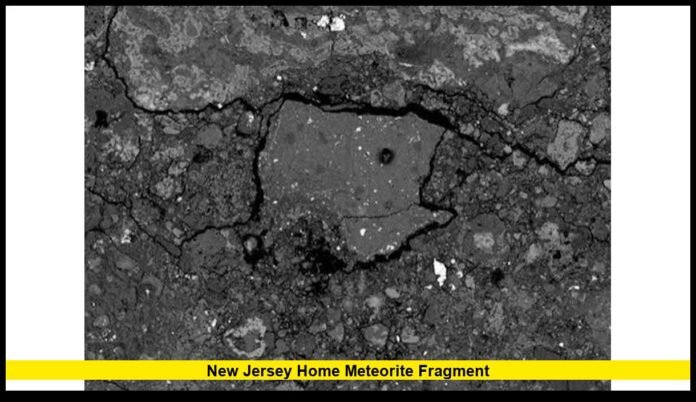

A scientific breakthrough has emerged from an unexpected event after new jersey home meteorite fragments collected from a residential property in Hillsborough have revealed some of the most pristine extraterrestrial material ever examined. Researchers studying the rare space rock have identified evidence of ancient salt-rich water, exceptionally well-preserved minerals, and complex organic compounds that provide valuable insight into the earliest days of the solar system. The discovery is helping scientists better understand how asteroids evolved billions of years ago and how essential chemical ingredients may have reached Earth long before life began.
An Unexpected Impact That Became a Scientific Milestone
Meteorites enter Earth’s atmosphere every day, but very few are recovered in pristine condition. Even fewer land in populated areas where they can be collected almost immediately after impact.
That is exactly what happened in Hillsborough, New Jersey, when a meteorite crashed through the roof of a family home. While the incident understandably startled the homeowners, the event quickly transformed into an extraordinary opportunity for planetary scientists.
The object struck the residence after surviving its fiery journey through Earth’s atmosphere. Instead of breaking apart beyond recognition, one sizeable fragment penetrated the roof and eventually came to rest inside the house. Thankfully, no one was injured during the incident.
Realizing the rock appeared unusual, the homeowners acted carefully instead of treating it like an ordinary stone. Their quick thinking preserved one of the cleanest meteorite samples researchers have had the opportunity to analyze in recent years.
That decision has now proven invaluable for science.
A Rare Carbon-Rich Visitor From Space
These ancient rocks formed approximately 4.56 billion years ago, during the infancy of the solar system when planets, moons, and asteroids were only beginning to take shape.
Unlike many ordinary meteorites composed primarily of metallic or rocky material, carbonaceous chondrites preserve primitive matter that has changed very little since the solar system’s formation.
Scientists value these meteorites because they often contain:
- Water-bearing minerals
- Carbon-rich compounds
- Primitive dust grains
- Ancient chemical signatures
- Organic molecules
Each sample serves as a natural record of conditions that existed billions of years before Earth became the habitable world we know today.
Preserved Almost Exactly As It Landed
One reason this meteorite has generated so much excitement is its remarkably fresh condition.
Meteorites recovered days or weeks after landing are frequently exposed to rain, humidity, bacteria, oxygen, soil contamination, and human handling. Those environmental factors gradually alter delicate minerals and destroy fragile organic compounds that researchers hope to study.
The Hillsborough sample avoided nearly all of those problems.
The homeowners carefully handled the meteorite using gloves and protective storage materials, minimizing contamination almost immediately after the impact.
Because of that careful preservation, researchers believe the specimen closely reflects its original chemical state as it traveled through space.
For scientists studying ancient solar system chemistry, that level of preservation is exceptionally rare.
Ancient Saltwater Leaves Its Mark
Perhaps the most remarkable discovery involves microscopic evidence of ancient salty fluids.
Researchers found mineral structures indicating that concentrated brines once circulated inside the meteorite’s parent asteroid.
These highly saline fluids interacted with surrounding minerals billions of years ago, leaving behind unique chemical fingerprints that remained locked inside the rock until it landed on Earth.
The discovery suggests that some primitive asteroids contained far more chemically active environments than scientists previously understood.
Instead of being completely dry collections of rock, these early bodies likely experienced internal water movement capable of producing complex mineral transformations.
Understanding those processes allows researchers to reconstruct the history of asteroids with far greater accuracy.
A Window Into Water’s Ancient Journey
Water has become one of the most important subjects in planetary science.
Scientists continue investigating where Earth’s water originated and how it became widespread throughout the young solar system.
Primitive asteroids are considered one possible source.
The Hillsborough meteorite provides additional evidence supporting the idea that water interacted extensively with rocky bodies during the solar system’s earliest history.
Tiny minerals inside the meteorite indicate prolonged exposure to liquid water, although not in the form of oceans or lakes.
Instead, researchers believe salty fluids slowly circulated through microscopic cracks and pores inside the asteroid over extended periods.
Those chemical reactions produced minerals that remained preserved for billions of years before finally arriving on Earth.
Organic Molecules Add Another Layer of Interest
In addition to water-related minerals, scientists identified an impressive variety of organic compounds throughout the meteorite.
Organic molecules naturally contain carbon and are considered important ingredients in prebiotic chemistry.
The sample includes several compounds that help researchers understand how increasingly complex chemistry developed long before life appeared on Earth.
These findings do not indicate that life existed inside the meteorite.
Rather, they demonstrate that important chemical building blocks can develop naturally within space environments under suitable conditions.
Many planetary scientists believe meteorites like this repeatedly delivered organic materials to Earth during the period known as the Late Heavy Bombardment, when countless asteroids collided with the young planet.
Those deliveries may have enriched Earth’s surface with chemical ingredients necessary for life’s eventual emergence.
Understanding the Meteorite’s Journey
Long before reaching New Jersey, the meteorite spent billions of years orbiting the Sun.
Researchers believe its parent body likely originated within the asteroid belt located between Mars and Jupiter.
Over time, collisions between asteroids gradually produced smaller fragments that drifted into new orbital paths.
Eventually, one fragment encountered Earth’s gravitational influence.
As the rock entered Earth’s atmosphere at tremendous speed, friction generated intense heat, causing much of its outer layer to melt away.
Despite losing material during atmospheric entry, the remaining core survived.
The object fragmented before impact, with one of the largest surviving pieces striking the Hillsborough home.
The dramatic journey lasted only seconds within Earth’s atmosphere but represented the final chapter of a voyage spanning billions of years.
Why Carbonaceous Chondrites Matter
Among all known meteorites, carbonaceous chondrites rank among the rarest and most scientifically valuable.
They preserve information unavailable from most other extraterrestrial rocks.
Researchers use them to investigate questions involving:
- Early planetary formation
- Asteroid evolution
- Ancient water activity
- Organic chemistry
- Solar system history
- Mineral development
- Prebiotic environments
Because these meteorites have undergone relatively little geological alteration, they provide a clearer picture of conditions that existed during the formation of the planets.
Each new sample helps refine existing theories while occasionally challenging long-held scientific assumptions.
Modern Technology Reveals Hidden Details
The investigation relied upon sophisticated laboratory instruments capable of examining microscopic structures invisible to the human eye.
Scientists analyzed the meteorite using multiple complementary techniques to study:
- Mineral composition
- Isotopic signatures
- Crystal structures
- Organic chemistry
- Water-related minerals
- Trace elements
By combining information from different analytical methods, researchers reconstructed portions of the meteorite’s geological history that occurred billions of years ago.
Modern technology now allows scientists to identify chemical details that would have remained hidden only a few decades ago.
Evidence of a Dynamic Early Solar System
One important conclusion emerging from the research is that primitive asteroids were far more dynamic than previously believed.
Rather than remaining frozen collections of dust and rock, many experienced internal chemical evolution driven by water and heat.
Even relatively small amounts of water could dramatically alter minerals over millions of years.
The Hillsborough specimen preserves evidence of those slow transformations.
These discoveries continue reshaping scientific understanding of how early asteroids evolved and how they contributed to planetary development throughout the solar system.
An International Scientific Effort
The investigation brought together specialists from multiple scientific disciplines.
Planetary geologists, mineralogists, chemists, astronomers, and astrobiologists collaborated to interpret the meteorite’s complex chemistry.
Each research team focused on different aspects of the specimen, including its mineral composition, water history, organic chemistry, and possible origin.
Such multidisciplinary cooperation has become increasingly important as laboratory techniques generate enormous amounts of highly detailed data.
By combining expertise across several fields, scientists gain a more complete understanding of ancient extraterrestrial materials.
What This Means for Future Space Research
The Hillsborough meteorite is expected to remain an important scientific reference sample for years to come.
Researchers anticipate additional laboratory studies will continue uncovering new information as analytical technology advances.
Future investigations may answer questions including:
- How long water circulated inside primitive asteroids.
- What temperatures existed during mineral formation.
- How organic molecules evolved over billions of years.
- Whether similar meteorites contain identical chemical signatures.
- How asteroid chemistry influenced the formation of terrestrial planets.
Every new discovery contributes to broader efforts aimed at understanding the origins of the solar system and the processes that shaped Earth’s earliest environment.
Lessons From an Extraordinary Discovery
One of the most remarkable aspects of this event is how ordinary people played an important role in advancing scientific knowledge.
The homeowners’ careful handling of the meteorite preserved evidence that could easily have been lost through contamination.
Their actions allowed researchers to examine exceptionally clean extraterrestrial material shortly after its arrival on Earth.
It serves as an important reminder that scientific discoveries sometimes begin in the most unexpected places.
While sophisticated laboratories perform the detailed analysis, preserving a specimen during its earliest moments on Earth can be equally important.
A Rare Opportunity That May Not Be Repeated Soon
Fresh meteorite falls capable of supporting groundbreaking research are exceptionally uncommon.
Most space rocks land unnoticed in oceans, deserts, forests, or remote landscapes where recovery is difficult or impossible.
Even when meteorites are located, environmental exposure often alters their chemistry before scientists can examine them.
The Hillsborough sample represents an unusually fortunate combination of circumstances.
It was observed soon after impact, recovered quickly, carefully preserved, and analyzed using advanced scientific techniques.
Those factors have transformed an unexpected household incident into one of the most valuable meteorite investigations of recent years.
As researchers continue examining its minerals and organic chemistry, the specimen is expected to provide additional insights into asteroid evolution, water distribution, and the chemical history of the early solar system.
The continuing study of new jersey home meteorite fragments demonstrates how even a single rock from space can reshape scientific understanding of events that occurred more than four and a half billion years ago, offering an extraordinary glimpse into the origins of our cosmic neighborhood.
Have thoughts about this incredible space discovery? Share your perspective in the comments and stay connected for more updates on the latest breakthroughs in science and astronomy.