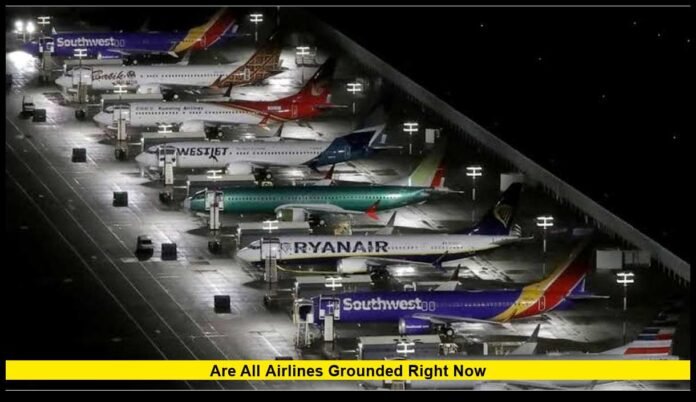

The question “Are all airlines grounded right now?” has become especially important for U.S. travelers following a major aviation disruption that affected airports across the country. On November 13, 2026, the Federal Aviation Administration (FAA) issued an extraordinary nationwide ground stop after a telecommunications failure disrupted air traffic control communications.
The decision temporarily prevented departing flights from operating normally at U.S. airports. It affected passengers traveling on major airlines, including American Airlines, Delta Air Lines, United Airlines, Southwest Airlines, and other domestic and international carriers.
However, a nationwide ground stop does not mean that every aircraft must immediately return to the ground. Flights already airborne can continue under air traffic control procedures, while certain international services and other qualifying operations can receive individual clearance.
The central issue is the reliability of the national air traffic control communication network, not a decision by every airline to permanently suspend service.
The disruption also illustrates how a technical problem affecting aviation infrastructure can quickly spread across the national transportation system, creating delays, diversions, missed connections, and cancellations.
Why a Nationwide Flight Ground Stop Is So Unusual
A nationwide aviation shutdown is one of the most serious operational measures available to the FAA.
Unlike a ground stop affecting a single airport, a national restriction can prevent departures across multiple regions simultaneously.
The last comparable nationwide technical disruption occurred in January 2023, when a malfunction involving the FAA’s Notice to Air Missions (NOTAM) system forced the agency to temporarily halt departures.
Before that, the previous nationwide shutdown followed the September 11, 2001, terrorist attacks.
The November 2026 incident is particularly significant because it involved communication infrastructure used by the country’s regional air traffic control centers.
These facilities coordinate aircraft traveling between airports and help controllers manage traffic across large sections of U.S. airspace.
When communication becomes unreliable across multiple centers, aviation authorities cannot simply continue normal departures and hope that the problem resolves itself.
The FAA’s priority is to prevent additional aircraft from entering an environment where normal coordination may be compromised.
What Happened to the FAA’s Communication Network?
The immediate problem involved a telecommunications outage affecting the FAA’s 22 regional Air Route Traffic Control Centers.
Transportation Secretary Sean Duffy confirmed that the communication failure was widespread and that FAA technicians were investigating.
These centers are essential to the national aviation network. They coordinate aircraft movements between departure and destination airports, communicate with pilots, and manage traffic passing through different airspace sectors.
Without dependable communications, controllers may have difficulty maintaining the normal flow of aircraft.
The Department of Homeland Security also began examining the incident.
Secretary Markwayne Mullin said the government had no indication at that stage that the disruption was a deliberate attack.
Although some reporting raised questions about a possible software or network update, the precise technical cause had not been officially established.
This distinction is important. Reports about a possible equipment or software failure should not be treated as a confirmed explanation until investigators release their findings.
Did the Outage Affect the FAA’s New SMART Technology?
Another issue attracting attention is the FAA’s recently introduced Strategic Management of Airspace, Routes and Trajectories (SMART) system.
The FAA announced on November 10 that the technology was expanding across all 22 air traffic control centers.
SMART is designed to combine information from numerous data streams, including weather, flight paths, traffic conditions, and controller staffing information.
Its purpose is to help aviation authorities anticipate congestion and improve traffic management.
Because the nationwide communications failure occurred shortly after the announcement, some travelers questioned whether the two developments were connected.
However, federal officials said there was no indication that the SMART system caused the ground stop. The company involved in developing the technology also denied that its product was responsible.
The communication failure and the SMART rollout should therefore be treated as separate matters unless subsequent technical findings establish otherwise.
Why Travelers Could Face Delays Even After Flights Restart
The end of a ground stop does not mean that every delayed passenger can immediately board an aircraft.
Airlines operate interconnected schedules in which aircraft and flight crews move between airports throughout the day.
A disruption at one major airport can affect flights in several other states.
Consider a passenger scheduled to travel from Seattle to New York through Chicago.
If the aircraft scheduled to operate the first segment is diverted or delayed, the passenger may miss the connecting flight even if the national restriction has already ended.
The airline may then need to locate another available seat, arrange a replacement aircraft, and coordinate crew availability.
This process can take considerable time.
The recovery period can also be complicated by airport congestion. Aircraft returning to gates, passengers waiting for rebooking, and delayed arrivals can create additional pressure on airport facilities.
The Impact on Cargo Airlines and Package Deliveries
The nationwide disruption is not limited to passengers.
Cargo airlines also depend on the FAA’s air traffic management system to move packages, commercial goods, medical supplies, and other shipments.
FedEx confirmed that it was monitoring the ground stop and preparing contingency measures to limit disruptions.
The company said normal flight operations would resume as soon as the FAA permitted them.
This matters because U.S. air cargo operations support businesses, retailers, manufacturers, and international supply chains.
A delayed cargo flight can affect delivery schedules even when the package itself has already been processed and is ready for transportation.
Businesses that depend on time-sensitive air shipments may therefore experience delays beyond the initial period of the ground stop.
What the Disruption Means for Travelers in Different U.S. Regions
The effects of a national ground stop are not necessarily identical across the country.
West Coast
Airports such as Seattle-Tacoma International Airport, Los Angeles International Airport, and San Francisco International Airport are important gateways for domestic and international travel.
Passengers traveling between the West Coast and the eastern United States may experience disruptions involving aircraft positioning and connecting flights.
San Francisco also became an important example of the exceptions permitted during the incident, with certain Pacific-bound services allowed to depart.
Midwest
Chicago O’Hare, Chicago Midway, and Denver International Airport are important connecting points.
Diversions involving these airports can affect passengers traveling between the East Coast, Midwest, Mountain West, and Pacific regions.
Northeast
New York, Boston, and Philadelphia are major air travel markets.
Weather conditions and heavy airport traffic can make recovery more complicated when a nationwide disruption occurs.
South and Southeast
Dallas-Fort Worth, Atlanta, Miami, and other major airports serve large domestic and international networks.
Disruptions at these hubs can affect connecting passengers traveling between different regions.
These regional considerations do not mean that every airport experienced the same level of disruption. Individual airport conditions and airline schedules determine the actual passenger impact.
How to Check Whether Your Airline Is Operating Normally
Passengers should use a combination of official aviation information and airline-specific updates.
The FAA’s National Airspace System Status provides information about ground stops, airport restrictions, and traffic delays.
The FAA’s official website provides agency announcements and aviation safety information.
For individual reservations, passengers should use their airline’s website or mobile application. Flight numbers provide a more reliable way to identify schedule changes than searching for an airport’s general operating status.
The U.S. Department of Transportation also provides information about airline passenger protections, cancellations, refunds, and consumer rights.
These four resources address different needs: national aviation restrictions, federal announcements, individual passenger protections, and operational flight information.
Can Passengers Get Their Money Back if Their Flights Are Canceled?
Yes. U.S. passenger refund protections generally apply when an airline cancels a flight and the traveler chooses not to accept alternative transportation.
The important distinction is between receiving a refund and receiving additional compensation.
A passenger who declines an alternative itinerary following an airline cancellation is generally entitled to a refund, including for a nonrefundable ticket.
However, additional compensation for inconvenience, hotels, meals, or transportation is governed by separate rules and airline policies.
A telecommunications outage affecting the FAA does not automatically mean that every airline must pay passengers additional compensation.
Travelers should keep cancellation notifications and receipts for expenses incurred during the disruption.
They should also avoid voluntarily canceling a reservation before understanding the consequences.
What Travelers Should Expect Over the Coming Hours
The aviation industry now faces two connected challenges: resolving the technical problem and restoring the flight schedules disrupted by the emergency order.
The FAA must establish that communication capabilities are reliable enough for normal operations.
Airlines then need to address the accumulated disruption.
The situation could remain uneven across airports even after the national restriction is removed. Some carriers may restore selected routes faster than others, depending on aircraft availability, crew positioning, and local conditions.
Weather may also contribute to additional delays.
For travelers with flights scheduled on November 14, checking departure information before leaving home is especially important.
Passengers should also make sure their airline has an accurate phone number and email address so that schedule notifications can reach them.
The Bigger Question About America’s Aviation Infrastructure
The nationwide ground stop has renewed attention on the technology supporting the U.S. aviation system.
Air traffic control depends on communication equipment, networks, software, and infrastructure that must work together reliably.
The federal government has been pursuing a broader modernization effort, including replacing older systems and improving the technology used by controllers.
However, modernization is a complex process involving equipment, contractors, testing, personnel, and nationwide coordination.
The November disruption highlights why backup systems and reliable contingency procedures are essential.
Even a temporary telecommunications failure can affect airlines, passengers, cargo operators, and airports across the country.
The investigation’s findings will be important not only for explaining this incident but also for identifying whether additional safeguards are needed to prevent similar disruptions.
Final Outlook
The nationwide FAA ground stop on November 13, 2026, was a major interruption to U.S. commercial aviation. The agency halted departing traffic after a communications outage affected all 22 regional Air Route Traffic Control Centers.
However, the restriction was not an instruction for every aircraft to land immediately. Flights already airborne were allowed to reach safe landing locations, and certain international, Alaska, and Hawaii operations received exceptions.
The disruption affected thousands of flights and created widespread problems for passengers, airlines, airports, and cargo operators. More than 600 diversions had been reported by Friday evening, while more than 13,000 flights were subsequently reported delayed or canceled in coverage of the developing crisis.
The most important outstanding questions concern the technical cause, the restoration of normal communications, and how quickly airlines can return to reliable schedules.
Have you experienced a flight cancellation, unexpected delay, or airport disruption? Share your experience in the comments and follow the latest U.S. aviation news for further developments.
Travel disruptions are not always limited to the aviation industry. Internet connectivity problems can also affect airline websites, online booking systems, airport operations, and passenger communications. Readers can follow the latest developments through this internet outage map to check reported service disruptions. Additionally, growing concerns about digital security make it important to understand whether the United States is under a cyber attack right now.