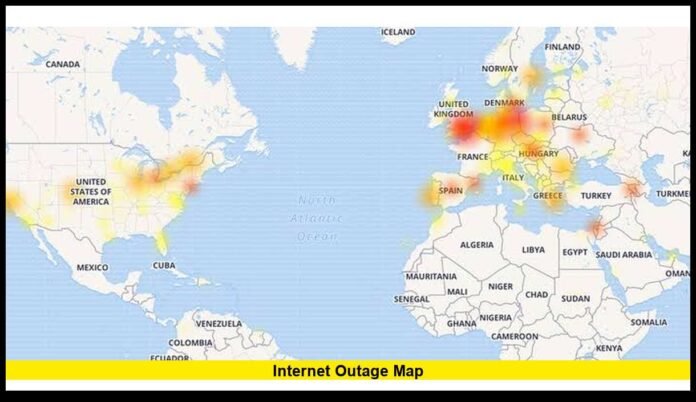

The Internet outage map is one of the quickest ways to find out whether internet service is down in your area, whether a major provider is experiencing technical problems, or whether a connection issue is limited to your home. With millions of Americans depending on broadband, fiber, cable, and wireless internet for work, education, communication, and entertainment, even a temporary disruption can affect daily activities.
As of the latest update, Americans can use independent outage-tracking platforms and individual internet providers’ service-status tools to monitor reported disruptions across the country. These resources help identify possible trouble spots, compare reports from different locations, and determine whether an internet problem is part of a larger network incident.
However, there is an important distinction: the United States does not have one comprehensive public map that independently confirms every residential internet outage in real time. Different platforms collect different information, and an outage report does not always mean a provider has confirmed a network failure.
Here is how to check internet outages across the United States, identify affected locations, understand provider disruptions, and find out what to do if your connection suddenly stops working.
Internet Outage Map: What Is Happening Across the United States?
Internet outages can occur at different levels, ranging from an isolated equipment problem to a widespread disruption affecting thousands of customers.
An outage-tracking map helps users understand where internet problems are being reported. Depending on the platform, information may include:
- Locations reporting internet connectivity problems.
- Internet providers experiencing increased customer complaints.
- Regional clusters of reported service interruptions.
- Possible disruptions involving broadband and wireless networks.
- Recent changes in outage reports.
- Service-status information from network monitoring systems.
Platforms such as Downdetector collect consumer reports to identify unusual increases in complaints. Network intelligence platforms, including ThousandEyes, monitor internet infrastructure and connectivity across service providers and major online platforms.
These tools provide different perspectives. A consumer-reporting map identifies where people are experiencing difficulties, while network monitoring can reveal technical disruptions affecting internet infrastructure.
An increase in reports should be treated as an indication of a possible outage, not automatic confirmation that an entire city or state has lost internet service.
Where to Check the Live Internet Outage Map
Several online resources can help Americans determine whether internet service is experiencing problems.
1. Downdetector Internet Outage Reports
Downdetector is a widely used resource for checking reported problems involving internet providers, websites, mobile networks, and online services.
Its individual service pages display recent user complaints and outage maps. When reports increase significantly above normal levels, the platform may indicate a possible service disruption.
Users can check reports involving major American internet providers, including:
- Xfinity
- AT&T
- Spectrum
- Verizon
- T-Mobile
- Cox Communications
- Frontier
- Google Fiber
The map can help identify whether complaints are concentrated in one metropolitan area or appearing across several regions.
Visit the Downdetector outage monitoring platform to explore current reports.
2. ThousandEyes Internet Outages Map
ThousandEyes provides another way to monitor internet disruptions. Its global internet monitoring map tracks outages involving internet service providers, cloud platforms, application providers, and network infrastructure.
The platform uses network telemetry and monitoring information to identify connectivity problems.
Its outage map updates approximately every five minutes and provides a view of ongoing and recently detected internet disruptions over the preceding 24 hours.
This makes it particularly useful for understanding problems that may extend beyond an individual household’s internet connection.
Readers can explore the ThousandEyes Internet Outages Map for additional network information.
Major Internet Providers to Check for Service Outages
A nationwide outage map can provide a useful overview, but customers should also check their individual provider’s service-status system.
Internet companies often have access to account-specific information that independent monitoring platforms cannot provide.
AT&T Internet Outages
AT&T customers can use the company’s outage information page to investigate disruptions involving internet and wireless services.
Customers may need to sign in or provide account information to check whether a particular address is affected.
AT&T also provides outage notifications and service updates through its support tools. Its Smart Home Manager application can help customers investigate connectivity issues and check service availability.
Customers experiencing problems should check the official AT&T outage information page before assuming that their equipment is defective.
Xfinity Internet Outages
Xfinity provides an outage-checking tool that allows customers to investigate service disruptions affecting their locations.
Depending on the available information, customers may be able to see:
- Whether an outage has been identified.
- The general type of service disruption.
- Information about the cause of the problem.
- Repair progress.
- An estimated restoration time, when available.
Customers can also report service problems if their connection is not working and no outage has been identified.
The official Xfinity service outage page provides additional information about checking local service status.
Spectrum Internet Outages
Spectrum customers should use the company’s official support resources to investigate internet connectivity problems.
Service interruptions may involve local network equipment, damaged cables, maintenance activities, or other technical issues.
Customers can also use Spectrum’s support application and account tools to access service-related information.
Verizon Fios and Home Internet
Verizon customers can check service availability and outage information through the company’s support system.
Fios customers may need to sign in to view disruptions associated with their service address. When an outage is identified, Verizon may provide a ticket number and an estimated repair completion time.
Other Internet Providers
Customers using other broadband services should also check their providers directly.
These include:
- Cox Communications
- Frontier Communications
- Optimum
- CenturyLink
- Quantum Fiber
- Mediacom
- Astound Broadband
- Google Fiber
- T-Mobile Home Internet
- Starlink
- Hughesnet
- Viasat
Availability of public outage information varies by company. Some providers offer detailed address-based tools, while others primarily provide information through customer support or account applications.
Internet Outage Map by State: Which Areas Can Be Affected?
Internet disruptions can occur in any U.S. state. However, the number of reported problems in a particular location does not necessarily indicate that the entire state is experiencing an outage.
The size of an affected area depends on the location of the damaged equipment, the provider’s network design, and the nature of the technical problem.
Here are some major regions where residents can use outage-tracking services to investigate local connectivity problems.
California
California has extensive broadband and wireless infrastructure serving large metropolitan areas and smaller communities.
Residents in Los Angeles, San Francisco, San Diego, Sacramento, and surrounding areas can use provider-specific tools to investigate internet interruptions.
Wildfires, power disruptions, construction damage, and network maintenance can affect telecommunications infrastructure.
Texas
Residents in Houston, Dallas, Austin, San Antonio, and other Texas communities depend on a combination of cable, fiber, wireless, and satellite internet services.
Severe weather, including thunderstorms and hurricanes, can damage infrastructure or interrupt electricity needed to operate network equipment.
Florida
Florida’s internet infrastructure can face additional challenges during hurricanes, tropical storms, flooding, and severe thunderstorms.
Residents should distinguish between internet service interruptions and broader electricity disruptions, particularly during severe weather events.
New York
New York has extensive broadband infrastructure across New York City, Buffalo, Rochester, Albany, and other communities.
Network maintenance, equipment failures, and construction-related damage can cause localized service interruptions.
Washington
Residents in Seattle, Tacoma, Spokane, Bellevue, and other Washington communities can use provider outage tools and independent reporting platforms to investigate connectivity problems.
Weather-related damage, power interruptions, and local infrastructure issues may affect service in individual neighborhoods.
Other States
Internet disruptions can also affect communities in Illinois, Georgia, Pennsylvania, Ohio, Arizona, Colorado, North Carolina, Michigan, and other states.
A map showing reports in one city does not establish that every customer in that location has lost service. The actual impact depends on the affected provider, network infrastructure, and service addresses involved.
Why Is the Internet Down? Common Causes of Internet Outages
Internet service depends on interconnected networks, physical infrastructure, electricity, and equipment. Problems in any of these areas can interrupt connectivity.
Several causes are particularly important.
1. Network Equipment Failures
Internet providers operate routers, switches, transmission equipment, and other network components.
A failure involving one of these systems can affect customers connected to the affected infrastructure.
Depending on the network configuration, the disruption may be limited to a small neighborhood or extend across a larger region.
2. Fiber-Optic Cable Damage
Fiber-optic cables carry large amounts of internet traffic across cities and between major network facilities.
Accidental construction damage, roadwork, excavation, and severe weather can break or damage cables.
When a major fiber connection is affected, multiple communities may experience slower service or complete connectivity loss.
3. Severe Weather and Natural Disasters
Storms, hurricanes, wildfires, floods, and winter weather can damage telecommunications infrastructure.
Even when internet cables remain intact, power failures can interrupt service by shutting down network equipment.
During major disasters, providers may need to wait until damaged areas are safe before beginning repairs.
4. Power Outages
Electricity is essential for most home internet equipment and much of the infrastructure supporting broadband networks.
A household may lose internet access because its modem or router has no power.
A larger electricity disruption can also affect neighborhood telecommunications equipment, depending on backup power arrangements.
5. Software and Configuration Problems
Internet providers regularly update network systems and equipment.
Incorrect configurations, software defects, and unsuccessful maintenance operations can sometimes produce connectivity problems.
These incidents may affect multiple customers without any physical damage to cables or infrastructure.
6. DNS and Routing Problems
Not every internet disruption involves a complete loss of connectivity.
Domain Name System (DNS) problems can prevent users from accessing websites even when their internet connection remains active.
Routing problems can also interrupt communication between networks, making particular websites or online services unavailable.
This explains why someone might be able to access certain applications while other websites fail to load.
How to Determine Whether an Internet Outage Is Affecting Your Area
If your internet suddenly stops working, following a few simple steps can help identify the problem.
Step 1: Check an independent outage map.
Look for increased reports involving your internet provider and nearby locations.
Step 2: Check your provider’s official outage page.
Enter your service address or sign in to your account if required.
Step 3: Compare another device.
Try connecting a smartphone, laptop, or tablet to the same Wi-Fi network.
If every device has the same problem, the issue may involve your router, modem, or internet connection.
Step 4: Test a wired connection.
If possible, connect a computer directly to your router using an Ethernet cable.
If the wired connection works but Wi-Fi does not, the problem may be related to wireless connectivity rather than an internet outage.
Step 5: Restart your equipment.
Unplug your modem and router, wait briefly, and reconnect them according to the manufacturer’s instructions.
Allow the equipment several minutes to reconnect.
Avoid performing a factory reset unless your provider specifically recommends it.
Step 6: Contact customer support.
If the connection remains unavailable and no outage appears on the map, contact your provider to investigate a possible line or equipment problem.
Internet Outage Map vs. Broadband Availability Map: Important Differences
One common source of confusion is the difference between an internet outage map and a broadband availability map.
These tools serve different purposes.
An outage map focuses on current or recently reported service interruptions.
A broadband availability map identifies locations where internet providers say they offer service.
The Federal Communications Commission’s National Broadband Map is designed primarily to show broadband availability across the United States.
It provides information about providers, network technologies, and advertised speeds at individual locations.
However, the FCC’s National Broadband Map is not a live residential internet outage tracker.
Its information is useful when comparing broadband availability or determining which companies offer internet service at a particular address.
Consumers should not interpret a provider appearing on the map as proof that its network is operating normally at that moment.
Similarly, an internet service appearing unavailable on an outage-reporting platform does not necessarily mean the provider has stopped offering service in that location.
What Should Americans Do During a Major Internet Outage?
A prolonged internet interruption can affect remote workers, students, small businesses, and households that rely on connected devices.
Taking a few precautions can reduce the disruption.
Use a mobile hotspot: If cellular service is available, a smartphone hotspot may provide temporary internet access. Check your wireless plan’s data limits.
Save important work locally: Cloud-based documents and applications may become inaccessible during a disruption. Keep essential files available offline when possible.
Check alternative connections: A public Wi-Fi hotspot, library, or other reliable internet location may provide temporary access, provided it is safe and appropriate to travel there.
Monitor official updates: Provider applications, support pages, and customer notifications are generally more useful for restoration information than unverified social media posts.
Prepare for emergencies: Keep essential phone numbers and emergency information accessible offline. If internet service and other communication systems fail, use available emergency communication methods.
Can an Internet Outage Map Predict Future Disruptions?
An internet outage map is primarily a monitoring tool, not a reliable forecasting system.
It can identify unusual reporting patterns, show where disruptions are being observed, and help users follow developing incidents.
However, it cannot reliably predict when a particular provider will experience its next outage.
Weather forecasts may indicate conditions that could threaten telecommunications infrastructure, but they do not establish that an internet disruption will occur.
Similarly, scheduled maintenance can sometimes lead to temporary service interruptions, but the actual impact depends on the provider’s network and maintenance arrangements.
Customers should rely on confirmed provider announcements when evaluating planned maintenance or expected restoration times.
What to Watch for in the Latest Internet Outage Updates
As Americans continue to depend on broadband connectivity, monitoring internet service reliability remains important for households and businesses.
Several developments deserve attention.
Major network disruptions: A sharp increase in reports across several cities may indicate a larger incident that requires additional investigation.
Fiber infrastructure problems: Damage to major transmission routes can affect multiple providers and communities, depending on their network dependencies.
Severe weather: Hurricanes, flooding, wildfires, and winter storms can create conditions that threaten internet infrastructure.
Cloud and application interruptions: Sometimes the internet connection is working normally while a specific cloud platform, website, or application is experiencing technical difficulties.
Restoration announcements: Provider-confirmed updates are particularly important because estimated repair times can change as technicians identify the cause and assess the damage.
Consumers should compare multiple sources before concluding that a nationwide outage is underway.
Final Outlook
An internet outage map is a valuable resource for identifying reported connectivity problems and understanding whether a disruption may extend beyond an individual home.
However, no single map provides a complete picture of every internet provider, location, and network incident across the United States.
The most reliable approach is to combine independent outage reports with official provider status information.
Whether you use Xfinity, AT&T, Spectrum, Verizon, Cox, Frontier, or another internet provider, checking the company’s own service information is an important step when connectivity disappears.
Remember that a temporary internet problem does not automatically indicate a nationwide network failure. It may involve local equipment, damaged infrastructure, electricity, or a specific online service.
Are you experiencing slow internet speeds or a complete service interruption in your area? Share your location and internet provider in the comments to help other readers compare reported problems and stay informed about the latest internet outage developments.
Internet disruptions can affect more than everyday browsing and online communication. They may also interfere with airline reservations, airport information systems, and other essential digital services. If you are concerned about flight disruptions, read our latest coverage answering Are all airlines grounded right now?. For a broader look at digital security threats and infrastructure concerns, explore our report on whether the U.S. is under a cyber attack right now.