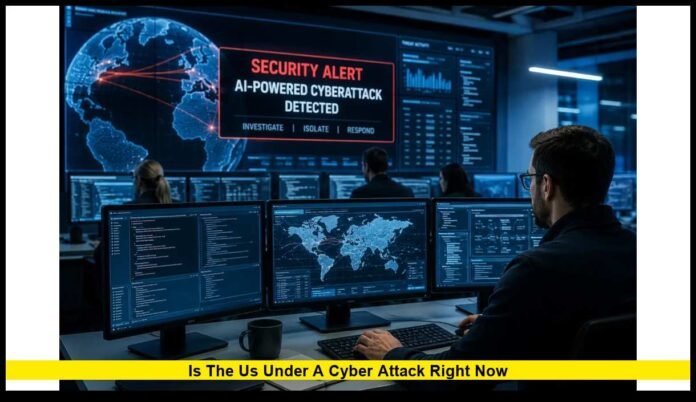

The question “Is the US under a cyber attack right now” has become increasingly important as cybercriminals, ransomware groups, foreign state-sponsored hackers, and other malicious actors continue targeting American businesses, government agencies, critical infrastructure, and individuals. The short answer is that the United States faces ongoing cyberattacks and persistent cybersecurity threats, but that does not automatically mean the country is experiencing one coordinated, nationwide cyberattack.
Cyberattacks can happen simultaneously across different parts of the country. A hospital may experience a ransomware incident while a government agency investigates an attempted intrusion, a financial institution blocks suspicious activity, and a private company works to contain a data breach. These incidents can be serious without indicating that the entire U.S. digital infrastructure has been compromised.
Understanding the difference between an ongoing cyber threat, a confirmed security breach, and a nationwide cyber emergency is essential. Americans also need to know which government agencies monitor these threats, what types of attacks are most concerning, and how to protect personal information when cyber incidents occur.
What Happened in the United States on November 13?
Two major technology and communications disruptions in November have drawn attention to the possibility of a cyberattack against the United States.
The first involved Microsoft 365, including Outlook and other business services. The disruption began on November 12 and continued into November 13, affecting users across multiple countries. Businesses, government offices, schools, healthcare organizations, and other institutions experienced problems accessing essential services.
Microsoft subsequently explained that the incident resulted from a technical issue involving network capacity and a subsequent network change. The company said the disruption was not related to malicious cyber activity or an AI-related incident. Services were gradually recovering, although some customers could continue experiencing intermittent problems and delayed email delivery.
The second incident involved the Federal Aviation Administration (FAA). On November 13, a telecommunications outage affected multiple Air Route Traffic Control Centers, prompting the FAA to order a rare nationwide ground stop for departing flights.
The disruption raised immediate concerns because air traffic control depends on reliable communications between controllers and pilots. However, Homeland Security Secretary Markwayne Mullin said there was no indication at that time that the incident resulted from a malicious cyberattack or deliberate sabotage. Officials were investigating the telecommunications problem.
These incidents are important because they demonstrate how dependent the United States is on interconnected digital and communications systems. However, neither incident should automatically be classified as a confirmed cyberattack.
Is the US Under a Cyber Attack Right Now? Understanding the Latest Threat Level
The United States faces continuous cyber threats, including attacks against government networks, private businesses, financial institutions, healthcare providers, and critical infrastructure.
The distinction between ongoing cyber threats and a nationwide cyber emergency is important.
An ongoing cyber threat means malicious actors are attempting to access computer systems, steal information, disrupt services, or establish unauthorized access. A nationwide cyber emergency would involve a much broader and more consequential disruption requiring an exceptional national response.
As of the latest available developments, there is no verified public confirmation that the entire United States is experiencing one coordinated nationwide cyberattack.
That does not mean the country is free from cyber incidents.
The FBI continues to publish cybersecurity alerts involving foreign intelligence services, ransomware groups, malicious software, compromised internet-connected devices, and attacks against critical infrastructure.
The intelligence community has also identified cyber operations by China, Russia, Iran, and North Korea as continuing national security concerns.
The most accurate assessment is that the United States remains under persistent cyber pressure, but individual cyber incidents should not be confused with a confirmed nationwide attack.
What the U.S. Intelligence Community Says About Cyber Threats
The 2026 Annual Threat Assessment released by the Office of the Director of National Intelligence provides important context for understanding the country’s cybersecurity situation.
The assessment identifies China, Russia, Iran, North Korea, and non-state ransomware groups as continuing threats to American government networks, private-sector organizations, and critical infrastructure.
These actors have different objectives.
Some seek sensitive government information, military intelligence, or access to technology. Others want to disrupt essential services, create opportunities for future attacks, or steal money through ransomware and digital extortion.
The assessment identifies China and Russia as particularly persistent and active cyber threats.
North Korea also presents a significant concern because of its sophisticated cyber operations and financially motivated activities. The assessment estimates that North Korean cryptocurrency thefts reached approximately $2 billion during 2025.
Iranian cyber operations also remain a concern, particularly when geopolitical tensions create incentives for retaliatory digital activity.
Another important development is the increasing use of artificial intelligence in cyber operations. AI tools can help attackers automate certain activities, improve phishing messages, and identify weaknesses more efficiently.
However, cybersecurity professionals can also use AI to detect unusual activity, investigate suspicious behavior, and improve defensive capabilities.
The intelligence assessment makes clear that cybersecurity is not simply a technology issue. It is an ongoing national security challenge involving government agencies, private companies, infrastructure operators, and ordinary Americans.
Which U.S. Government Agencies Are Monitoring Cyberattacks?
Several federal agencies have responsibilities for identifying, investigating, preventing, and responding to cyber incidents.
Understanding their roles helps Americans distinguish official warnings from unverified online claims.
1. Cybersecurity and Infrastructure Security Agency (CISA)
CISA is one of the central federal organizations responsible for coordinating cybersecurity efforts and helping protect the country’s critical infrastructure.
Its responsibilities include:
- Publishing cybersecurity advisories.
- Identifying vulnerabilities that attackers may exploit.
- Sharing information about ransomware and malicious software.
- Supporting federal, state, local, tribal, and territorial governments.
- Helping critical infrastructure organizations improve security.
- Coordinating responses to significant cyber incidents.
CISA also works with private-sector organizations because many essential American services are operated by private companies.
Its cybersecurity resources and alerts can help organizations identify vulnerabilities before attackers exploit them.
2. Federal Bureau of Investigation (FBI)
The FBI investigates cybercrime, ransomware operations, financial fraud, data breaches, and malicious activities involving foreign governments.
Its cyber division works with other federal agencies and international partners to identify criminal networks, investigate intrusions, and disrupt malicious infrastructure.
The FBI also publishes public warnings when investigators identify campaigns that could affect American organizations or individuals.
Its 2026 cybersecurity alerts include warnings about Russian intelligence-linked phishing campaigns, Iranian-affiliated activity, vulnerable internet-connected devices, and attacks against critical infrastructure.
3. National Security Agency (NSA)
The NSA contributes intelligence and technical expertise to national cybersecurity efforts.
It works to identify foreign cyber threats, protect national security systems, and share information that can help government agencies and organizations defend their networks.
Its activities are particularly relevant when cyber operations involve foreign intelligence services or threats to national security.
4. Department of Homeland Security (DHS)
DHS coordinates a broad range of homeland security responsibilities, including cybersecurity and critical infrastructure protection.
It works with CISA, the FBI, state authorities, and private organizations to address threats that could affect public safety and essential services.
These agencies have different responsibilities, but their cooperation is essential when a cyber incident has consequences beyond an individual organization.
The Biggest Cybersecurity Threats Facing the United States
Not every cyberattack works in the same way. Some attacks target personal information, while others attempt to disable important systems or gain access to government networks.
Several categories deserve particular attention.
Ransomware Attacks Against American Organizations
Ransomware remains one of the most disruptive forms of cybercrime.
Attackers gain unauthorized access to an organization’s network, encrypt files, steal sensitive information, or threaten to publish confidential data unless the victim pays.
Hospitals, schools, local governments, manufacturers, and businesses can all become targets.
The consequences can extend beyond financial losses.
A ransomware attack against a healthcare organization could disrupt appointment systems, medical records, billing operations, and other services. A similar incident affecting a local government could interrupt public services and administrative operations.
Ransomware groups are also changing their tactics. The 2026 intelligence assessment highlights a shift toward faster, higher-volume operations that can make attacks more difficult to identify and contain.
Foreign Government-Linked Cyber Operations
Foreign state-sponsored hackers present a different type of risk from ordinary cybercriminals.
Their objectives may include intelligence collection, long-term access to sensitive networks, disruption of infrastructure, or preparation for potential future conflicts.
China, Russia, Iran, and North Korea have all been identified in U.S. intelligence reporting as significant cyber threats.
These operations can target government departments, defense contractors, technology companies, telecommunications providers, and other organizations with strategically valuable information.
One important concern is that an intrusion may remain undetected for an extended period.
An attacker does not necessarily need to disrupt a system immediately. Maintaining access can provide intelligence or create opportunities for later operations.
Phishing and Identity Theft
Phishing attacks remain a major cybersecurity problem for American consumers and businesses.
These scams commonly involve fraudulent emails, text messages, websites, or phone calls designed to persuade people to reveal passwords, banking information, or verification codes.
Criminals frequently impersonate:
- Banks and credit card companies.
- Government agencies.
- Delivery companies.
- Technology support departments.
- Employers and business partners.
- Online shopping platforms.
Some phishing campaigns are highly personalized and can appear convincing.
A message claiming that an account has been suspended or that an urgent security update is required may encourage someone to click a malicious link.
Once attackers obtain login credentials, they may attempt to access email accounts, financial services, cloud storage, and workplace systems.
Attacks Against Critical Infrastructure
Critical infrastructure is particularly important because its disruption can affect large numbers of people.
The United States relies on interconnected systems to provide electricity, drinking water, transportation, telecommunications, healthcare, and financial services.
Cyberattacks against these systems can create consequences beyond ordinary data loss.
For example, unauthorized access to industrial control systems could interfere with equipment used to monitor or manage physical operations.
The FBI and other federal agencies have warned about malicious activity involving internet-connected programmable logic controllers used in water and wastewater infrastructure.
Their July 30, 2026, public advisory reported that water and wastewater utility companies in at least seven states had reported incidents beginning July 27. Some incidents degraded water operations.
This is a particularly important warning because it demonstrates that cyber threats are not limited to computers, websites, or email accounts.
They can also affect technology responsible for managing physical infrastructure.
Cyberattacks Targeting Financial Institutions
Banks, credit unions, payment processors, investment platforms, and financial technology companies are attractive targets because they handle valuable financial and personal information.
Attackers may attempt to steal account credentials, access customer records, manipulate payment processes, or disrupt online banking services.
Not every financial service interruption is evidence of hacking.
Technical failures, maintenance problems, software defects, and network outages can also prevent customers from accessing accounts.
Customers should therefore rely on official bank announcements and verified security notices rather than assuming that every login problem represents a cyberattack.
Could a Cyberattack Shut Down the U.S. Internet?
A frequently asked question is whether hackers could shut down the internet across the entire United States.
A nationwide internet shutdown would be an exceptionally complicated event.
The American internet ecosystem consists of numerous interconnected networks operated by telecommunications companies, internet service providers, cloud platforms, data centers, and other organizations.
There is no single switch that controls the entire country’s internet connectivity.
However, cyberattacks can disrupt individual providers, major cloud platforms, domain name services, or telecommunications infrastructure.
Such incidents can prevent millions of people from accessing websites, applications, business systems, or online services.
A major provider outage can therefore create the impression that the entire internet is down, even when most underlying internet infrastructure remains operational.
The November 2026 Microsoft disruption illustrates this issue.
When a major technology provider experiences a service failure, organizations that depend on its infrastructure can experience simultaneous problems.
This can affect communication, productivity, business operations, and access to important information.
The broader lesson is that the United States needs resilient infrastructure, independent backup systems, and effective recovery plans.
Are American Airports and Transportation Systems at Risk?
Transportation networks are among the critical infrastructure sectors that require strong cybersecurity protections.
Airports, airlines, air traffic control facilities, rail networks, shipping operations, and logistics providers rely on digital systems to coordinate complex activities.
A cyber incident could potentially affect scheduling, communications, passenger services, or operational technology.
However, a transportation disruption should not automatically be described as a cyberattack.
The November 13 FAA incident is an important example.
A telecommunications outage affected air traffic control communications and resulted in a nationwide ground stop for departing flights.
Officials reported no indication at that time that the disruption was caused by a malicious cyber operation.
The investigation into its cause remained important because communication reliability is essential to aviation safety.
Travelers should monitor official FAA information and airline notifications during significant transportation disruptions.
They should also be cautious about social media posts claiming that an airport shutdown proves hackers have compromised the national aviation system.
Are Hospitals and Healthcare Systems Facing Cyber Threats?
Healthcare remains a high-priority target for cybercriminals because hospitals and medical providers manage sensitive patient information and operate systems that support essential medical services.
An attack can affect electronic health records, appointment scheduling, laboratory operations, insurance processing, and communication between medical departments.
In some cases, organizations may need to temporarily use manual procedures while restoring affected technology.
The risks are not limited to hospitals.
Medical laboratories, pharmaceutical companies, healthcare technology providers, insurance organizations, and third-party vendors can also become targets.
The intelligence community’s 2026 assessment highlights the use of AI-assisted cyber operations against sectors that include healthcare and public health.
Healthcare organizations must therefore protect not only their own networks but also the technology and services supplied by outside partners.
For patients, an outage does not necessarily mean medical records have been stolen.
A service interruption, a confirmed data breach, and a ransomware incident are different events. Patients should look for direct communication from their healthcare providers before assuming their information has been compromised.
Could Cyberattacks Affect U.S. Elections and Government Services?
Election security is another important part of the national cybersecurity discussion.
Election infrastructure includes voter registration databases, election administration networks, reporting systems, and technology used by local election offices.
The FBI and CISA have issued warnings about cyber threats targeting election and campaign officials during the 2026 U.S. midterm election cycle.
Potential threats include phishing, account compromise, website disruption, unauthorized access, and attempts to obtain sensitive information.
However, it is essential to distinguish attacks against election-related computer systems from interference with actual vote counting.
A compromised email account or an unavailable public website does not automatically mean ballots or election results have been altered.
Election officials use multiple procedures to protect the voting process, and cybersecurity incidents must be evaluated according to the systems involved and the evidence available.
Americans should obtain election information from their state and local election offices rather than relying on unverified online claims.
How AI Is Changing the Cyberattack Landscape
Artificial intelligence is creating new opportunities for both cybercriminals and cybersecurity professionals.
Attackers can potentially use AI to create more convincing fraudulent messages, automate research into potential victims, and improve the efficiency of certain malicious activities.
Traditional phishing messages often contain obvious spelling mistakes, awkward wording, or suspicious formatting.
AI-generated messages can be more polished and personalized, making them harder to recognize.
Voice cloning and synthetic media also create additional risks.
A criminal could impersonate an executive, employee, family member, or service provider to persuade someone to transfer money or reveal confidential information.
However, AI does not make every cyberattack sophisticated or successful.
Many successful intrusions still involve basic security failures, including weak passwords, unpatched software, exposed devices, and stolen login credentials.
Organizations should therefore continue investing in fundamental cybersecurity protections rather than assuming that advanced technology alone can solve the problem.
What Should Americans Do If the U.S. Is Experiencing a Cyberattack?
Most Americans do not need to take extraordinary action simply because cybersecurity threats exist.
However, basic precautions can reduce the risk of financial fraud, identity theft, and unauthorized access.
The following measures are useful during both ordinary conditions and major cyber incidents.
1. Enable Multifactor Authentication
Multifactor authentication adds another verification step when someone attempts to access an account.
Even if a criminal obtains a password, additional authentication can make unauthorized access more difficult.
Enable this feature on important accounts, particularly:
- Email accounts.
- Banking and financial services.
- Social media platforms.
- Cloud storage.
- Workplace accounts.
- Government service accounts.
Where available, use an authenticator application or security key rather than relying exclusively on text-message verification.
2. Change Compromised Passwords
If a company confirms that an account or password has been compromised, change the affected password immediately.
Avoid using the same password across multiple services.
A password manager can help create and securely store unique passwords for different accounts.
If attackers gain access to one reused password, they may attempt to use it on other websites.
3. Avoid Suspicious Links and Attachments
During a major cybersecurity incident, scammers may impersonate affected organizations.
They might send fraudulent messages claiming that users must verify their accounts, download emergency security software, or reset their passwords.
Do not click links in unexpected messages.
Instead, open the organization’s official website or application directly and check its published security announcements.
4. Keep Devices and Software Updated
Software updates frequently include security fixes that address vulnerabilities.
Install updates for operating systems, browsers, mobile applications, routers, and other connected devices.
For businesses, security teams should prioritize vulnerabilities that are actively being exploited.
CISA’s Known Exploited Vulnerabilities Catalog is an important resource for identifying vulnerabilities that attackers are already using.
5. Monitor Financial Accounts
Check bank statements, credit card transactions, and payment applications regularly.
Look for unfamiliar purchases, unexpected transfers, or account changes.
Contact the financial institution through its verified phone number if suspicious activity appears.
If personal information has been exposed, consider additional identity protection measures, including placing a fraud alert or credit freeze where appropriate.
6. Maintain Backups of Important Information
Regular backups can help individuals and businesses recover from ransomware incidents, accidental deletion, and hardware failures.
Organizations should maintain backups that attackers cannot easily access or modify.
Backup systems should also be tested to confirm that data can actually be restored.
A backup that has never been tested may not provide reliable protection during an emergency.
7. Follow Official Cybersecurity Announcements
Americans should rely on government agencies and affected organizations for confirmed information.
The following official resources are particularly useful:
- CISA cybersecurity resources and alerts provide information about vulnerabilities, malicious activity, and defensive measures.
- FBI 2026 cybersecurity alerts include warnings about active campaigns and cybercriminal activity.
- ODNI 2026 Annual Threat Assessment explains the intelligence community’s assessment of foreign cyber threats.
- CISA Secure Our World offers practical cybersecurity guidance for individuals and organizations.
These resources can help readers separate verified warnings from speculation.
Which Signs Could Indicate a Cyberattack?
Not every unusual computer problem indicates malicious activity. Nevertheless, certain warning signs deserve attention.
For individuals, possible indicators include:
- Unexpected password reset notifications.
- Login alerts from unfamiliar locations.
- Financial transactions that were not authorized.
- Emails sent from an account without the owner’s knowledge.
- Security settings changed without permission.
- Unexpected account lockouts.
- Messages requesting verification codes.
For businesses and government organizations, warning signs may include unusual network traffic, unauthorized administrator accounts, unexpected file encryption, suspicious remote access, unexplained system changes, and unusual activity involving sensitive information.
These indicators do not independently prove that an attack has occurred.
A cybersecurity investigation is needed to determine whether the activity resulted from malicious access, a software problem, or another technical issue.
Could the United States Experience a Larger Cyberattack in the Future?
The possibility of a larger cyberattack remains a serious national security concern.
The United States operates complex digital systems that support banking, transportation, energy, communications, healthcare, government operations, and commercial activity.
An attacker who successfully compromises a strategically important system could create disruptions affecting multiple organizations.
However, predicting when or where a major cyberattack will occur is difficult.
The 2026 intelligence assessment identifies persistent threats from foreign governments and non-state actors, but it does not establish that a nationwide cyberattack is inevitable or provide a confirmed date for one.
Several developments deserve continued attention:
- Increasing attacks against critical infrastructure.
- Greater use of ransomware and data extortion.
- Exploitation of unpatched internet-connected devices.
- Foreign intelligence operations targeting government networks.
- AI-assisted phishing and cybercrime.
- Vulnerabilities affecting cloud platforms and software suppliers.
- Attacks against third-party technology providers.
Cybersecurity preparedness is especially important because a serious incident may affect organizations that do not appear to be direct targets.
A technology supplier, communications provider, or cloud service can become a point of disruption for many customers simultaneously.
Why Cybersecurity Preparedness Matters for Every American State
Cyber threats do not follow state boundaries.
A malicious campaign can target organizations in multiple states at the same time. A national cloud service disruption can affect businesses across the country, while an attack against a regional utility can have more localized consequences.
State and local governments also face different challenges depending on the infrastructure and services they operate.
Water utilities, public schools, county governments, healthcare providers, emergency communications systems, and local transportation networks all need appropriate cybersecurity protections.
Smaller organizations may have fewer resources to maintain dedicated security teams.
This can make partnerships with state cybersecurity offices, federal agencies, and trusted technology providers particularly valuable.
Preparedness should include incident response plans, secure backups, employee training, vulnerability management, and reliable alternative communication methods.
It should also include regular exercises that test how organizations would respond if important systems became unavailable.
The November aviation and Microsoft disruptions demonstrate why operational resilience matters even when an outage is not caused by a hacker.
What to Watch for in the Latest U.S. Cyberattack Updates
Several developments will be important when assessing the cybersecurity situation in the United States.
First, investigators and federal agencies may publish additional details about significant infrastructure incidents. Confirmed evidence of unauthorized access, malicious software, or foreign involvement would provide a stronger basis for classifying an event as a cyberattack.
Second, the FBI and CISA may issue new advisories if they identify additional threats affecting American organizations.
Third, the November 13 FAA telecommunications disruption deserves attention because officials were still investigating its underlying cause. A confirmed technical failure should be distinguished from a deliberate attack, while any new evidence of malicious activity would materially change the assessment.
Fourth, Microsoft’s post-incident reporting will help explain the technical failure behind its November 12–13 service disruption and the steps taken to prevent a recurrence.
Finally, organizations should monitor warnings involving critical infrastructure, especially water systems, telecommunications, healthcare, energy, and transportation.
Readers should pay attention to confirmed government announcements rather than viral claims that a cyberattack has already shut down the country.
The Bottom Line
The United States is facing continuous cyber threats, and confirmed incidents involving government networks, private organizations, and critical infrastructure demonstrate that the risks are real.
However, the latest publicly available information does not establish that the country is currently experiencing one coordinated nationwide cyberattack.
The November 13 FAA ground stop was associated with a telecommunications outage, with officials reporting no indication at that time of a malicious cyberattack. The Microsoft 365 disruption was also attributed to a technical problem rather than malicious activity.
At the same time, federal intelligence assessments and FBI cybersecurity warnings show that foreign government-linked actors and criminal groups continue targeting American systems.
For individuals, the most practical response is to secure important accounts, enable multifactor authentication, update devices, monitor financial activity, and avoid suspicious messages.
For businesses and government organizations, the priority should be protecting critical systems, maintaining reliable backups, and preparing for disruptions.
Do you believe the United States is prepared to handle a major cyberattack? Share your thoughts and stay informed about the latest verified U.S. cybersecurity developments.
Cybersecurity incidents can sometimes disrupt essential services, business operations, and digital infrastructure. Internet service interruptions are another important issue to monitor, particularly when widespread connectivity problems are reported. Readers can use our internet outage map to understand reported connectivity disruptions across different areas. Meanwhile, concerns about transportation infrastructure and flight operations are covered in our report, Are all airlines grounded right now?.