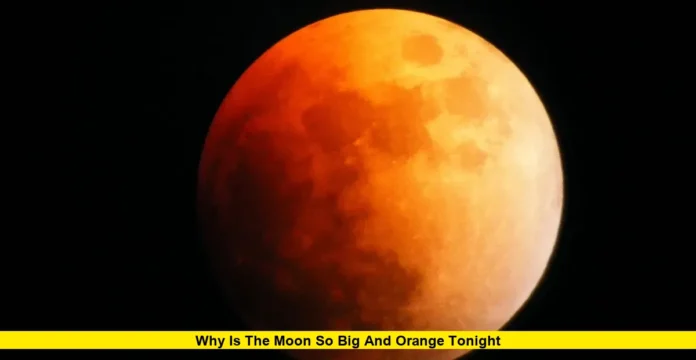

If you walked outside this week and stopped dead in your tracks staring at a massive, glowing, burnt-orange ball hanging low in the sky, you are in good company. People all across the United States are looking up and asking the same question: why is the moon so big and orange tonight? The answer is a fascinating combination of atmospheric science, a well-known optical trick your brain plays on you, and the arrival of one of the most beautiful full moon events of the year — the 2026 Flower Moon.
The timing is perfect for anyone who loves the night sky. May’s full moon peaked on May 1, 2026, at 1:23 PM Eastern Time, and its glow has been dominating the evening sky ever since. Whether you caught it cresting the eastern horizon just after sunset or watched it drift slowly across the southern sky later in the evening, this moon has been putting on a show that is hard to ignore.
Step outside tonight, take a photo of that gorgeous orange moon, and drop it in the comments — we want to see your view from wherever you are in the country!
What Is the Flower Moon and Where Does the Name Come From?
Every full moon of the year carries a traditional nickname, and May’s full moon is called the Flower Moon. The name is not modern or invented by astronomers — it comes from a long tradition rooted in European, Colonial American, and Native American cultures that tied the lunar calendar to what was happening in the natural world each month.
May is when spring hits full stride across the Northern Hemisphere. Wildflowers are blooming in fields and forests, trees are lush with new growth, and the landscape is alive with color. The full moon that rises during this time of year earned its name from that burst of natural beauty. Other months have equally descriptive names — the Wolf Moon in January, the Harvest Moon in September, the Cold Moon in December — each one reflecting what people were experiencing in the world around them when it appeared.
The 2026 Flower Moon rose in the southeastern sky just after the sun dipped below the horizon on the evening of May 1. It tracked across the southern portion of the sky through the night before setting in the southwest in the early morning hours. For anyone who went out and watched it rise, that low, glowing, orange orb climbing slowly above the rooftops and trees was the signature image of this year’s Flower Moon.
The Real Reason the Moon Looks So Orange
Here is where science steps in to explain what your eyes are seeing.
When the moon is sitting low on the horizon, its light has to travel through an enormous thickness of Earth’s atmosphere before it reaches your eyes. The atmosphere is full of gas molecules, dust particles, and other microscopic debris. As moonlight pushes through all of that material, the shorter wavelengths of visible light — the blues and violets — get scattered in every direction and never make it to your eyes. The longer wavelengths — reds and oranges — are much harder to scatter, so they travel straight through and reach you intact.
The result is a moon that looks deeply orange, amber, or even rust-colored when it first rises. This is the exact same physical process that makes sunrises and sunsets so vivid and warm. The science behind it is called Rayleigh scattering, named after the British physicist who first described it in the 19th century. It is a fundamental property of how light behaves when it interacts with the atmosphere, and it happens every single day and night on Earth.
As the moon climbs higher in the sky over the course of the night, the angle changes. At a higher position, moonlight cuts through far less atmosphere to reach you, so more of those blue wavelengths survive the journey. The color gradually shifts from deep orange to yellow, then to the bright, cool white most people associate with a full moon high overhead.
The intensity of the orange color can also vary depending on local conditions. When there is wildfire smoke in the air, heavy dust from weather systems, or elevated pollution, those extra particles give the light even more material to interact with — and the result can be a moon that looks an even darker, more dramatic shade of burnt orange or red. On nights when the air is exceptionally clean and clear, the orange effect may be less intense.
Why Does the Moon Look So Gigantic Near the Horizon?
The orange color gets people talking, but the apparent size of the moon near the horizon is what truly stops people in their tracks. It looks enormous. It looks like something out of a science fiction movie. And here is the thing — it is almost entirely an illusion.
The moon is not actually bigger when it sits near the horizon. Photographs prove this beyond any doubt. If you take a photo of the moon when it first rises and another photo of the same moon hours later when it is high overhead, keeping your camera zoom settings identical, the moon will be essentially the same size in both images. The moon itself has not changed.
What changes is your brain’s interpretation of what it is seeing.
When the moon is high in the sky, there is nothing around it for comparison. It floats alone against a vast, dark backdrop, and your brain — which is constantly judging the size of objects based on context — perceives it as a relatively small disc against an immeasurably large sky.
When the moon is near the horizon, everything is different. Now it sits behind trees, above rooftops, next to buildings, and just over hilltops. Your brain sees those familiar objects and uses them as size references. A moon that appears to tower above a row of houses or peek over a distant mountain range gets processed as enormous, because your brain is doing what it always does — comparing the unfamiliar to the familiar. The result is that the moon appears far larger than it actually is.
This phenomenon is called the Moon Illusion, and it has puzzled scientists, philosophers, and ordinary observers for thousands of years. Despite being one of the most universally experienced optical illusions on the planet, researchers still do not have a single, universally agreed-upon explanation for exactly why the human brain processes it this way. What they do know is that it is a product of visual perception and cognition, not of anything the atmosphere or the moon itself is actually doing.
You can test this yourself tonight. When the moon looks enormous on the horizon, hold your arm out straight and cover the moon with your thumbnail. Then do the same thing a few hours later when it is high in the sky. Your thumbnail will cover it just as easily both times. Same moon. Same size. Completely different experience.
Is This a Supermoon? Not Exactly — Here Is What Makes May’s Moon Unique
A lot of people hear “big moon” and automatically assume “supermoon.” In 2026, the Flower Moon is actually the opposite of a supermoon — it is a micromoon.
The moon’s orbit around Earth is not a perfect circle. It is an ellipse, which means the moon is sometimes closer to Earth and sometimes farther away. The closest point in that orbit is called perigee, and when a full moon occurs near perigee, it is called a supermoon — it genuinely is slightly larger and brighter than usual. The farthest point in the orbit is called apogee, and when a full moon occurs near apogee, it is called a micromoon.
The May 1, 2026 Flower Moon occurred near apogee, making it a micromoon. This means the moon is technically about 5 percent smaller and around 10 percent dimmer than an average full moon. The difference is subtle enough that most casual observers would never notice it without a side-by-side comparison. But it does mean that the giant orange moon you saw rising over the horizon looked dramatic thanks to the Moon Illusion — not because the moon was genuinely closer to Earth than usual.
Interestingly, May 2026 brings two full moons in the same calendar month. The second full moon arrives on May 31 and is technically known as a Blue Moon — the name given to a second full moon within a single calendar month. Both of May’s full moons are micromoons, meaning both occur while the moon is near its farthest point from Earth. That is a rare double occurrence worth noting for any skywatching enthusiast.
The Orange Moon Is Normal — Here Is Why Social Media Gets It Wrong
Every time an unusually vivid orange moon rises, social media lights up with dramatic claims. Posts describe it as a Blood Moon, an omen, a rare phenomenon, or a sign of something extraordinary. Most of the time, none of that is accurate.
An orange moon near the horizon is one of the most routine events in nature. It happens every single month, every time the full moon rises. The reason it generates so much excitement is simply that it looks so stunning — and that is a perfectly valid reason to pay attention to it. But the science behind it is completely ordinary and has been understood for well over a century.
A genuine Blood Moon is something different. That term refers specifically to a total lunar eclipse, when Earth passes directly between the sun and the moon and casts a full shadow across the lunar surface. During totality, the only light reaching the moon is sunlight that has been bent around Earth’s edges by the atmosphere — and since that process filters out blue light and lets red light through, the moon glows a deep copper or red color. A total lunar eclipse is a genuinely rare event, and the next one visible from North America is still months away.
An orange moon at moonrise is not an eclipse. It is not a blood moon. It is simply physics doing what physics does every night, and it is beautiful every single time.
How to Get the Most Out of Watching the Moon This Month
If you missed the Flower Moon at its most dramatic on the night of May 1, do not worry — the moon remains strikingly bright and beautiful for several nights around the full moon date, and the Blue Moon on May 31 gives you another excellent opportunity.
The best time to watch is always right at moonrise, just after the sun goes down. That is when the moon sits lowest on the horizon and the orange effect is at its strongest. Find a location with a clear view to the east or southeast and, if possible, position yourself so there are interesting foreground objects — buildings, tree lines, bridges, hills — that can frame the rising moon and amplify that sense of enormous scale.
For photography, even a smartphone camera can capture something spectacular when the moon is near the horizon. Tap on the moon in your camera app to let the sensor properly expose for the bright disc, and experiment with including interesting foreground elements in the frame. The first 30 to 60 minutes after moonrise typically offer the most dramatic conditions before the moon climbs too high and the orange glow begins to fade.
May 2026 is also an exceptional month for spotting planets. Venus is bright in the western sky just after sunset, Jupiter is visible in the constellation Gemini to the southwest, and Saturn is beginning to appear in the pre-dawn sky. A pair of binoculars will make all of these targets more rewarding and give you a much clearer view of the moon’s cratered surface as well.
The moon puts on this show every month, but it never gets old — drop a comment below and tell us where you watched the Flower Moon rise and what it looked like from your part of the sky!