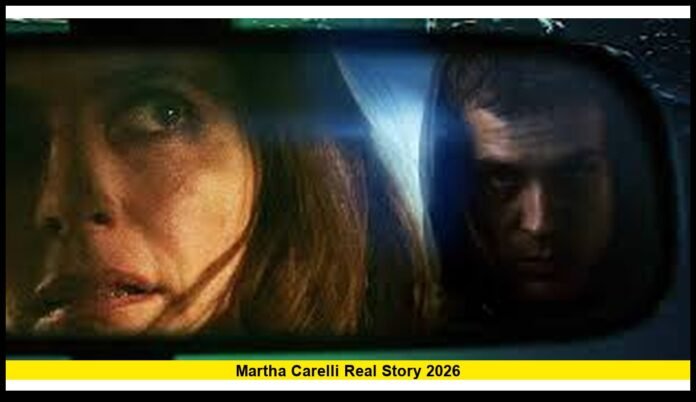

Martha Carelli Real Story has attracted renewed attention following the release of Kidnapped in Her Own Home: The Martha Carelli Story, a 2026 crime thriller now streaming on Netflix. The film draws on a frightening real-life kidnapping that took place in Washington state in April 1978. The case involved an escaped prisoner who entered a family home, held its occupants at gunpoint, and forced a woman into a dangerous hostage situation. However, one important detail often gets overlooked: Martha Carelli is a pseudonym used to protect the real survivor’s identity.
The case became known to a wider audience through true-crime author Ann Rule’s account, “The Painter’s Wife.” Decades later, the story has reached a new generation through Lifetime’s television adaptation and its subsequent arrival on Netflix. While the film captures the danger and fear surrounding the kidnapping, some details differ from the historical account. Understanding those differences is essential to separating the documented crime from its dramatic portrayal.
Latest Update on the Martha Carelli Story
As of November 7, 2026, Kidnapped in Her Own Home: The Martha Carelli Story is available on Netflix. The movie originally premiered on Lifetime on May 2, 2026, before reaching Netflix in November.
The renewed interest has prompted viewers to search for the real events behind the movie, the identity of the woman represented by Martha Carelli, and what happened after her ordeal ended. The historical account establishes that the woman survived a violent abduction, suffered serious physical injuries, and experienced lasting psychological effects.
Nevertheless, the survivor’s publicly documented story does not provide a verified account of every aspect of her later life. Her privacy remains an important consideration when examining the case.
Who Was Martha Carelli in the Real Story?

Martha Carelli is the name associated with the kidnapping survivor in Ann Rule’s nonfiction account and the 2026 film. It is not the woman’s confirmed real name. Rule changed names in her true-crime writing to protect the privacy of survivors and other people involved in the cases she documented.
The woman was a wife and mother living in Washington state when the kidnapping occurred. Before the incident, she was leading an ordinary family life. That routine changed dramatically when an escaped inmate entered her home and turned the residence into a place of confinement and fear.
The decision to use a pseudonym matters because it distinguishes the publicly available account from the survivor’s private identity. Although viewers may want to learn more about her family, personal history, and life after the crime, those details should not be treated as established facts without reliable confirmation.
The central focus of the Martha Carelli story is therefore not an independently verified public biography. It is the account of a real woman whose experience became the subject of a nonfiction crime narrative and, eventually, a television dramatization.
What Happened on April 18, 1978?
The events behind the Martha Carelli story unfolded in April 1978 in southeastern Washington. On April 18, an escaped prisoner was hiding around the family’s home before the situation escalated into a violent hostage incident.
The fugitive, identified as Michael Anderson in the published account and film, had escaped from the Franklin County Jail in Pasco, Washington. Reports about the case describe four inmates escaping from the jail two days before the kidnapping.
Anderson remained on the run and sought a place to hide while planning his next move. The family’s home became part of that plan, placing the occupants in immediate danger.
The incident demonstrates how a criminal escape developed into a much broader emergency. What began as an effort to avoid capture ultimately involved a family held at gunpoint, a forced getaway, another hostage, and a police response that ended with the fugitive’s arrest.
It is important to recognize that the names used in the narrative may not match the individuals’ actual identities. The historical events and the pseudonyms used to tell them must be considered separately.
How an Escaped Prisoner Took Control of the Family Home
The most disturbing part of the story is the way the fugitive used the family’s home as a hiding place before revealing himself. According to published accounts, he spent time near or inside the residence without the family initially realizing the extent of the danger.
When he confronted the woman, he used threats and a firearm to control her movements. Her husband and children also became caught in the crisis.
The family’s ordinary surroundings offered little protection once the armed fugitive took control. The threat was no longer limited to the possibility of a break-in. The occupants had to respond to an unpredictable captor whose immediate objective was to avoid arrest.
The film dramatizes this frightening sequence through tense confrontations and attempts by the woman to survive without provoking further violence. Although the production is based on the real case, viewers should not assume that every conversation, scene, or character interaction reproduces the historical record word for word.
The essential fact remains that the kidnapping involved a genuine threat to the woman and her family. Their home became the setting for a crime that would have lasting consequences for the survivor.
The Forced Getaway and a Second Hostage
The crisis did not end when the fugitive left the family home. The historical account describes how he forced the woman to drive as he attempted to continue his escape.
During the subsequent events, the fugitive also took department store manager Edward “Doug” Parry hostage. Parry’s involvement became particularly important because his actions helped alert authorities to the danger without immediately provoking the captor.
The journey brought the hostages into a situation where their safety depended on finding an opportunity to seek help. An openly confrontational move could have made an already dangerous situation worse.
The published account describes a stop at a motel, where Parry managed to communicate the hostage situation discreetly to a clerk. The clerk then contacted law enforcement.
That decision created an opportunity for officers to intervene. Police surrounded the motel and took action after the captor left the room. The incident ended with the fugitive in custody and the hostages found alive.
Parry’s actions became an important part of the account because they helped bring the ordeal to an end. The outcome also illustrates the role that quiet communication and timely police intervention can play during hostage situations.
Martha Carelli’s Injuries and the Lasting Impact
Surviving the kidnapping did not mean that the woman emerged without serious harm. Published accounts describe significant physical injuries, including a broken nose, a concussion, and facial trauma.
The incident also had psychological consequences. The account describes lasting symptoms associated with post-traumatic stress disorder, including flashbacks connected to the frightening experience.
Such effects can continue after an immediate physical danger has passed. A survivor may return to ordinary surroundings while still coping with memories of violence, fear, and the loss of personal security.
However, there is a distinction between documenting the consequences of the crime and claiming to know the survivor’s entire recovery journey. Public accounts provide information about her injuries and reported trauma, but they do not establish every detail of her later medical care, family life, or personal circumstances.
No reliable, comprehensive public account establishes all aspects of the woman’s life today. Claims about her current location, age, family relationships, or present-day activities should therefore be treated cautiously unless supported by credible evidence.
Respecting that limitation is particularly important in a case where a pseudonym was deliberately used to preserve privacy.
What Happened to the Kidnapper?
The published account states that the fugitive identified as Michael Anderson was arrested after the motel incident. He subsequently pleaded guilty to multiple criminal charges connected to the events, including kidnapping, robbery, assault, and escape.
Reports also describe further escape attempts while he was awaiting trial on the new charges. He ultimately received multiple life sentences, along with additional prison terms related to earlier crimes.
These details explain why the story is remembered as more than a frightening abduction. The incident involved an escaped prisoner, several people placed in danger, and a criminal case that resulted in severe punishment.
There is, however, an important limitation when discussing the man’s identity and later status. Michael Anderson is the name used in the account associated with the story, and the use of pseudonyms means readers should not automatically treat it as his confirmed legal identity.
Likewise, the available information does not establish a fully verified current account of his whereabouts or whether he remains alive. It would be inaccurate to present an unconfirmed claim about his present status as fact.
How Ann Rule Brought the Case to Public Attention
Ann Rule was a prominent American true-crime author known for examining real criminal cases and the people affected by them. Her account, “The Painter’s Wife,” helped bring the Martha Carelli kidnapping into the public record for readers interested in true crime.
The story appeared in Smoke, Mirrors, and Murder: And Other True Cases, a collection of Rule’s nonfiction crime narratives published in the late 2000s. Her approach combined accounts of criminal conduct with attention to the experiences of victims and survivors.
The use of pseudonyms was a significant part of how the case was presented. It allowed the narrative to discuss the events while limiting the exposure of people whose lives had been affected by the crime.
Rule’s work subsequently provided the foundation for the television adaptation. The resulting film introduced the story to viewers who may not have encountered the original account.
The connection between the book and the movie is important because it explains why the case has resurfaced decades after the original events. The renewed attention reflects the continuing public interest in real crimes, survival, and the long-term consequences of violence.
Is the 2026 Movie an Accurate Account of the Real Events?
Kidnapped in Her Own Home: The Martha Carelli Story is inspired by a real kidnapping, but it is a dramatization rather than a documentary.
The film stars Stana Katic as Martha Carelli, Tyler Perez as Michael Anderson, and Michael Shenefelt as Doug Parry. Dove Meir also appears as John Carelli.
The production presents the incident as a suspenseful struggle for survival. Its scenes focus on the family’s confinement, the captor’s attempts to escape, the forced journey, and the woman’s efforts to survive the ordeal.
Some of these elements reflect the published historical account. However, the production also changes details, including character names and aspects of the family and setting. The pseudonyms used in the source material further complicate attempts to match every screen character directly to a real person.
Dramatic dialogue, reconstructed conversations, and the timing of particular scenes should not automatically be treated as historical evidence. Television productions often compress events and adjust details to create a coherent narrative within a limited running time.
For readers seeking the Martha Carelli real story, the most reliable approach is to separate the established outline of the kidnapping from the film’s creative presentation.
Why the Martha Carelli Story Is Receiving Attention Again
The renewed interest in the case is closely connected to the 2026 release of the film. Its arrival on Netflix has made the story accessible to viewers who may have missed its original Lifetime premiere.
True-crime adaptations often lead audiences to investigate the real events behind a production. In this case, searches extend beyond the kidnapping itself to the survivor’s identity, her injuries, the fugitive’s fate, and the differences between the historical account and the screen version.
The use of a pseudonym also creates a natural limit to what can responsibly be reported. Curiosity about a survivor’s life does not establish that private information is available or that unverified online claims are accurate.
The story’s continuing relevance lies in the documented consequences of the crime. A woman and her family faced an armed fugitive in their own home, and the situation escalated into a dangerous hostage episode before law enforcement brought it to an end.
The Martha Carelli Story: What Is Known Today?
The central facts remain clear. The Martha Carelli story is based on a real 1978 kidnapping in Washington state. The survivor’s name was changed in the published account to protect her privacy, and the incident was later adapted into a 2026 television thriller.
The woman survived serious physical injuries and experienced lasting psychological effects. The fugitive was captured after the motel incident, and the published account describes guilty pleas and multiple life sentences.
The movie is now available on Netflix, bringing renewed attention to a case that first reached readers through Ann Rule’s true-crime writing. However, the survivor’s confirmed current identity and complete present-day circumstances have not been established in reliable public reporting.
The distinction between what is documented and what remains private is essential to understanding the case accurately. The real story is compelling without the need to invent personal details or treat dramatic scenes as historical fact.
What are your thoughts on the real events behind Kidnapped in Her Own Home: The Martha Carelli Story? Share your comments and stay tuned for verified updates as more information becomes available.