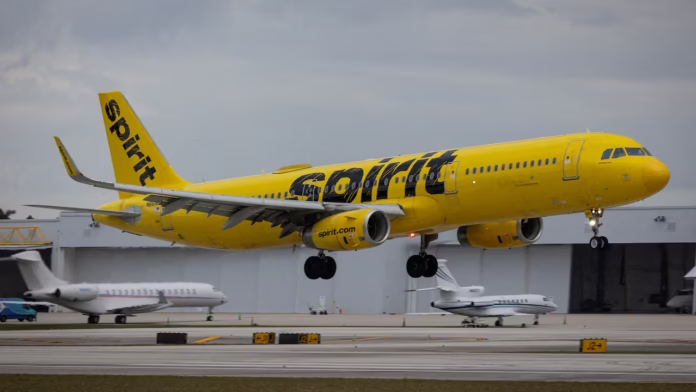

Spirit Airlines was once America’s scrappiest budget carrier — now it’s gone for good. If you’ve been asking why was Spirit Airlines shut down, the answer involves years of mounting losses, two separate bankruptcy filings, a catastrophic global energy crisis, and a last-minute government rescue that fell apart at the worst possible moment. On May 2, 2026, the airline permanently ceased all operations, canceled every scheduled flight, and left 17,000 workers without jobs almost overnight.
The collapse didn’t happen in a single day. It was years in the making — and the final chapter unfolded with stunning speed.
Ready to rebook? American, Delta, United, Frontier, and Southwest are all offering rescue fares and price caps specifically for displaced Spirit passengers. Act fast — availability is limited.
A Budget Airline Built on a Razor-Thin Business Model
Spirit Airlines built its entire identity around one promise: the lowest base fares in American aviation. The airline pioneered the ultra-low-cost carrier model in the U.S., charging rock-bottom prices for the seat itself while billing passengers separately for everything else — carry-on bags, seat selection, snacks, and more.
For budget-conscious travelers, Spirit was a lifeline. For millions of Americans who couldn’t afford traditional airfares, Spirit made flying possible. And for the broader airline industry, Spirit’s existence kept competitive pressure on larger carriers, forcing them to introduce cheap “basic economy” options just to stay relevant.
But underneath that business model was a structure with almost no margin for error. Revenue depended heavily on ancillary fees and high passenger volume. The moment travel demand softened, the cracks showed fast — and they never fully healed.
The Pandemic Broke Spirit’s Financial Foundation
Spirit was never the most financially robust airline, but the COVID-19 pandemic delivered a blow from which it never truly recovered. When travel demand collapsed in 2020, Spirit’s revenue evaporated. The airline burned through cash at a staggering rate, and by the time air travel began returning to normal, Spirit had already accumulated billions of dollars in losses.
By the time of its first bankruptcy filing in November 2024, the company had lost more than $2.5 billion since the start of 2020. That figure alone tells the story of just how deep the financial hole had become.
Throughout 2024 and 2025, Spirit made desperate attempts to cut costs. It eliminated nearly 4,000 jobs. It dropped more than 200 underperforming routes. It tried to merge with JetBlue Airways, a deal that federal regulators ultimately blocked on antitrust grounds. Every potential lifeline either failed to materialize or proved insufficient to turn the tide.
Two Bankruptcies in Less Than a Year
Most airlines that file for Chapter 11 bankruptcy emerge leaner and restructured. Spirit filed twice in less than 12 months — a sign of just how severe the airline’s underlying problems were.
The first filing came in November 2024, following the collapse of the JetBlue merger. Spirit hoped to use the bankruptcy process to restructure its debt, reduce costs, and stabilize the business. It wasn’t enough.
By August 2025, Spirit filed for bankruptcy a second time, disclosing in regulatory filings that it had “substantial doubt” about its ability to continue operating. The airline slashed its workforce further, cutting routes and staff in an attempt to survive on a smaller footprint.
At the end of 2025, Spirit employed approximately 17,000 people, including pilots, flight attendants, mechanics, gate agents, and support staff — all of whom were now working for a company that was openly questioning its own survival.
The Iran War and the Fuel Crisis That Sealed Spirit’s Fate
Just as Spirit appeared to be making progress on restructuring, a geopolitical event thousands of miles away changed everything.
In early 2026, the outbreak of war involving Iran triggered a severe global energy crisis. Iran’s influence over the Strait of Hormuz — a critical shipping chokepoint through which roughly 20% of the world’s oil supply flows — sent crude oil and jet fuel prices skyrocketing almost overnight.
For a healthy, well-capitalized airline, surging fuel costs are painful but manageable. For Spirit — already operating under bankruptcy protection, already burning through its remaining cash reserves — the fuel spike was catastrophic.
In February 2026, Spirit had actually reached a deal with its creditors to emerge from its second bankruptcy. The plan would have allowed the airline to reduce its debt load and continue flying. Three days after that deal was announced, the war in Iran began.
The fuel cost projections that followed were devastating. Analysts estimated that if prices remained elevated, Spirit’s fuel expenses would rise by hundreds of millions of dollars within the year — money the airline simply did not have and could not borrow.
Spirit’s CEO Dave Davis was direct about what this meant: sustaining operations required hundreds of millions of additional dollars in liquidity. Spirit didn’t have it, and no one was willing to provide it on terms that made sense.
The Failed Government Rescue
With Spirit spiraling toward collapse, the Trump administration stepped in with a proposed bailout. Negotiations were intense, high-stakes, and ultimately unsuccessful.
The administration’s proposed rescue package would have given the U.S. government a 90% ownership stake in the airline in exchange for emergency funding. President Trump personally signaled support for a deal, and just days before the shutdown, Spirit’s legal team described negotiations as being in “very advanced discussions.”
But a critical group of Spirit’s bondholders — including major financial firms — opposed the terms of the deal. From their perspective, the proposed agreement left them with less money than they were owed in the bankruptcy proceedings, and they pushed back hard.
Transportation Secretary Sean Duffy publicly acknowledged the effort the administration had made, while also being candid about Spirit’s long-standing problems. The airline’s low-cost model, he noted, “wasn’t working” well before the Iran war added fuel to the fire.
The counteroffer from creditors was rejected by the government. With no agreement in place, Spirit’s cash reserves ran dry. The company had no choice but to begin an immediate wind-down.
The Final Hours: How the Shutdown Unfolded
The end came with almost no warning for most of the people affected.
In the early hours of Saturday, May 2, 2026, Spirit’s flight attendant union sent an urgent message to its roughly 5,000 members: “We are delivering the hardest news of our lives — Spirit will permanently cease operations at 3:00 AM Eastern Time.”
Most of Spirit’s employees learned about the shutdown through media reports rather than official company communication. Airport check-in desks sat empty. Customer service lines went dark. Spirit’s website posted a brief statement: “All flights have been canceled, and customer service is no longer available.”
The airline had approximately 9,000 flights scheduled from May 2 through the end of the month — an average of 300 flights per day carrying roughly 60,000 passengers. Every single one of those flights was canceled.
Spirit’s closure marks the first shutdown of a significant U.S. airline since Midway Airlines collapsed in the aftermath of the September 11, 2001 attacks. In the aviation world, that’s a historic milestone — and not a welcome one.
What Happens to Spirit Passengers Now
If you held a Spirit ticket for an upcoming flight, you are entitled to a refund. The Department of Transportation confirmed that Spirit maintains a reserve fund specifically to issue refunds to the original form of payment for affected travelers. Credit and debit card users can also initiate chargebacks directly through their card issuers.
Passengers who booked through a third party — a travel agent, an online booking platform — should contact that service directly for refund assistance.
For those who need to rebook immediately, the airline industry has stepped up with a range of relief options. United, Delta, JetBlue, and Southwest agreed to cap ticket prices for Spirit customers on routes where Spirit previously operated. Frontier Airlines offered 50% off base fares across its entire network. American Airlines — which operates at 70 of the 72 airports Spirit served — launched a dedicated rescue fare program and is adding flight capacity on key Spirit routes.
Within just the first 12 hours after the shutdown announcement, United Airlines alone rebooked 14,000 displaced Spirit passengers onto its own flights.
What Spirit’s Closure Means for U.S. Airfare
Spirit’s collapse isn’t just a story about one airline. It has real consequences for everyone who flies within the United States.
For years, Spirit’s ultra-low-cost fares forced the entire industry to keep prices more competitive. The moment Spirit entered a new route, other carriers often dropped their prices in response. With Spirit now gone, that downward pressure on fares disappears on dozens of domestic routes — and passengers will likely feel it in their wallets.
The four largest U.S. carriers — United, American, Delta, and Southwest — already control roughly 80% of available domestic flights. With Spirit eliminated, the remaining low-cost alternatives are Frontier, Allegiant, and a small group of regional carriers. Competition on many routes just got significantly thinner.
The broader airline industry is also navigating significant headwinds from the Iran war. Analysts project that U.S. passenger airlines could collectively see their annual fuel bills rise by tens of billions of dollars compared to pre-war forecasts. Airlines are expected to raise fares and cut unprofitable routes in response — trends that will directly affect what Americans pay to fly.
What Happens to Spirit’s 17,000 Employees
The human cost of the shutdown is enormous. Pilots, flight attendants, mechanics, customer service agents, and corporate employees — many of whom had worked for Spirit for years — lost their jobs with almost no advance notice.
Pilot unions described the closure as “a devastating blow” to more than 2,000 pilots who had made significant financial concessions during the restructuring process, believing in the airline’s ability to survive. Flight attendant and mechanic unions called on Spirit’s leadership and the federal government to ensure workers receive all compensation and benefits they are legally owed.
American Airlines announced it is launching a dedicated job listing page for former Spirit employees. United Airlines said it would do the same. Major carriers are also working to provide transportation home for Spirit crew members who were stranded mid-trip when the shutdown was announced.
The End of a 34-Year Run
Spirit Airlines traced its origins to a Michigan-based trucking company founded in the 1960s. The company transitioned into air travel in the 1980s and spent more than three decades building one of the most recognizable — and most polarizing — brands in American aviation.
Its bright yellow planes. Its fees for everything. Its rock-bottom base fares. Love it or hate it, Spirit changed how Americans think about the cost of flying.
“We are proud of the impact of our ultra-low-cost model on the industry over the last 34 years,” the company said in its final public statement.
The question of why was Spirit Airlines shut down ultimately has no single answer. It was a perfect storm — pandemic losses that never healed, a failed merger, two bankruptcies, a geopolitical fuel shock, and a last-minute rescue that couldn’t survive the conflicting demands of creditors and government. Any one of those factors alone might have been survivable. Together, they were not.
If you were a Spirit passenger, a former employee, or someone tracking what this means for airfare across the country — share your thoughts in the comments below and keep checking back as this story continues to develop.