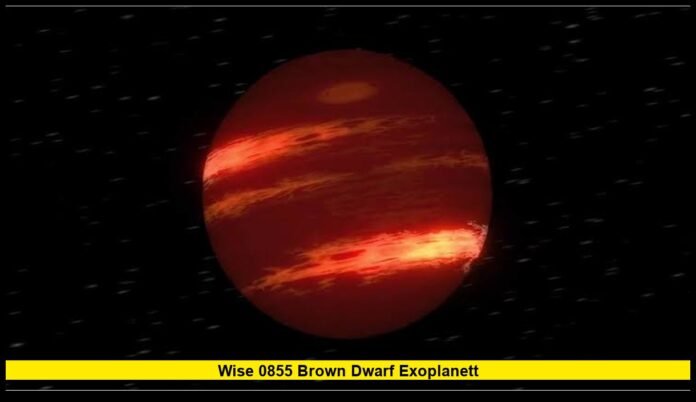

The WISE 0855 brown dwarf exoplanet has become a major focus of astronomical research after new observations revealed changing water clouds and complex atmospheric chemistry on one of the coldest known objects beyond our solar system. Located approximately 7.5 light-years from Earth, WISE 0855-0714 offers scientists a rare opportunity to investigate weather, atmospheric circulation, and chemical processes on a Jupiter-sized world that emits very little light.
In October 2026, researchers announced important findings from observations made with NASA’s James Webb Space Telescope (JWST). The study provides evidence that water clouds in the object’s atmosphere change thickness over time. Astronomers also observed variations in chemical signatures associated with carbon monoxide and phosphine, suggesting that atmospheric activity occurs at different depths.
These findings represent a significant step toward understanding how extremely cold planetary-mass objects function. Although WISE 0855 is often discussed alongside exoplanets because of its planet-like properties, astronomers classify it as a Y-type brown dwarf. It does not have a known host star, making it a particularly valuable target for studying atmospheric processes without the complications associated with a bright nearby star.
What Is WISE 0855-0714?
WISE 0855-0714, officially designated WISE J085510.83−071442.5, is an ultracool brown dwarf discovered in 2014 using observations from NASA’s Wide-field Infrared Survey Explorer and the Spitzer Space Telescope.
Brown dwarfs occupy a category between stars and planets. They can form through processes resembling stellar formation, but they do not have sufficient mass to sustain the hydrogen fusion that powers ordinary stars throughout their main-sequence lifetimes.
WISE 0855 is especially unusual because its temperature and estimated mass place it close to the physical characteristics associated with giant planets.
Its estimated effective temperature is approximately 265 kelvins, although published analyses and atmospheric models produce somewhat different values. Its size is comparable to Jupiter, and its estimated mass is several times Jupiter’s mass.
The object is exceptionally faint at visible wavelengths. Most of the radiation astronomers can study comes from the infrared portion of the electromagnetic spectrum, making specialized telescopes essential for investigating its atmosphere.
Key facts about WISE 0855-0714:
- Classification: Y-type brown dwarf.
- Distance: Approximately 7.5 light-years from Earth.
- Temperature: Approximately 265 kelvins in recent atmospheric analyses.
- Size: Comparable to Jupiter.
- Mass: Estimated to be several times Jupiter’s mass.
- Discovery: 2014.
- Observing instrument: James Webb Space Telescope’s Near-Infrared Spectrograph.
- Major recent finding: Evidence of changing water-cloud thickness and variable atmospheric chemistry.
These characteristics make WISE 0855 one of the most important nearby objects for studying the atmospheric behavior of extremely cold brown dwarfs.
Latest Discovery: Water Clouds Change Over Time
The most significant recent development emerged from research led by astronomer Brittany Miles of the University of Arizona’s Steward Observatory.
The team used JWST to observe WISE 0855 for approximately 11 hours, collecting a new spectrum of its infrared light every 15 minutes. This repeated observing strategy allowed researchers to follow atmospheric changes rather than relying on a single measurement.
The findings, announced by the University of Arizona in October 2026, provide the first direct confirmation that water clouds outside our solar system change thickness over time.
The observations indicate that clouds are distributed unevenly across the object’s atmosphere. As different atmospheric regions move into and out of view, the infrared spectrum changes.
This is important because scientists previously had evidence suggesting that water condensation and clouds could play a role in the atmosphere of WISE 0855. However, determining how those clouds changed over time was considerably more difficult.
The new results provide evidence that atmospheric conditions are dynamic, with cloud thickness changing independently of some of the chemical variations observed deeper within the atmosphere.
Rather than presenting a uniform layer of clouds, WISE 0855 appears to have a more complicated atmospheric structure.
The findings also demonstrate the value of observing cold astronomical objects repeatedly. A single spectrum can reveal which molecules are present, but a time series can help scientists determine how atmospheric features evolve.
How James Webb Detected Atmospheric Changes
JWST is particularly useful for studying WISE 0855 because its infrared instruments can detect radiation from objects that are extremely faint in visible light.
The research team used the telescope’s Near-Infrared Spectrograph, commonly known as NIRSpec. The instrument recorded observations across wavelengths of approximately 2.87 to 5.27 micrometers, with a spectral resolution of around 1,000.
Spectroscopy separates incoming light into its component wavelengths. Different atmospheric molecules absorb radiation at characteristic wavelengths, producing recognizable patterns that researchers can analyze.
By comparing spectra taken at different times, astronomers can identify changes in molecular absorption and the amount of radiation emerging from particular atmospheric layers.
The 2026 observations revealed variations reaching approximately 10% peak to peak at certain wavelengths, with particularly strong changes associated with carbon monoxide absorption.
That figure describes the measured variation in the spectral signal at specific wavelengths. It does not mean the entire atmosphere experienced a 10% change in temperature or that its total chemical composition changed by the same amount.
Researchers combined the measurements with atmospheric models and statistical techniques to investigate the origins of the changing signals.
Their analysis supports a picture in which cloud variations occur at relatively high atmospheric levels, while some chemical changes reflect processes deeper inside the brown dwarf.
Carbon Monoxide and Phosphine Reveal Deeper Atmospheric Activity
Water clouds were not the only important finding. The observations also revealed correlated changes in spectral features associated with carbon monoxide and phosphine.
Carbon monoxide consists of carbon and oxygen, while phosphine is a molecule containing phosphorus and hydrogen. Both compounds can help researchers investigate the chemical conditions and movement of gases within cold atmospheres.
The team used principal component analysis to examine relationships between the changing spectral signals. Their results indicated that variations associated with carbon monoxide and phosphine follow a related pattern.
The findings suggest that atmospheric mixing transports gases from deeper, warmer regions toward higher levels.
This process is closely connected to disequilibrium chemistry, which occurs when chemical reactions and atmospheric transport operate at different rates.
When gases rise through an atmosphere faster than chemical reactions can restore equilibrium, their observed abundances may reflect conditions in deeper regions rather than the local temperature and pressure where they are detected.
Similar processes are known in giant-planet and WISE 0855, WISE 0855-0714, brown dwarf, exoplanet research, James Webb Space Telescope, water clouds, astronomy news, atmospheric chemistry, NASA discoveries, space science,
The new observations provide an opportunity to investigate their changing signatures over time on an exceptionally cold object.
However, the research does not mean that scientists have completely mapped the atmosphere of WISE 0855. More observations and improved models are needed to establish the precise mechanisms responsible for each variation.
Why Water Clouds Matter on Such a Cold World
Water clouds are familiar on Earth, but their formation and behavior in a brown dwarf’s atmosphere can differ substantially from terrestrial weather.
At sufficiently low temperatures, water vapor can condense into ice particles. Whether these particles form persistent clouds depends on the atmospheric temperature profile, pressure, vertical mixing, and the movement of material between different layers.
On WISE 0855, the observed variations suggest that cloud coverage is patchy rather than uniform.
Thicker clouds can change how infrared radiation escapes from the atmosphere. Thinner regions may allow radiation from deeper layers to become more visible. As the object rotates, the combined spectrum changes depending on which regions contribute most strongly to the observed light.
These effects make cloud thickness an important factor in interpreting atmospheric observations.
The latest research also suggests that water-cloud variations and chemical fluctuations are not simply different manifestations of one process. Instead, the evidence points to atmospheric activity operating at multiple depths.
This distinction could help scientists improve models of cloud formation, circulation, and chemical transport on other cold worlds.
Is WISE 0855 an Exoplanet or a Brown Dwarf?
Despite the frequent association between WISE 0855 and exoplanet research, its formal classification is important.
An exoplanet is a planet beyond our solar system. Many confirmed exoplanets orbit stars, although free-floating planetary-mass objects are also studied because they may reveal important information about planetary formation and evolution.
WISE 0855 is classified as a Y-type brown dwarf. It is not known to orbit a star, and there is no confirmed evidence that it was ejected from a planetary system.
Its estimated mass overlaps with the range of some giant planets, but mass alone does not always settle the distinction between planets and brown dwarfs. Formation history and the classification framework also matter.
The object is therefore best described as a free-floating, planetary-mass brown dwarf.
Its atmosphere nevertheless makes it highly relevant to exoplanet science. The physical processes observed on WISE 0855 may help researchers interpret observations of giant planets whose temperatures and atmospheric conditions overlap with those of cold brown dwarfs.
How Cold Is WISE 0855 Compared With Earth?
WISE 0855 has an estimated effective temperature of approximately 265 kelvins in the recent study. That is about minus 8 degrees Fahrenheit? No—the equivalent temperature is approximately minus 8 degrees Celsius, or 18 degrees Fahrenheit.
For context, Earth’s average surface temperature is approximately 15 degrees Celsius, although temperatures vary substantially across the planet.
The comparison should be interpreted carefully. WISE 0855 is not a rocky world with an Earth-like surface. Its effective temperature describes its overall energy emission, while the temperature and pressure of its atmosphere vary with depth.
Its low temperature makes it especially valuable for research because water condensation and other chemical processes become important under conditions that are difficult to study in warmer brown dwarfs.
Despite the presence of water clouds, WISE 0855 is not known to be habitable. Atmospheric water and cloud formation alone do not demonstrate that an object can support life.
What Earlier Research Revealed About WISE 0855
The latest findings build on more than a decade of observations.
Discovery in 2014
WISE 0855 was identified through infrared observations that revealed a nearby, exceptionally cold object moving across the sky. Follow-up observations helped establish its distance and unusual physical properties.
Its proximity makes it an attractive target for detailed atmospheric investigations, although its faintness presents substantial observational challenges.
Early Evidence of Water and Methane
Earlier spectroscopic studies identified molecules including water vapor, methane, ammonia, and carbon monoxide.
These observations established that the object’s atmosphere contains a chemically complex mixture of gases. Researchers also investigated whether water-ice clouds could explain features that were difficult to reproduce with simpler atmospheric models.
However, early studies did not provide a definitive picture of changing cloud thickness. Different combinations of temperature, chemistry, and cloud properties can sometimes produce similar spectral signals.
Additional Findings From JWST
Later observations using JWST’s Mid-Infrared Instrument helped researchers investigate how water abundance changes with atmospheric pressure. A 2025 study also reported the detection of an ammonia isotopologue containing nitrogen-15.
These findings provided additional clues about atmospheric chemistry and the movement of gases through different layers.
In September 2026, another time-resolved JWST analysis examined temperature and chemical variations on WISE 0855. Together, the recent research demonstrates how improved infrared observations are making it possible to examine atmospheric processes in greater detail.
The newest water-cloud results add a time-dependent dimension to this work, allowing scientists to study how the observed atmosphere changes during an observing session.
What Scientists Hope to Discover Next
Future observations could help researchers determine how atmospheric changes develop over longer periods.
One important question concerns the object’s rotation. Repeated observations across multiple observing windows could help establish how quickly atmospheric features move across its visible hemisphere.
Scientists also need to investigate the relationship between cloud formation, temperature changes, and vertical atmospheric circulation.
Another challenge is refining chemical models. The observed correlation between carbon monoxide and phosphine provides evidence of atmospheric transport, but additional measurements are needed to determine how these processes operate at different depths.
Longer observing campaigns could help establish whether the patterns recorded during the 11-hour session persist, repeat, or change over time.
Researchers may also compare WISE 0855 with other brown dwarfs to determine which atmospheric properties are common among cold objects and which are unusual.
These comparisons could improve the interpretation of giant exoplanet atmospheres, particularly when researchers cannot directly resolve clouds or measure atmospheric circulation.
Frequently Asked Questions
What is the latest discovery about WISE 0855?
The latest major findings, announced in October 2026, provide evidence that water clouds on WISE 0855 change thickness over time. Researchers also observed variations in carbon monoxide and phosphine spectral features.
How far away is WISE 0855 from Earth?
WISE 0855 is approximately 7.5 light-years away, making it one of the closest known brown dwarfs.
Does WISE 0855 have water clouds?
Recent JWST observations provide evidence consistent with patchy water clouds whose thickness changes over time.
Is WISE 0855 habitable?
There is no evidence that WISE 0855 supports life. Water clouds and atmospheric chemistry do not establish that an object has habitable conditions.
Why is WISE 0855 important to astronomy?
Its exceptionally cold atmosphere allows researchers to investigate water condensation, chemical transport, and atmospheric variability. These findings can improve models of brown dwarfs and giant planets.
Conclusion
WISE 0855 is providing astronomers with an unusually detailed look at atmospheric weather beyond our solar system. The latest James Webb observations indicate that water clouds change thickness while chemical signatures reveal activity occurring deeper within the atmosphere. These discoveries are helping researchers move beyond static descriptions of distant worlds toward a better understanding of how their atmospheres actually behave.
What do you think about the discovery of changing water clouds on a world 7.5 light-years away? Share your thoughts in the comments and follow the latest astronomy discoveries for more updates.