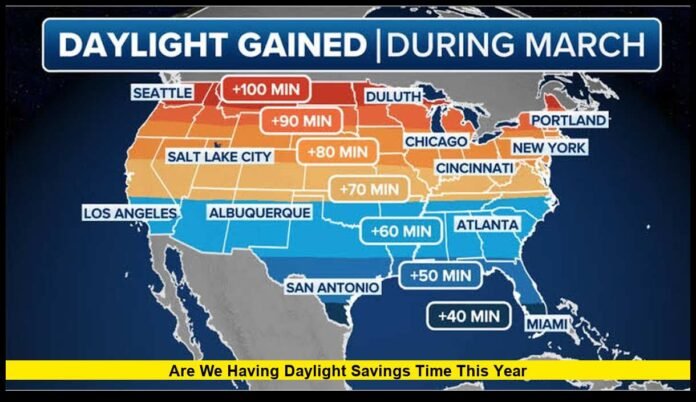

Are we having daylight savings time this year? Yes, most Americans are still following Daylight Saving Time in 2026, and the next clock change is scheduled for Sunday, November 1. People living in states that observe the seasonal adjustment will turn their clocks back one hour, returning to standard time. Although lawmakers have renewed efforts to make Daylight Saving Time permanent, the current federal schedule remains in effect.
The upcoming change means Americans will gain an extra hour on the clock when the local time moves from 2 a.m. back to 1 a.m. The adjustment will affect daily routines, morning commutes, travel plans, and the amount of daylight people experience during evening activities.
The debate over ending seasonal clock changes has also gained attention in Washington. The House of Representatives passed the Sunshine Protection Act in July 2026, but the bill has not become law. As a result, Americans should continue preparing for the November clock change.
When Does Daylight Saving Time End in 2026?
Daylight Saving Time will end on Sunday, November 1, 2026, in most parts of the United States. The change takes place at 2 a.m. local daylight time, when clocks move backward to 1 a.m. local standard time.
This adjustment marks the transition from Daylight Saving Time to standard time for the fall and winter months. People will see earlier sunrises and earlier sunsets according to the clock.
The United States follows a schedule established by federal law. Daylight Saving Time begins on the second Sunday in March and ends on the first Sunday in November.
The important dates are:
| Event | Date | Clock adjustment |
|---|---|---|
| Daylight Saving Time began | March 8, 2026 | Clocks moved forward one hour |
| Daylight Saving Time ends | November 1, 2026 | Clocks move backward one hour |
| Daylight Saving Time begins again | March 14, 2027 | Clocks move forward one hour |
These dates apply to areas that observe Daylight Saving Time. Hawaii, most of Arizona, and several U.S. territories follow different timekeeping rules.
For most Americans, the November adjustment will happen automatically on smartphones, computers, and connected devices. However, traditional clocks, older appliances, and some vehicle displays may require manual changes.
People should check their device settings before the transition, especially if they rely on alarms or appointments scheduled early Sunday morning.
Are Americans Still Changing Their Clocks in November?
Yes. The United States has not eliminated the seasonal clock change nationwide. Most states continue to observe the traditional system, which moves clocks forward in spring and backward in fall.
The possibility of permanent Daylight Saving Time has attracted considerable attention because many Americans would prefer to stop adjusting their clocks twice a year.
However, public support for changing the system does not automatically alter federal law. Congress must complete the necessary legislative process before the country can adopt a different nationwide arrangement.
In July 2026, the House of Representatives passed the Sunshine Protection Act by a vote of 308 to 117. The proposal would establish permanent Daylight Saving Time for participating areas.
The bill subsequently moved to the Senate for consideration. House approval alone did not make the proposal law.
Therefore, Americans should not assume that the November clock change has been canceled. The established schedule remains the one to follow unless legislation changes the rules.
For families, travelers, employees, and business owners, the practical decision is simple: prepare for clocks to move back on November 1.
What Is the Sunshine Protection Act?
The Sunshine Protection Act is legislation intended to make Daylight Saving Time permanent. Its central purpose is to eliminate the regular spring and fall clock changes in areas covered by the law.
Under the existing system, participating states observe Daylight Saving Time during the warmer months. They return to standard time in November and remain there until the following March.
Permanent Daylight Saving Time would remove those seasonal transitions. Clocks would remain on the daylight-saving schedule throughout the year.
Supporters say the change could give Americans more daylight during the evening hours. Later sunsets by the clock could benefit people who exercise outdoors, shop after work, participate in recreational activities, or spend time with family.
Supporters also argue that maintaining one clock schedule throughout the year could simplify planning and reduce the disruption associated with seasonal adjustments.
However, permanent Daylight Saving Time would not create additional sunlight. It would change how daylight aligns with the hours shown on clocks.
During winter, sunrise would occur later according to the clock. This could affect children traveling to school, people commuting before sunrise, and workers who start their shifts early.
The proposal therefore involves a choice between different daylight patterns rather than a way to increase the total amount of daylight available.
For 2026, the key fact remains unchanged: the Sunshine Protection Act has not replaced the current federal schedule.
Why Does the United States Observe Daylight Saving Time?
Daylight Saving Time shifts clocks forward by one hour during part of the year. This arrangement changes the relationship between daylight and people’s daily schedules.
When clocks move forward in March, sunrise and sunset appear later on the clock. This provides more evening daylight compared with standard time.
The change can make it easier for people to enjoy outdoor activities after work or school during spring and summer.
When clocks move backward in November, the United States returns to standard time. Sunrise and sunset then occur earlier according to the displayed clock.
The current schedule follows federal legislation that took effect in 2007. Under the rules, the seasonal adjustment begins on the second Sunday in March and ends on the first Sunday in November.
The system does not apply uniformly to every U.S. location. Certain states and territories remain on standard time throughout the year.
That distinction is important when people discuss nationwide clock changes. Even if Congress changes the federal rules, the final arrangements would depend on the legislation and its application to different jurisdictions.
For now, most Americans should expect the usual November adjustment.
Which States Do Not Observe Daylight Saving Time?
Although most of the country changes its clocks twice a year, some U.S. locations do not participate.
Hawaii does not observe Daylight Saving Time. Most of Arizona also remains on standard time throughout the year.
Arizona has an important exception: the Navajo Nation observes Daylight Saving Time. This means the time displayed in some parts of the state can differ from that in surrounding communities during the months when the seasonal adjustment applies.
Several U.S. territories also remain on standard time throughout the year.
| Location | Observes Daylight Saving Time? |
|---|---|
| Most U.S. states | Yes |
| Hawaii | No |
| Most of Arizona | No |
| Navajo Nation in Arizona | Yes |
| Puerto Rico | No |
| Guam | No |
| American Samoa | No |
| U.S. Virgin Islands | No |
| Northern Mariana Islands | No |
These differences matter for travel, business appointments, remote work, and communication with family members in other parts of the country.
For example, someone traveling from California to Hawaii should not assume that both locations will make the same seasonal clock adjustment.
People should check the time rules for their specific destinations before arranging early-morning calls, booking transportation, or scheduling important appointments.
What Time Should You Change Your Clock on November 1?
In areas that observe Daylight Saving Time, the official fall adjustment occurs at 2 a.m. local daylight time.
At that moment, clocks move backward to 1 a.m. local standard time.
Most people do not need to stay awake to make the adjustment. They can change traditional clocks before going to bed on Saturday, October 31.
A few simple steps can help households prepare:
- Check wall clocks and traditional alarm clocks.
- Adjust appliances that do not update automatically.
- Confirm the time zone settings on smartphones and computers.
- Review early Sunday appointments and travel plans.
- Check vehicle clocks if they do not update automatically.
- Confirm work schedules if an overnight shift crosses the time change.
Modern smartphones and internet-connected computers usually update automatically when their time zone settings are correct.
However, some older electronic devices may not adjust without manual intervention. Checking these devices can prevent missed alarms and scheduling confusion.
Travelers should also verify transportation schedules. Airline departures and arrivals use established local times, and the repeated hour can complicate overnight travel planning.
Do We Gain an Hour or Lose an Hour in November?
Americans in areas that observe the November transition gain one hour on the clock.
When clocks move backward from 2 a.m. to 1 a.m., the hour between 1 a.m. and 2 a.m. repeats. As a result, the local clock records an additional hour during the transition.
The spring change works in the opposite direction. When clocks move forward from 2 a.m. to 3 a.m., the hour between 2 a.m. and 3 a.m. disappears from the local clock.
The easiest way to remember the difference is:
- Spring forward: Clocks move ahead one hour.
- Fall back: Clocks move backward one hour.
The November adjustment does not add sunlight to the day. Instead, it changes how daylight aligns with the clock.
For people who work overnight shifts, the repeated hour can affect scheduling and timekeeping. Employers may need to account for the transition when recording hours worked.
People with early appointments should also confirm the correct local time rather than relying on assumptions about when the change occurs.
How Will the November Clock Change Affect Daily Life?
The November transition changes when daylight appears in relation to ordinary daily schedules.
After clocks move back, sunrise and sunset generally occur about an hour earlier according to the clock than they did before the transition. Many people notice brighter mornings and darker evenings.
These changes can affect commuting, school schedules, outdoor exercise, shopping, and other everyday activities.
Morning Commutes
People who leave home early may experience more daylight during their morning commute after the clocks change.
However, the actual conditions depend on location, weather, and the time of year. Drivers should continue to use appropriate headlights and remain alert in low-light conditions.
Evening Activities
Earlier sunsets can make outdoor activities after work or school more difficult for people who depend on natural light.
Walking, cycling, gardening, and other recreational activities may require earlier scheduling or additional lighting.
Work and School Schedules
The clock adjustment does not automatically change school timetables, office hours, or business appointments.
These schedules generally remain tied to local clock time. However, some people may need a few days to adapt to the changed relationship between daylight and their routines.
Travel and Transportation
Travelers should check the local time at their destinations, especially when moving between states that follow different timekeeping rules.
The November adjustment can also affect overnight travel because the clock repeats an hour. Confirmed departure and arrival times should take priority over assumptions about the time difference.
Is the United States Ending Daylight Saving Time in 2026?
No nationwide end to Daylight Saving Time has taken effect as of October 17, 2026.
The House of Representatives passed the Sunshine Protection Act in July, but that action did not change the existing legal system.
The bill proposes permanent Daylight Saving Time. It must complete the required legislative process before the United States can adopt that arrangement nationwide.
Until a replacement becomes law, the current schedule remains in effect for participating states.
This distinction is important because a proposal can attract political support without becoming law. A bill’s passage through one chamber of Congress does not automatically cancel existing requirements.
For now, Americans should continue to plan around November 1, 2026, as the fall clock-change date.
The next scheduled spring adjustment is March 14, 2027. Unless the legal framework changes, clocks will move forward one hour on that date in areas that observe Daylight Saving Time.
What Would Happen If Permanent Daylight Saving Time Becomes Law?
If the Sunshine Protection Act becomes law in its current form, participating areas would no longer follow the usual spring and fall clock-change schedule.
Instead, they would remain on Daylight Saving Time throughout the year.
This would mean no routine November adjustment and no scheduled March change for areas covered by the new rules.
Supporters believe the arrangement could simplify planning and provide more daylight during evening hours. Families, businesses, and people who enjoy outdoor activities might benefit from later sunsets by the clock.
However, permanent Daylight Saving Time would also affect winter mornings.
In some locations, sunrise would occur later according to the clock. Children heading to school and workers traveling before sunrise could face darker morning conditions.
Permanent standard time offers a different alternative. It would also eliminate seasonal clock changes, but it would generally place daylight earlier in the clock day than permanent Daylight Saving Time would.
The debate therefore concerns which daily schedule works best for Americans, not whether one approach produces more total sunlight.
Any future change would also need to account for states and territories that currently follow different rules.
Until Congress completes the necessary process, these possibilities remain part of the policy debate rather than a description of an implemented nationwide change.
What Should Americans Expect After November 2026?
Under the existing schedule, most of the United States will return to standard time on November 1, 2026.
The next spring transition is scheduled for March 14, 2027. Clocks will move forward one hour again in areas that observe Daylight Saving Time.
These dates provide the basis for planning unless federal law changes.
People should prepare by checking clocks, device settings, appointments, and transportation schedules. Most connected devices will update automatically, but older clocks and appliances may need manual adjustment.
It is also important to distinguish the clock change from the seasonal reduction in daylight. As winter approaches, days become shorter in many parts of the United States. Moving clocks backward changes how daylight appears on the clock, but it does not change the amount of sunlight available on a particular date.
Anyone following the debate over permanent Daylight Saving Time should wait for confirmation that a new law has taken effect before changing future plans.
The current outlook is straightforward: most Americans should prepare to turn their clocks back on November 1, 2026.
Important Points to Remember
- Daylight Saving Time remains in effect in most of the United States during 2026.
- The fall clock change is scheduled for Sunday, November 1.
- Clocks will move backward one hour at 2 a.m. local daylight time.
- Most Americans will gain an hour on the clock during the transition.
- Hawaii and most of Arizona do not observe Daylight Saving Time.
- The Sunshine Protection Act passed the House in July 2026 but has not become law.
- The next scheduled spring clock change is March 14, 2027.
Frequently Asked Questions
Are we having daylight savings time this year in 2026?
Yes. Most U.S. states observe Daylight Saving Time in 2026. The spring clock change occurred on March 8, and the fall adjustment is scheduled for November 1.
When do clocks go back in 2026?
Clocks go back on Sunday, November 1, 2026. In locations that observe Daylight Saving Time, the clock moves from 2 a.m. to 1 a.m. local time.
Do we gain an hour in November 2026?
Yes. People in participating areas gain one hour on the clock because the hour between 1 a.m. and 2 a.m. repeats during the fall transition.
Has Daylight Saving Time been canceled in the United States?
No. The existing seasonal clock-change system remains in place for participating states. Proposed legislation has not replaced the current rules.
Did the Sunshine Protection Act pass in 2026?
Yes. The House of Representatives passed the Sunshine Protection Act on July 14, 2026, by a vote of 308 to 117. However, House approval alone did not make it law.
Which states do not observe Daylight Saving Time?
Hawaii and most of Arizona do not observe Daylight Saving Time. The Navajo Nation in Arizona does observe it. Several U.S. territories also remain on standard time year-round.
Will my phone change its clock automatically in November?
Most smartphones and connected computers update automatically when their date, time, and time zone settings are correct. Traditional clocks and some household devices may require manual adjustment.
When does Daylight Saving Time start again in 2027?
Under the current schedule, Daylight Saving Time begins again on Sunday, March 14, 2027. Clocks will move forward one hour in areas that observe the change.
Why do Americans still change their clocks twice a year?
Federal law establishes the seasonal schedule for participating areas. Although lawmakers continue to debate permanent Daylight Saving Time, the existing rules remain in effect until a replacement becomes law.
Will the November 2026 clock change affect every American?
No. Most Americans will experience the change, but residents of Hawaii, most of Arizona, and U.S. territories that do not observe Daylight Saving Time will not make the seasonal adjustment.
Are you ready for the November 1 clock change, or would you prefer permanent Daylight Saving Time? Share your opinion in the comments and stay informed about confirmed changes to the U.S. clock schedule.