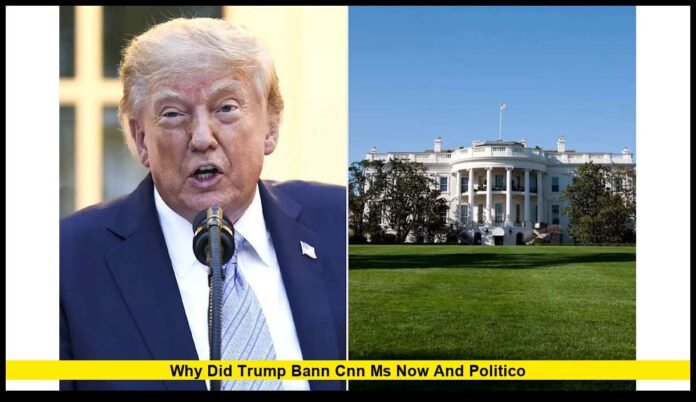

The question why did Trump ban CNN MS NOW and Politico has become a major focus of the latest dispute between the White House and the American news media. President Donald Trump announced that the three organizations would be barred from the White House, accusing them of repeatedly publishing what he described as false or misleading coverage of his administration. The decision was followed by the actual denial of access to reporters from the three outlets the next morning, turning Trump’s announcement into a direct confrontation over White House press access and the limits of presidential authority.
The development is significant because the affected organizations were not merely criticized by the president. Their reporters had their White House access credentials disabled or confiscated. The action immediately raised questions about the First Amendment, press freedom, government transparency and the rules governing journalists who cover the executive branch.
What Trump Announced About CNN, MS NOW and Politico
Trump announced the restrictions on September 18, saying that CNN, MS NOW and Politico were being removed from White House access because of what he characterized as repeated “fake news.”
In his public comments, Trump did not identify one particular article or broadcast as the event that triggered the decision. Instead, he described the action as the result of accumulated coverage over an extended period.
Trump said he was tired of what he considered inaccurate reporting and argued that news organizations should not be able to publish what he described as false stories about the president, his administration or the country.
During remarks at the White House, he also indicated that the restrictions could potentially affect additional news organizations. He specifically mentioned The New York Times and The Washington Post when discussing outlets he considers to be part of the “fake news” media, although he did not announce that those organizations had been banned at that time.
The administration did not initially provide a detailed written explanation outlining the specific reports that supposedly justified the restrictions.
That distinction is important because the White House action was based on a broad criticism of the outlets’ coverage rather than a publicly identified single story.
The Ban Became Real the Following Day
Initially, there was uncertainty about exactly how Trump’s announcement would be implemented.
On Friday afternoon, journalists representing the three organizations were still able to work from the White House complex. By Saturday morning, however, the administration had put the restriction into effect.
CNN White House reporter Betsy Klein was denied access after her press credentials were deactivated. MS NOW White House correspondent Akayla Gardner and a photographer also encountered restrictions. Politico White House reporter Cheyenne Haslett was similarly turned away, with her White House pass confiscated.
The incidents demonstrated that the White House decision was not simply a political statement or criticism of the media.
The reporters could no longer enter the White House grounds using the credentials they had previously been issued.
That created a much broader dispute because White House reporters depend on physical access for presidential events, briefings, interviews, meetings and other government activities.
Akayla Gardner and MS NOW
Akayla Gardner is a Washington, D.C.-based White House correspondent for MS NOW, where she covers the Trump administration, politics, policy and the economy. Before joining MS NOW, Gardner worked at Bloomberg News, reporting on both the Trump and Biden administrations. She also wrote Bloomberg’s weekly Washington Edition: Inside the White House newsletter.
Gardner has extensive experience covering national politics and presidential travel. Her reporting has taken her to multiple continents, including coverage of the G20 summit in India, the Ukraine peace summit in Switzerland and other international trips involving U.S. officials. She also covered the 2024 presidential election across battleground states.
She became the focus of national attention in September 2026 after MS NOW journalists were denied access to the White House. Gardner reported that her White House-issued badge had been disabled when she attempted to enter the complex on September 19. An MS NOW photographer also had his credential taken, according to reports.
Gardner studied at The Ohio State University, where she was active in student journalism and helped establish the university’s chapter of the National Association of Black Journalists.
Cheyenne Haslett and POLITICO
Cheyenne Haslett is a White House reporter for POLITICO, where she covers the Trump administration, presidential politics and developments inside the White House. She has built her journalism career around national politics and has reported on major political events and policy developments in Washington, D.C.
Haslett has experience covering the White House and the political environment surrounding President Donald Trump. Her reporting frequently focuses on presidential activities, administration officials, policy decisions and the political issues shaping the Trump presidency.
She became the focus of national attention in September 2026 after POLITICO journalists were denied access to the White House. Haslett attempted to enter the White House to perform her reporting duties, but her access was denied and her White House press credential was confiscated, according to reports.
The incident occurred after the White House announced restrictions involving journalists from POLITICO, MS NOW and CNN. The move generated broader attention because press credentials provide journalists with access needed to cover the president and administration officials directly.
POLITICO has continued to defend its journalists and its ability to report from the White House. Haslett’s experience has therefore become part of the wider dispute involving the Trump administration and several major news organizations over White House press access.
Her name has appeared prominently in coverage of the controversy because she was among the POLITICO reporters directly affected by the restrictions.
Betsy Klein Denied White House Access
Betsy Klein, a senior White House reporter for CNN, became part of a major media-access dispute on September 19, 2026, after she was denied entry to the White House while reporting on the Trump administration. Her White House press credential had been deactivated, and Secret Service personnel prevented her from entering the complex.
Klein reported the incident on air, explaining that when she arrived to work, she was informed that her press pass was no longer active. According to her account, a Secret Service agent took the credential and did not provide a further explanation, instead directing her to the White House press office.
The action followed President Donald Trump’s announcement that CNN, MS NOW and POLITICO would be barred from the White House. Trump said the outlets had engaged in what he characterized as “fake news” reporting about his administration. The restrictions were subsequently enforced against reporters from all three organizations.
Klein was not the only journalist affected. Akayla Gardner of MS NOW was also denied entry and had her credential confiscated, while Cheyenne Haslett of POLITICO was later turned away and had her White House access pass confiscated.
CNN said it stood behind its journalists and would continue its reporting. The White House access dispute has also prompted discussion among press-freedom and First Amendment experts about government restrictions on journalists covering the presidency.
Trump’s Main Reason: Coverage He Says Is False
Trump’s stated justification centers on his long-running criticism of media organizations that he believes portray his administration negatively.
He has repeatedly used the term “fake news” when criticizing news reports he disputes. In this case, he extended that criticism into an access decision involving three major political and national news organizations.
Trump said the decision was cumulative rather than based on one specific incident. He argued that the organizations had produced numerous reports he considered inaccurate over time.
That means the immediate reason given by the president was dissatisfaction with the content of the outlets’ journalism.
CNN, MS NOW and Politico dispute the characterization of their reporting and have said they will continue covering the administration.
The disagreement therefore involves two fundamentally different positions. The White House argues that it should not be required to provide access to organizations whose reporting it considers dishonest. The affected media organizations argue that government access cannot be conditioned on whether the president approves of their coverage.
Why Politico Received Additional Attention
Politico became part of the dispute for another reason as well.
Trump separately pointed to federal spending on Politico subscriptions during the Biden administration. He cited approximately $8 million in payments for subscriptions and said his administration subsequently canceled them.
That issue is separate from Trump’s broader complaints about CNN and MS NOW.
The reference to Politico’s federal subscriptions added another element to the controversy because it connected the White House’s criticism of the publication to government spending decisions.
However, Trump’s broader explanation for the ban remained focused on the news organizations’ coverage.
How CNN Responded
CNN rejected the justification for the restrictions and said its journalists would continue covering the federal government.
The network said its mission would continue even if reporters were prevented from entering the White House. CNN also maintained that journalists have a constitutional right to report on government activity without interference from government officials.
The network’s response also emphasized that removing physical access does not eliminate the organization’s ability to report.
CNN journalists can continue interviewing lawmakers, administration officials, attorneys, analysts and other sources outside the White House complex. They can also report on public documents, government announcements, congressional activity and other developments.
The practical impact is therefore a reduction in direct White House access rather than an end to coverage of the Trump administration.
MS NOW Also Plans to Continue Reporting
MS NOW, formerly known as MSNBC, also rejected the restriction.
The network said it intended to take steps to defend what it described as its First Amendment rights and the role of independent journalism.
MS NOW correspondent Akayla Gardner described the experience of arriving at the White House and discovering that her credentials had been disabled. The episode was publicly documented as the administration began enforcing Trump’s announcement.
Like CNN, MS NOW can continue reporting from outside the White House.
The restriction nevertheless affects the organization’s ability to participate directly in events that take place inside the complex and may complicate routine White House coverage.
Politico Says It Will Defend Its Reporters
Politico also rejected the decision.
After reporter Cheyenne Haslett was denied access, the organization said it stood behind her and its other journalists covering the White House. Politico also said it would defend its First Amendment rights.
The organization’s position is that political journalism should continue regardless of whether the president approves of its coverage.
That argument places the dispute within a larger constitutional question: whether government officials may exclude journalists from an established press-access system because of disagreement with their reporting.
Why the First Amendment Is Central to the Dispute
The First Amendment protects freedom of speech and freedom of the press.
That does not mean every journalist automatically has unrestricted access to every government facility. The White House has security responsibilities, and presidential events can involve limited-access spaces, security restrictions and controlled press pools.
The legal question is more specific.
When a government creates a system through which journalists receive credentials and access to government facilities, constitutional concerns can arise if particular journalists or news organizations are excluded because officials dislike their viewpoints or reporting.
The White House Correspondents’ Association has argued that the restrictions raise First Amendment concerns. The organization said the issue extends beyond the three affected companies because the same standard could potentially be applied to other news organizations.
Several press-freedom organizations and legal experts have similarly argued that the government’s motive and the structure of the access system will be important if the dispute reaches court.
Previous Trump Conflicts With Journalists
The latest confrontation did not emerge in isolation.
Trump has had repeated disputes with journalists and news organizations during both his first and second terms.
During his first presidency, the White House attempted to suspend CNN correspondent Jim Acosta’s press access following a contentious exchange between Acosta and Trump. CNN challenged the decision, and a federal judge ordered the White House to restore Acosta’s credential.
The Trump administration also fought with the Associated Press over White House access during the current administration. That dispute followed the AP’s decision not to adopt the administration’s preferred terminology for the Gulf of Mexico. The administration subsequently restricted the AP’s access to certain presidential events, and the dispute moved into federal court.
These earlier cases provide important context for understanding the latest confrontation.
They also demonstrate why the question of press credentials can quickly become a constitutional issue rather than simply a disagreement between a president and a journalist.
What the White House Ban Means for Press Access
White House access gives journalists opportunities that cannot always be duplicated from outside the complex.
Reporters inside the White House can attend briefings, observe presidential movements, question administration officials and cover events as they happen.
Removing access can therefore make some aspects of reporting more difficult.
At the same time, the affected organizations can still report on the administration using other sources and public information. Congressional offices, federal agencies, court filings, public statements and interviews with officials outside the White House remain available.
The central question is therefore not whether CNN, MS NOW or Politico can report on Trump at all.
They can.
The question is whether they can be excluded from a government press-access system because the president objects to their coverage.
Trump Has Suggested More Media Restrictions Could Follow
Another important part of the latest development is Trump’s warning that other organizations could face similar treatment.
The president indicated that additional outlets could be added to the restrictions and referred to The New York Times and The Washington Post when discussing organizations he considers to produce unacceptable coverage.
As of the latest update, however, those organizations had not been formally subjected to the same White House ban.
That distinction matters because Trump’s comments about possible future restrictions should not be treated as equivalent to an actual access revocation.
For now, the confirmed action concerns CNN, MS NOW and Politico.
What Could Happen Next?
The dispute could move into the courts if the affected organizations challenge the restrictions.
A legal case could require judges to examine the nature of the White House press-access system, the government’s stated justification and whether the decision was based on protected journalistic viewpoints.
Previous federal court cases involving White House press credentials could become relevant to any new litigation.
The legal outcome cannot be determined in advance, and the precise arguments will depend on how the administration formally implements the restrictions and how the affected organizations challenge them.
The political and media consequences are also likely to continue developing as the White House interacts with other news organizations.
Why This Story Is Bigger Than Three News Organizations
The controversy involves more than CNN, MS NOW and Politico because White House press access affects how Americans receive information about presidential decisions.
The executive branch makes decisions involving foreign policy, national security, immigration, the economy, federal appointments and numerous other issues. Journalists covering the White House serve as intermediaries between those government activities and the public.
When a president restricts access for selected organizations, questions naturally arise about how the government decides which reporters may participate in official press activities.
The White House maintains that it has authority to control access to its facilities. The affected news organizations and press-freedom groups argue that government officials cannot use that authority to punish outlets for unfavorable coverage.
That disagreement is now at the heart of the latest Trump-media confrontation.
The Current Status
As of the latest update, the ban has been enforced against journalists from CNN, MS NOW and Politico.
Reporters from the three organizations were denied entry to the White House, and their credentials were disabled or confiscated. All three organizations have said they intend to continue covering the Trump administration and defending their journalists.
Trump has maintained that the organizations deserve to lose access because of what he considers inaccurate reporting.
The White House has not publicly identified a single report as the specific cause of the decision, with Trump instead describing the action as the result of cumulative coverage.
The constitutional dispute remains unresolved. If the organizations pursue legal action, courts could ultimately be asked to determine whether the administration’s restrictions comply with the First Amendment and other applicable legal protections.
For now, the situation represents a significant escalation in the relationship between the Trump administration and several major news organizations. The immediate issue is access to the White House, but the larger debate concerns how a president, the press and the public interact in a constitutional democracy.