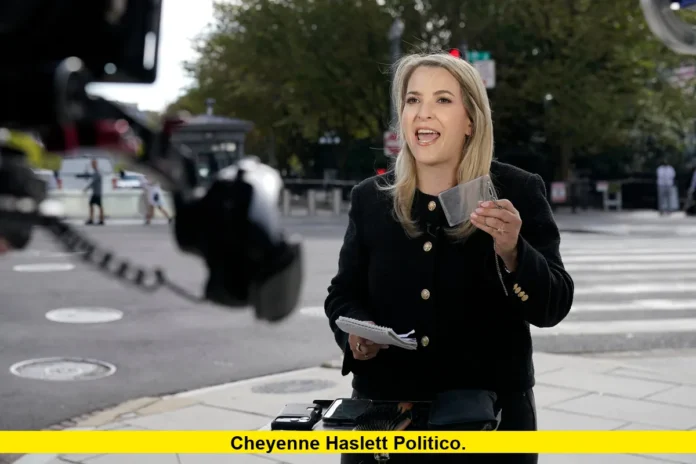

Cheyenne Haslett Politico coverage is drawing renewed attention after the White House denied the POLITICO reporter entry on September 19, 2026, following President Donald Trump’s announcement that CNN, MS NOW and POLITICO would be barred from the White House. Haslett’s press credential was confiscated by the Secret Service after she attempted to enter the White House complex to perform her reporting duties.
The incident quickly became the latest development in the Trump administration’s increasingly contentious relationship with several major news organizations. It also placed Haslett, who covers the White House for POLITICO, at the center of a major national media-access story.
Who Is Cheyenne Haslett?
Cheyenne Haslett is a Washington-based journalist who serves as a White House reporter for POLITICO. Her professional background includes extensive political and policy reporting at ABC News, where she worked as a campaign reporter and producer before moving to POLITICO. Her public professional profile identifies her as a White House reporter covering health and technology.
Haslett’s journalism career began before her move into White House reporting. She studied at the University of Connecticut and graduated in 2017. During her college years, she worked for The Daily Campus, the university’s independent student newspaper. University records also list her as a 2017 political science honors graduate.
Her earlier work at ABC News included reporting on national politics, presidential campaigns and major policy issues. ABC News continues to maintain an author page listing work published under her name, while its press materials have identified her as a campaign reporter and producer.
Haslett later joined POLITICO as a White House reporter. In a professional announcement, she said she had started the new position in October. Her POLITICO role has placed her directly inside the daily reporting operation covering President Trump and his administration.
Why Cheyenne Haslett Is in the News Now
The immediate reason Haslett is receiving widespread attention is the White House access dispute involving POLITICO.
On Friday, September 18, Trump announced that CNN, MS NOW and POLITICO would no longer have access to the White House. He accused the organizations of publishing what he characterized as “fake news.” He did not identify a specific report as the reason for the decision.
Trump also indicated that other news organizations could potentially face similar restrictions. The announcement therefore affected more than the three organizations named in the initial decision because it raised questions about how White House press access would be handled going forward.
The policy was put into practice the following morning.
Haslett attempted to enter the White House complex on Saturday, September 19. POLITICO said the Secret Service denied her entry and confiscated the access pass that allowed her to enter the White House. POLITICO editor-in-chief Jonathan Greenberger publicly said the organization stood behind Haslett and its other reporters covering the administration.
The incident was not limited to POLITICO.
CNN senior White House reporter Betsy Klein and MS NOW White House correspondent Akayla Gardner were also denied access that morning. Their press credentials were disabled or taken as they attempted to enter the complex.
The simultaneous restrictions made Haslett one of three prominent White House reporters directly affected by the administration’s new policy.
What Happened to Haslett’s White House Credential
According to reports from POLITICO and other news organizations, Haslett arrived at the White House on Saturday to carry out her normal reporting responsibilities.
Her access credential did not remain valid under the newly announced restrictions. The Secret Service prevented her from entering and confiscated the pass.
POLITICO subsequently confirmed the incident publicly. Greenberger said Haslett had attempted to enter the White House to do her job as a POLITICO reporter and that the Secret Service denied her entry. He also said the organization would defend its First Amendment rights.
The Associated Press likewise reported that Haslett was denied access and that her badge was confiscated. The AP identified her as POLITICO’s White House reporter in its coverage of the incident.
The development is significant because a White House access credential is central to the day-to-day work of journalists assigned to cover the president. Reporters with access can work from the White House complex, attend qualifying events and gather information directly from officials and other journalists.
Losing physical access therefore changes the practical conditions under which a White House correspondent operates.
POLITICO’s Response to the Ban
POLITICO has defended Haslett and its broader White House reporting operation.
Greenberger said the organization stood by Haslett and all of its reporters covering the White House. He also stated that POLITICO would vigorously defend its First Amendment rights.
That response came after the White House restriction became operational rather than remaining an announcement.
The distinction matters. The administration announced the ban on Friday, but the impact on individual journalists became visible the next morning when reporters attempted to enter the complex and were stopped.
For Haslett, that meant the policy directly affected her ability to report from inside the White House grounds.
Haslett’s Role at POLITICO
Haslett’s current position is broader than simply appearing at White House events.
Her professional profile describes her as a White House reporter covering health and technology. Her reporting background includes national policy, politics and presidential campaigns.
Before joining POLITICO, Haslett built experience at ABC News covering federal policy and political developments. Her earlier reporting included presidential campaign coverage and national political stories.
Her ABC News author page contains numerous articles under her name, demonstrating a substantial body of political reporting before her transition to POLITICO.
Her background also includes early journalism experience at the University of Connecticut. The Daily Campus identifies Haslett as a former staff writer, while university records list her political science honors thesis among the institution’s completed honors work.
This background helps explain why her name is now appearing in national coverage of White House press access. She is not a newcomer to political journalism. She has spent years reporting on presidential politics, federal policy and the White House.
September 19 White House Access Timeline
The sequence of events surrounding Haslett can be summarized clearly:
- September 18, 2026: President Trump announced that CNN, MS NOW and POLITICO would be barred from the White House.
- September 18: Trump described coverage from the outlets as “fake news” but did not identify a particular article that prompted the decision.
- September 19: Reporters from the three organizations arrived at the White House and were denied access.
- September 19: Haslett attempted to enter the complex and was stopped by the Secret Service.
- September 19: POLITICO confirmed that Haslett’s White House access pass had been confiscated.
- September 19: POLITICO said it would defend its First Amendment rights.
- September 20: The access dispute remained a major subject of U.S. political and media coverage.
How the Haslett Incident Fits Into the Larger Press-Access Dispute
The dispute involving Haslett did not occur in isolation.
The Trump administration has previously taken actions affecting press access. During Trump’s first term, CNN reporter Jim Acosta temporarily lost his White House access credential following a confrontation with the president. CNN challenged the action in court, and a judge ordered the credential restored.
The administration also restricted Associated Press access during Trump’s second term after the news organization continued using “Gulf of Mexico” rather than the administration’s preferred “Gulf of America.” That dispute produced separate litigation over White House press access.
The current dispute involving POLITICO, CNN and MS NOW is therefore part of a broader series of conflicts involving presidential access and news organizations.
However, the September 2026 action has its own specific circumstances. The three organizations were named together in Trump’s September 18 announcement, and their reporters were subsequently denied entry the following day.
What POLITICO Has Said About Its Reporting
POLITICO’s response has focused on its ability to continue reporting on the federal government.
The organization has not indicated that the loss of physical access will end its White House coverage. Instead, its public response emphasized support for Haslett and its broader reporting team.
That distinction is important for readers searching for information about Haslett’s current professional status. The available reporting does not indicate that she has left POLITICO or stopped working as a White House reporter.
Her professional profile continues to identify her as a POLITICO White House reporter.
The September 19 incident concerns access to the White House complex, not a reported termination of her employment.
What Happens Next for Cheyenne Haslett?
As of the latest verified reports available on September 20, Haslett remains identified as a POLITICO White House reporter, while the immediate dispute concerns her physical access to the White House.
POLITICO has said it intends to defend its First Amendment rights. CNN and MS NOW have made similar statements after their reporters were denied entry.
The White House has referred questions about the restrictions to Trump’s public comments. No specific news story has been publicly identified as the sole basis for the ban.
That leaves several practical questions unresolved, including how long the restrictions will remain in place and whether affected organizations will pursue legal action.
For now, the confirmed facts are narrower: Haslett was denied entry on September 19, her White House credential was confiscated, POLITICO publicly backed her, and she remains a White House reporter for the organization.
Why Searches for Cheyenne Haslett Are Rising
Search interest around Haslett is closely connected to the September 19 White House incident.
Her name appeared alongside CNN’s Betsy Klein and MS NOW’s Akayla Gardner as the three reporters directly affected by the newly enforced restrictions. News reports and photographs from the White House complex showed the journalists outside the grounds after being denied access.
For readers who previously knew Haslett primarily through her political and policy reporting, the incident has brought her work to wider national attention.
Her career path also explains why her name appears across multiple news databases. She previously worked at ABC News, where she covered national political stories and campaigns, before joining POLITICO’s White House reporting team.
The current controversy is therefore tied directly to her professional role rather than a separate personal development.
Latest Status of Cheyenne Haslett
The latest confirmed information is that Cheyenne Haslett remains a POLITICO White House reporter and was denied access to the White House on September 19, 2026.
Her access pass was confiscated by the Secret Service after she attempted to enter the complex. POLITICO has publicly supported her and said it will defend its First Amendment rights.
There is no verified information in the latest reports indicating that Haslett has resigned from POLITICO, been fired, or ended her White House reporting assignment.
The central issue remains the White House’s decision to restrict access for journalists working for POLITICO, CNN and MS NOW.
Cheyenne Haslett’s name is now closely tied to one of the most closely watched White House press-access disputes of September 2026, and further confirmed developments could shape the next chapter of the story.