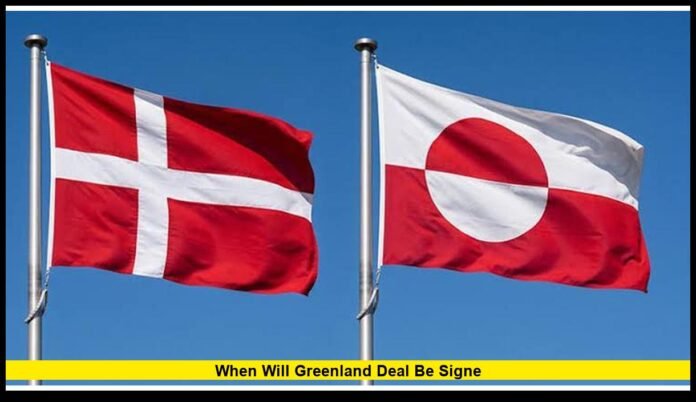

The question when will Greenland deal be signed is becoming clearer after the United States, Denmark and Greenland reached an agreement on a new Arctic security framework. The three governments are preparing to formally sign the agreement in New York during the United Nations General Assembly, with U.S. officials identifying Tuesday, September 22, 2026, as the expected signing date. The agreement is not a transfer of Greenland to the United States, and its implementation will still require additional national procedures.
The development represents a major change in the dispute surrounding Greenland. For much of the year, Washington’s interest in the Arctic island had been associated with proposals for greater U.S. control and repeated arguments that Greenland was essential to American national security. Denmark and Greenland had consistently rejected any suggestion that the territory was available for purchase or unilateral takeover.
The emerging agreement instead centers on defense cooperation, U.S. military access, Arctic security and restrictions on potential adversarial activity.
Greenland Deal Expected to Be Signed in New York
The governments of the United States, Denmark and Greenland announced that they expect to sign the agreement during the UN General Assembly in New York.
Denmark’s government confirmed that the agreement is expected to be signed during the gathering of world leaders. The announcement also made clear that signing will not immediately make the agreement legally effective because further parliamentary procedures are required.
Two U.S. officials separately told CBS News that the signing is expected to take place in New York on Tuesday, September 22, when leaders are gathering for the high-level portion of the General Assembly.
That makes September 22 the key date currently being reported for the formal signing.
However, the distinction between an expected signing date and the agreement’s entry into force is important. The governments have announced the political agreement, but the legal process does not end when representatives put their signatures on the document.
The Deal Is About Security, Not a U.S. Acquisition of Greenland
One of the most important developments is what the agreement does not appear to do.
The arrangement does not transfer ownership of Greenland from Denmark to the United States. Greenland remains within the Kingdom of Denmark, while exercising extensive self-government.
Danish and Greenlandic officials have emphasized that the proposed agreement recognizes the sovereignty and territorial integrity of the Kingdom of Denmark as well as the Greenlandic people’s right to self-determination.
That position contrasts with President Donald Trump’s description of the agreement. Trump said the United States would obtain permanent control over security and other needs in Greenland.
Those descriptions have generated questions about exactly what authority Washington would receive under the final document.
The full legal text has not been broadly published, meaning some of the most important details remain subject to clarification.
What the United States Is Seeking
The central American objective is greater long-term security access to Greenland.
Greenland occupies an exceptionally important geographic position between North America and Europe and close to Arctic routes connecting the Atlantic and Arctic regions. The island is also home to the U.S. Pituffik Space Base, which supports important American defense and space-related missions.
The emerging agreement is expected to strengthen the American military position on the island and provide long-term access and overflight rights. A U.S. State Department official also indicated that the arrangement could allow the United States to expand its military infrastructure in Greenland.
Trump has said his administration would begin developing a larger military presence in Greenland.
The proposed framework therefore appears to address Washington’s strategic concerns without requiring Denmark to surrender sovereignty over the territory.
Why Greenland Is Strategically Important
Greenland’s location has made it an important part of North American and NATO defense planning for decades.
The island lies along potential air and maritime approaches between North America and Europe. Its location also gives the United States an advantageous position for monitoring activity across the Arctic and North Atlantic.
American forces have operated in Greenland for decades. The U.S. military presence dates back to the early Cold War, when Arctic geography became increasingly important to American defense planning.
The existing Pituffik installation demonstrates that Washington already has a substantial security relationship with Greenland.
The proposed agreement could therefore be viewed as an effort to formalize and expand existing arrangements rather than creating a completely new U.S. military relationship with the island.
Some analysts have noted that the precise differences between the new agreement and earlier U.S.-Danish defense arrangements remain unclear because the full text has not yet been publicly released.
Russia and China Are Central to the Security Discussion
Another major element involves countries considered strategic competitors of the United States.
According to U.S. officials, the agreement would prevent non-NATO adversaries from establishing military bases in Greenland and would impose restrictions on sensitive investments by American adversaries.
The provisions are particularly significant because Greenland has attracted international attention for its geographic position and natural resources.
Washington has repeatedly argued that increased Chinese or Russian involvement in the Arctic could create security risks.
Under the proposed agreement, the United States would receive stronger assurances that adversarial powers could not establish military infrastructure on Greenland.
The precise definition of sensitive investments, the enforcement mechanism and the full list of restrictions are among the details that will need to be examined once the final agreement becomes available.
Denmark’s Position on Sovereignty
Denmark’s government has taken care to distinguish the security agreement from the earlier dispute over American acquisition of Greenland.
Prime Minister Mette Frederiksen said the proposed agreement strengthens shared security in the Arctic and North Atlantic while recognizing Denmark’s sovereignty and Greenland’s right to self-determination.
This is a significant part of the political framework.
Greenland is an autonomous territory within the Kingdom of Denmark, and questions about its future status ultimately involve Greenland’s population and its right to self-determination.
The new agreement therefore attempts to address American security concerns while avoiding a transfer of territorial sovereignty.
That distinction could become increasingly important as the agreement moves through the approval process.
Greenland’s Government Also Welcomes the Agreement
Greenland’s Prime Minister Jens-Frederik Nielsen has described the developing agreement as beneficial to Greenland, Denmark and the United States.
His comments have focused on strengthening security while ensuring that Greenland’s interests and its role in international cooperation are recognized.
The Greenlandic government’s participation is particularly notable because Greenland is expected to be a direct party to the new arrangement.
That could make the agreement different from older defense arrangements negotiated primarily between Washington and Copenhagen.
The direct involvement of Greenland could also become important if the territory’s constitutional relationship with Denmark changes in the future.
Signing Does Not Mean the Deal Takes Effect Immediately
A common misunderstanding surrounding the announcement is that the agreement becomes fully operational the moment it is signed.
That is not the case.
Denmark’s government has explicitly said that the agreement will enter into force only after the necessary national parliamentary procedures have been completed.
This creates several stages.
First, the governments must formally sign the agreement.
Second, the appropriate domestic procedures must take place.
Third, the agreement can enter into force once those requirements have been satisfied.
The timeline for the latter stages could therefore extend beyond the expected September signing.
What Could Still Change Before Implementation?
Although the three governments have announced that an agreement has been reached, the absence of a fully public legal text means that some questions remain open.
The most important unresolved issues include the exact scope of American military access, the authority associated with future bases, the treatment of sensitive investments and the procedures for implementing the agreement.
Trump has characterized the arrangement as providing permanent American security authority. Danish and Greenlandic officials, meanwhile, have emphasized sovereignty and self-determination.
Those descriptions are not necessarily mutually exclusive, but they highlight why the final text will matter.
The wording of the agreement will determine how the competing interests are translated into legal obligations.
What Happens to the Existing U.S. Military Base?
The United States already operates Pituffik Space Base in northwestern Greenland.
The facility was established under the long-standing U.S.-Danish defense relationship and remains an important part of America’s Arctic defense infrastructure.
The new agreement is expected to create additional opportunities for American military activity and potentially additional facilities.
A State Department official said the agreement would provide permanent access and overflight rights and could allow the U.S. military to increase its presence.
However, the number, location and size of any future facilities have not been fully disclosed.
That means the eventual military footprint could become clearer only after implementation begins.
How the Agreement Could Affect NATO
The Greenland dispute had become an unusually sensitive issue inside the NATO alliance because Denmark is a NATO member and Greenland is part of the Kingdom of Denmark.
The prospect of confrontation between the United States and Denmark created concerns about the wider alliance relationship.
The new agreement could reduce one source of tension by establishing a formal framework for American security interests in Greenland while maintaining Danish sovereignty.
NATO has welcomed the development, describing greater cooperation in the Arctic as relevant to security and stability in the region.
The practical effect on NATO will depend heavily on how the agreement is implemented and how Washington, Copenhagen and Nuuk interpret their respective responsibilities.
Why September 22 Is the Key Date
September 22 is important because it is the beginning of the high-level UN General Assembly meetings.
With senior American, Danish and Greenlandic officials in New York, the setting provides an opportunity to formalize the agreement publicly.
CBS News reported that two U.S. officials identified Tuesday, September 22, as the expected signing date. Denmark’s official announcement, however, described the timing more generally as the following week during the UN General Assembly.
For that reason, September 22 is best understood as the currently reported target date rather than a completed event.
If the signing proceeds as expected, attention will then shift toward the parliamentary approval process and publication of the final legal provisions.
The Bigger Picture for Greenland
The emerging agreement represents a major shift from the earlier debate over whether the United States could acquire Greenland.
Instead of pursuing a territorial transfer, the governments are moving toward a security arrangement designed to give Washington greater military access and prevent rival powers from establishing a strategic foothold on the island.
For Denmark, the agreement provides a way to cooperate more closely with the United States while maintaining its stated sovereignty over Greenland.
For Greenland, the key issue remains participation in decisions affecting its security and future.
For the United States, the arrangement addresses concerns about Arctic defense, military access and potential strategic competition.
The balance between those interests will ultimately depend on the final wording and implementation of the agreement.
What Readers Should Watch Next
The next major development will be the formal signing in New York.
After that, several issues are likely to receive close attention:
- Release of the full agreement
- Parliamentary procedures in Denmark and Greenland
- The timetable for entry into force
- Plans for additional U.S. military infrastructure
- Rules governing foreign military activity
- Restrictions on sensitive foreign investments
- Greenland’s role in implementing the agreement
- Any additional statements from Washington, Copenhagen or Nuuk
The final legal document will be especially important because public statements from the three governments have emphasized different aspects of the arrangement.
When Will Greenland Deal Be Signed? Latest Answer
For readers searching when will Greenland deal be signed, the latest available information points to Tuesday, September 22, 2026, in New York during the United Nations General Assembly.
The three governments have confirmed that they expect to sign the Arctic security agreement during the UN gathering, while U.S. officials have identified September 22 as the anticipated date.
The agreement is expected to strengthen U.S. military access and security cooperation in Greenland, restrict potential adversarial military activity and sensitive investments, and preserve the sovereignty framework emphasized by Denmark and Greenland.
The signing, however, will not immediately complete the legal process. Denmark has said that the agreement must go through necessary parliamentary procedures before it enters into force.
That makes the upcoming signing an important milestone, but not the final step.
The next phase will depend on the agreement’s actual text, parliamentary procedures and the practical arrangements governing America’s future military presence in Greenland.