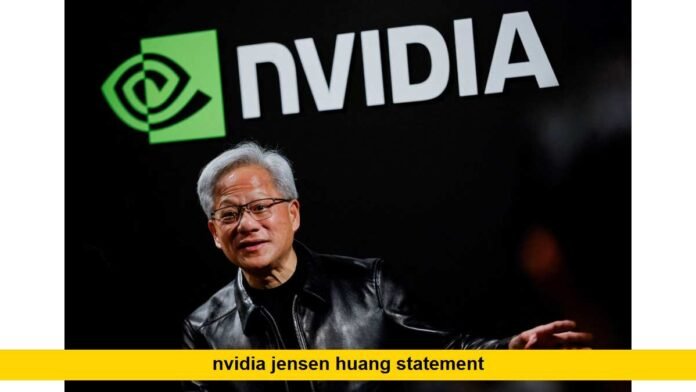

Nvidia is facing an important turning point after co-founder Jensen Huang indicated that he would consider returning to the company’s top leadership position if its board of directors believed his reinstatement would benefit the business. The nvidia jensen huang statement released on November 17, 2026, has renewed attention around the semiconductor giant’s leadership, corporate governance, and future direction as the artificial intelligence industry continues to grow.
Huang’s comments represent his first major public response since leaving Nvidia on November 12. Although he has expressed regret over his personal mistakes and accepted responsibility for the situation, his willingness to return has created another layer of uncertainty surrounding the company’s executive transition.
For a business that has become central to the global AI economy, the leadership question carries consequences extending beyond its boardroom.
Jensen Huang Breaks His Silence Following Nvidia Departure
In his public statement, Huang acknowledged the difficult circumstances surrounding his departure and thanked colleagues, friends, and supporters who had reached out to him and his family.
He described Nvidia as his life’s work and reflected on the experience of building the company with employees and business partners over more than three decades.
Huang also acknowledged that he had failed to meet the company’s standards. He accepted responsibility for his personal mistakes, expressed regret over the problems created for the board, and committed to cooperating with its independent investigation.
One of the most significant parts of his statement concerned the possibility of returning.
Huang indicated that if the board determined his reinstatement would serve shareholders, employees, Nvidia, and the United States, he would be honored to resume the CEO position.
His comments do not constitute a formal request for reinstatement or confirmation of negotiations. Instead, they make clear that he has not completely ruled out returning to the company he helped establish.
Why Nvidia’s Leadership Changed
The leadership crisis developed following reports involving Huang’s personal relationships and concerns about a possible foreign intelligence operation.
The situation attracted attention because Nvidia occupies an important position in the American semiconductor industry. Its advanced processors are used in artificial intelligence development, scientific research, cloud computing, and other strategically important technologies.
The company’s board initiated an independent investigation after concerns emerged in public reporting.
Huang subsequently announced an apology to his family and acknowledged personal misconduct. Nvidia later confirmed his immediate resignation as president and CEO, along with his departure from the board.
The company has not publicly established that Nvidia technology or confidential information was compromised. Allegations and national security questions should not be treated as proven findings while the investigation remains ongoing.
The circumstances nevertheless created a serious governance challenge for the company.
Colette Kress Takes Charge During the Transition
Following Huang’s departure, Nvidia appointed Colette Kress as interim chief executive officer.
Kress is not a new figure within the organization. She joined Nvidia in September 2013 and has spent more than a decade overseeing its financial operations.
She previously held senior finance positions at Cisco and Microsoft, bringing substantial experience in technology-sector management.
Her appointment provides continuity during a period when Nvidia needs to maintain relationships with major customers, suppliers, investors, and international partners.
Kress will continue serving as Nvidia’s chief financial officer while performing her interim CEO responsibilities.
The board has indicated that it will consider both internal and external candidates when selecting a permanent chief executive.
This approach leaves the company’s long-term leadership structure unresolved, although the existing management team is expected to continue executing its business strategy.
Nvidia Board Faces an Important Decision
Huang’s willingness to return does not automatically mean Nvidia’s directors will reconsider their decision.
Reports indicated that the board was not considering reinstating him as of November 16. The company has already initiated its search for a permanent replacement, making the possibility of a leadership reversal uncertain.
Directors must consider several competing priorities.
First, they have a responsibility to protect shareholders and maintain effective corporate governance. Any decision involving Huang’s return would need to account for the circumstances surrounding his departure.
Second, Nvidia must preserve operational stability. Its customers depend on reliable access to advanced computing products, while major technology companies are making long-term investments based on its product development plans.
Third, the investigation must be allowed to proceed independently. A leadership decision made without considering relevant findings could create additional problems for the company.
The board therefore faces a decision involving both business performance and executive accountability.
Why Jensen Huang’s Possible Return Matters to the AI Industry
Huang’s influence extends far beyond Nvidia’s headquarters.
Since co-founding the company in 1993, he has overseen its transformation from a graphics processor manufacturer into a major provider of accelerated computing and AI infrastructure.
Nvidia’s graphics processing units have become essential components in many modern AI systems. Technology companies use its processors to train advanced models, operate AI applications, and support increasingly complex computing workloads.
Its CUDA software platform has also helped establish a broad development ecosystem around Nvidia hardware.
This combination of processors, networking technology, and software has strengthened the company’s competitive position.
Huang’s departure consequently raises questions about whether Nvidia can maintain its strategic direction without the executive who has guided much of its development.
However, the company’s technological success also reflects the work of its engineers, researchers, management teams, manufacturing partners, and customers.
A leadership transition does not automatically mean that Nvidia’s competitive position will weaken.
Investors Watch Nvidia’s Financial Performance
The leadership developments are taking place during an important period for Nvidia shareholders.
The company is scheduled to report its third-quarter fiscal 2027 financial results on November 17, with investors paying close attention to demand for AI processors and data center infrastructure.
Nvidia previously projected quarterly revenue of approximately $108 billion, plus or minus 2%.
That guidance reflects the scale of demand the company has been experiencing as major technology businesses increase spending on artificial intelligence infrastructure.
Investors will be monitoring several financial indicators:
- Data center revenue and demand for AI computing products.
- Gross margins and operating profitability.
- Sales expectations for upcoming product platforms.
- Supply chain capacity and manufacturing availability.
- International sales and export restrictions.
- Management’s outlook for future AI infrastructure spending.
The leadership situation adds another consideration to the investment outlook.
Shareholders will want confidence that Nvidia can maintain its financial momentum while addressing questions about executive accountability and corporate oversight.
What Happens If Huang Does Not Return?
If Nvidia’s board continues with its existing succession process, the company will eventually need a permanent chief executive capable of managing its next stage of development.
Colette Kress remains an important candidate to consider because of her experience with the company’s financial operations and internal structure.
However, the board has not limited its search to existing executives.
An external appointment could introduce a different management approach, while an internal candidate might provide greater continuity with Nvidia’s established business strategy.
Regardless of the outcome, the next CEO will face considerable responsibilities.
These include maintaining Nvidia’s technological leadership, managing relationships with major AI companies, responding to international regulatory developments, and navigating increasing competition in the semiconductor market.
The company will also need to demonstrate that its governance practices are sufficiently strong to protect its long-term interests.
Nvidia’s Next Chapter Remains Uncertain
The latest developments have placed Nvidia at an unusual crossroads. Huang has expressed openness to returning, but the board has already moved forward with a leadership transition and an independent investigation.
His statement provides insight into his willingness to reconsider his departure, not confirmation that he will regain control of the company.
Meanwhile, Kress and Nvidia’s management team must continue operating a business that plays a significant role in the development of artificial intelligence worldwide.
The coming leadership decisions will help determine how the company balances its founder’s legacy with the need for accountability, stability, and effective governance.
For investors, customers, and the broader technology industry, Nvidia’s ability to maintain its business momentum may ultimately matter more than whether its former CEO returns.
For now, the possibility remains open from Huang’s perspective, but the decision belongs to Nvidia’s board of directors.