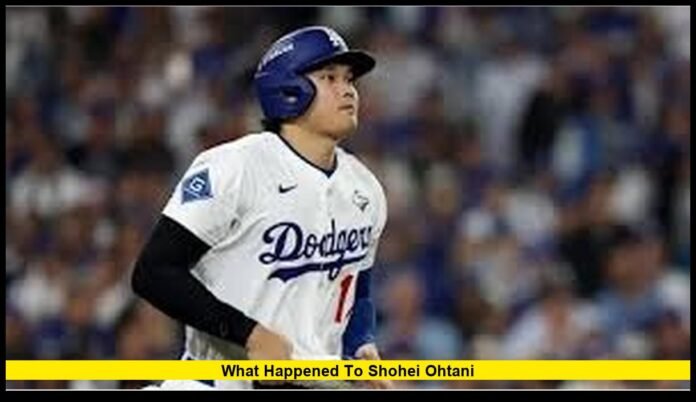

Few names in baseball — or all of sports — carry the weight and wonder of Shohei Ohtani. The Los Angeles Dodgers’ global icon, a player whose very existence has redefined what’s possible in Major League Baseball, has spent years dazzling fans with his ability to dominate both as a pitcher and as a hitter. But recently, the question echoing across the baseball world has been: what happened to Shohei Ohtani?
After a breathtaking season that saw him lead the Dodgers to the 2025 World Series, Ohtani’s year ended in a rare stumble. His performance in Game 7 against the Toronto Blue Jays — a game that saw him chased from the mound early — left fans stunned and analysts debating whether the immense demands of his two-way role finally caught up to him. Yet beneath the surface, Ohtani’s story is one of resilience, evolution, and the continued challenge of balancing baseball immortality with human limits.
A Game 7 That Shocked the Baseball World
On November 1, 2025, the world tuned in to watch Shohei Ohtani do what only he could: start as the Dodgers’ Game 7 pitcher while also batting in the lineup. It was supposed to be the perfect ending to a near-perfect season. Instead, it became one of the few nights when the superstar looked human.
Ohtani lasted just 2⅓ innings, giving up three earned runs on five hits, including a momentum-shifting three-run homer to Toronto’s Bo Bichette in the third inning. The Dodgers, hoping to ride Ohtani’s brilliance to victory, were suddenly forced to turn to their bullpen earlier than anyone expected.
Despite flashing his trademark 100 mph fastball, Ohtani’s control wasn’t sharp. His slider flattened, his splitter hung, and his usually flawless command wavered under the weight of fatigue and short rest. Manager Dave Roberts pulled him after just 52 pitches, ending Ohtani’s night far sooner than fans had imagined.
Still, even amid the disappointment, Ohtani made history. His second-inning single marked the first hit by a Game 7 starting pitcher in a World Series since 1982 — another reminder that even on a difficult night, his talent shines in ways no other player can replicate.
A Season for the Ages
To truly understand what happened to Shohei Ohtani, one must first appreciate what he accomplished during the 2025 season. It wasn’t just remarkable — it was unprecedented.
Ohtani became the centerpiece of the Dodgers’ historic year, carrying them to a 109-win regular season while producing at elite levels on both sides of the ball. His statistics border on the unbelievable:
| Category | Stat (2025) |
|---|---|
| Batting Average | .313 |
| Home Runs | 54 |
| RBI | 122 |
| OPS | 1.067 |
| ERA | 2.89 |
| Strikeouts | 214 |
| Innings Pitched | 176 |
At the plate, Ohtani crushed opposing pitchers with a combination of power and discipline that few have ever possessed. On the mound, he remained one of the most dominant strikeout artists in baseball, baffling hitters with his electric arsenal of fastballs, sliders, and splitters.
But the very thing that makes Ohtani special — his ability to excel as both a pitcher and hitter — also presents unique challenges. No other athlete in modern history has shouldered this kind of physical and mental workload. By October, the strain was evident.
Fatigue and the High Cost of Greatness
The Dodgers made the controversial decision to start Ohtani in Game 7 on just three days’ rest. For most pitchers, such a move would be risky; for Ohtani, who also plays nearly every day as a hitter, it was even more demanding.
Baseball fans have long marveled at Ohtani’s endurance, but every athlete has a limit. His mechanics appeared slightly off, and his command — usually pinpoint — showed signs of fatigue. Despite his competitive fire, Ohtani simply didn’t have his usual dominance on the mound.
Still, critics were quick to note that his “bad” outing would be considered decent for most pitchers. Allowing three runs in barely three innings under World Series pressure isn’t a collapse; it’s a sign of how impossibly high expectations have become for a player who often defies logic.
Behind the scenes, Dodgers coaches admitted the decision to start Ohtani was a difficult one. Roberts later told reporters, “Shohei wanted the ball. He always does. That’s who he is. But he’s human, too. The man gave us everything all year long.”
What Makes Shohei Ohtani Different
What makes Shohei Ohtani so captivating isn’t just his numbers — it’s his mentality. Few athletes in any sport match his work ethic, discipline, and humility.
Ohtani’s routine is the stuff of legend. Teammates say he arrives hours before anyone else, meticulously stretching, reviewing video, and perfecting every aspect of his mechanics. He balances two completely different training regimens — one for pitching, one for hitting — with military-like precision.
Even after tough outings like Game 7, Ohtani remains calm and composed. Speaking through his interpreter after the loss, he said, “It’s disappointing, of course. But baseball gives us moments to grow. I’ll learn from this one.”
Those words reflect what has made him a global inspiration: his constant pursuit of improvement, no matter how high he’s already climbed.
Dodgers Players and Fans Rally Behind Him
The Dodgers’ clubhouse rallied around Ohtani after Game 7, refusing to let one rough start define his season. Teammate Mookie Betts summed it up best: “We wouldn’t even be here without Shohei. He’s the reason we’re in this position.”
Fans echoed that sentiment. Within hours of the game’s end, social media flooded with messages of support under hashtags like #WeBelieveInShohei and #OhtaniStrong. Many praised his courage for taking the mound on short rest and applauded his leadership throughout the season.
At Dodger Stadium, murals and fan tributes began appearing almost immediately — visual reminders that Ohtani remains one of the most beloved figures in modern sports.
Even baseball legends weighed in. Former MLB star Albert Pujols said, “Every great player has a moment like this. It’s what makes you stronger. Ohtani’s story isn’t about one game — it’s about changing baseball forever.”
Health and the Future of the Two-Way Role
Ohtani’s performance also reignited debate about the future of the two-way player model in MLB. Some analysts wonder whether the physical strain is sustainable long-term.
For context, Ohtani has already endured significant injuries in his career — including elbow surgery earlier in his MLB tenure. The Dodgers have been cautious, implementing advanced recovery and conditioning programs to help him balance both roles.
Still, the Game 7 outing served as a reminder that even Ohtani’s superhuman talent requires careful management. Expect the Dodgers to re-evaluate his schedule for 2026, possibly spacing out pitching starts or giving him more DH-only days to maintain endurance deep into the postseason.
Roberts confirmed that the organization plans to “find smarter ways to utilize” Ohtani’s abilities without compromising his health. Fans can rest assured, though — there’s no sign of him stepping away from pitching or hitting anytime soon.
The Human Side of Baseball’s Brightest Star
For all his fame and talent, Shohei Ohtani remains remarkably grounded. His humility and dedication have endeared him to teammates, coaches, and fans worldwide.
In interviews, he rarely talks about his records or achievements. Instead, he focuses on teamwork, preparation, and gratitude for the opportunity to play the game he loves. That authenticity has made him a rare figure — not just an athlete, but a role model who represents the best of sportsmanship.
Game 7 didn’t tarnish Ohtani’s reputation; if anything, it humanized him. It reminded fans that even the greatest athletes experience setbacks. It also showed the kind of character that has defined his entire career: accountability, composure, and an unshakeable commitment to improvement.
What Happened to Shohei Ohtani: A Turning Point, Not a Fall
So, what happened to Shohei Ohtani? He faced fatigue. He struggled under the crushing weight of expectations. And he lost one game — but he didn’t lose himself.
Ohtani’s 2025 season remains one of the greatest ever recorded. His influence stretches far beyond box scores; he’s inspiring a new generation of players to dream bigger, train harder, and believe that limitations can be rewritten.
As the 2026 season approaches, the Dodgers’ superstar will no doubt return sharper, wiser, and hungrier. The lessons learned from this World Series — about balance, endurance, and vulnerability — will only fuel his next chapter.
When future generations look back, Game 7 won’t define Shohei Ohtani’s legacy. It will stand as a moment that tested him, refined him, and reminded the world why his story is unlike any other in the history of baseball.
Shohei Ohtani’s greatness isn’t about perfection — it’s about persistence. Even after the toughest nights, he remains the player every fan wants to watch and every team dreams of having.
How do you think the Dodgers should manage Shohei Ohtani’s two-way role next season? Share your thoughts below and join the conversation.