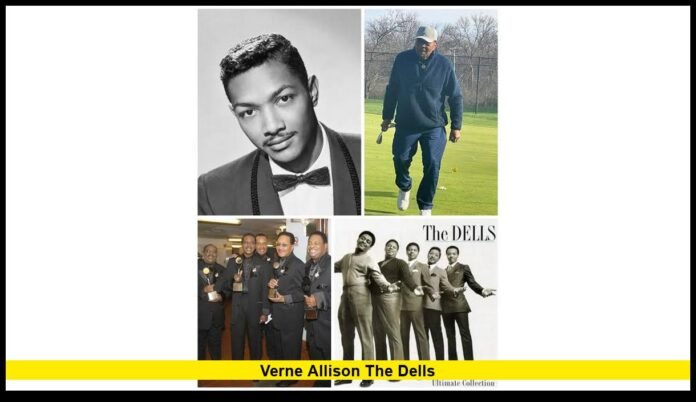

Verne Allison The Dells is drawing renewed attention after the death of Verne Allison, an original member of the influential Chicago vocal group, at age 90. Allison died on October 7, 2026, after a career that remained closely connected to The Dells for more than half a century.
As a second tenor, Allison helped create the layered vocal sound that became one of The Dells’ trademarks. His career began during the rise of doo-wop and continued through the development of soul and rhythm and blues.
His story is inseparable from the history of one of America’s most enduring vocal groups.
Who Was Verne Allison?
Verne Allison was born June 22, 1936, in Chicago, Illinois. He became involved in music while growing up in the Chicago area and eventually joined several other young singers from Thornton Township High School in Harvey, Illinois.
The singers formed the foundation of what would become The Dells.
Allison served as a second tenor, contributing harmony rather than functioning primarily as the group’s lead vocalist. That role was central to the group’s distinctive sound.
The Dells built their reputation around carefully blended voices. Each singer had an individual role, but the overall impact came from how those voices worked together.
Allison remained connected to that vocal identity throughout the group’s extraordinary career.
The Formation of The Dells
The roots of The Dells date to the early 1950s in Harvey, Illinois.
Allison performed alongside singers including Marvin Junior, Johnny Funches, Chuck Barksdale and Michael McGill. Lucius McGill was also involved during the group’s early formation.
The original ensemble performed under the name El-Rays.
The young singers developed their style through harmony singing and live performances. Their early music reflected the doo-wop movement that was becoming increasingly popular across the United States.
Their first recording opportunity came in 1954 with “Darling I Know.”
The release did not immediately make them major stars, but it established the group as a professional recording act and provided a foundation for what came next.
The group subsequently adopted the name The Dells.
The Breakthrough With “Oh, What a Night”
The Dells reached a major milestone in 1956 with “Oh, What a Night.”
The recording became a major R&B success and helped establish the group nationally. It eventually became one of the best-known songs associated with The Dells.
The success was important because it gave the young singers a much larger platform.
For Allison, it was part of the beginning of an unusually long professional journey.
The song would later return to prominence when The Dells recorded a new version years afterward. That recording again performed strongly, proving that the group’s appeal had survived changing musical trends.
A Difficult Period After the 1958 Accident
The Dells’ progress was interrupted by a serious automobile accident in 1958.
Michael McGill suffered severe injuries, forcing the group to stop performing for a period. The incident represented one of the most difficult moments in the group’s early history.
Rather than ending their career, the setback was followed by a reunion.
The group eventually returned to music around 1960. Johnny Carter joined after Johnny Funches left the lineup.
Allison remained part of the ensemble during this important rebuilding period.
The comeback demonstrated the determination that would become one of the defining characteristics of The Dells.
From Doo-Wop to Soul
The American music scene changed rapidly during the 1960s.
Doo-wop began giving way to soul, and vocal groups had to adapt to remain commercially successful. The Dells proved particularly effective at making that transition.
Their harmonies remained recognizable, but their arrangements became more sophisticated.
The group recorded a series of successful songs, including “There Is,” “Wear It on My Face,” “Always Together” and “Stay in My Corner.”
“Stay in My Corner” became one of the group’s signature achievements. It reached No. 1 on the R&B chart and also became a Top 10 pop hit.
That success showed that The Dells could compete with newer soul acts while retaining the vocal techniques that had defined their earliest recordings.
Allison’s Contribution to The Dells
Allison’s career was built around ensemble performance.
As second tenor, he helped fill the middle and upper portions of the group’s vocal arrangements. His contribution may not always have received the same attention as the group’s most prominent lead performances, but it was essential to the overall blend.
The Dells’ music depended heavily on harmony.
Their arrangements required singers to maintain precise timing and pitch while supporting the lead. Allison’s long tenure meant that his voice became part of the group’s established identity.
He was also involved in the group’s creative work, with members contributing to songwriting and the development of their repertoire.
That combination of performing and creative participation helped make The Dells more than a collection of hired vocalists.
The Dells’ Long Run of Success
The Dells achieved an extraordinary level of longevity.
Their music reached audiences during several different eras of American popular culture. The group began recording during the 1950s and continued producing important material decades later.
Their catalog included R&B hits as well as songs that reached mainstream pop listeners.
Among the group’s notable recordings were:
- “Oh, What a Night”
- “Stay in My Corner”
- “There Is”
- “Wear It on My Face”
- “Always Together”
- “Give Your Baby a Standing Ovation”
- “A Heart Is a House for Love”
The group repeatedly demonstrated that vocal harmony could remain commercially relevant even as musical styles changed.
The Importance of “A Heart Is a House for Love”
One of The Dells’ later successes came with “A Heart Is a House for Love.”
The recording was associated with the soundtrack to the 1991 film “The Five Heartbeats,” which explored the fictional story of a male vocal group.
The film introduced many younger viewers to the traditions of classic R&B vocal groups.
The Dells’ connection to the movie added another dimension to their cultural legacy. Their music was no longer confined to listeners who had followed the group since the 1950s.
A new generation encountered the group’s sound through film and popular culture.
The Dells Receive Major Honors
The group’s achievements eventually earned recognition from major music institutions.
The Dells were inducted into the Rock & Roll Hall of Fame in 2004.
They also entered the Vocal Group Hall of Fame that same year.
The honors recognized a career that had already lasted for decades and highlighted the group’s importance to American vocal music.
For Allison, the recognition was significant because he was part of the original group and had remained associated with it through its long evolution.
The honors also confirmed The Dells’ place among the influential vocal groups that shaped R&B and soul.
Six Decades of Musical History
Very few vocal groups maintained their identity for as long as The Dells.
Allison’s association with the group began during the 1950s and continued for roughly six decades.
During that time, American music changed dramatically.
The group experienced the transition from early rock and roll and doo-wop into soul, funk and later forms of R&B. New recording technologies and changing audience preferences also transformed the music business.
Yet The Dells continued to draw on the strength of their vocal arrangements.
Allison’s longevity within the group was therefore particularly notable.
He remained part of a musical partnership that survived personnel changes, shifting trends and the challenges faced by many older vocal groups.
The Final Years of The Dells
The Dells continued performing well into the 21st century.
By the early 2010s, health concerns affecting longtime members contributed to the end of the group’s performing era.
The group ultimately completed a run that lasted approximately 60 years.
That achievement placed The Dells among the longest-lasting vocal groups in American popular music.
For Allison, the conclusion of the group’s performing career marked the end of an extraordinary professional chapter, but the recordings continued to preserve the group’s work.
A Family Connection to Music
Allison’s musical legacy also continued through his family.
His son, Verne “VA” Allison, has pursued a career involving singing, songwriting, production and multiple instruments.
The family connection provides another example of how musical knowledge and artistic traditions can continue from one generation to the next.
For fans of The Dells, it also offers a personal connection to the legacy of one of the group’s founding voices.
What Made The Dells Different?
The Dells’ longevity was not based on a single hit.
Their success came from their ability to evolve while protecting the vocal identity that made them recognizable.
They could perform traditional harmony-based material while also embracing modern soul arrangements.
That flexibility helped them remain relevant across multiple generations.
The group’s history also reflects the importance of Chicago to American R&B. The city produced numerous influential artists and groups, and The Dells became one of its most respected vocal exports.
Allison’s career represents an important part of that story.
Verne Allison’s Place in R&B History
Allison’s contribution should be viewed within the larger development of American vocal music.
He belonged to a generation of singers who helped transform street-corner harmony into professional recording careers.
The Dells demonstrated that vocal-group music could survive beyond the initial doo-wop boom.
Their recordings showed how layered harmonies could work within increasingly sophisticated soul arrangements.
Allison was part of that transformation from the beginning.
His decades with The Dells also gave him a rare perspective on the evolution of American music.
Verne Allison The Dells: Key Facts
| Detail | Information |
|---|---|
| Full name | Verne Allison |
| Date of birth | June 22, 1936 |
| Birthplace | Chicago, Illinois |
| Profession | Singer and vocalist |
| Vocal role | Second tenor |
| Group | The Dells |
| Early group name | El-Rays |
| Group origins | Harvey, Illinois |
| First recording | “Darling I Know” |
| Breakthrough song | “Oh, What a Night” |
| Rock & Roll Hall of Fame induction | 2004 |
| Vocal Group Hall of Fame induction | 2004 |
| Final performing era | Around 2012 |
| Date of death | October 7, 2026 |
| Age at death | 90 |
Remembering Verne Allison
Verne Allison’s death marks the loss of an original member of a group that helped shape American R&B.
His career was unusual not only because of its length but also because of its consistency. He remained connected to The Dells through an era when the music industry experienced enormous change.
From the group’s earliest days as the El-Rays to its later Hall of Fame recognition, Allison was part of the journey.
His second-tenor contribution helped create the vocal texture that distinguished The Dells from countless other groups.
The group’s recordings remain available to listeners, ensuring that Allison’s work continues to be heard.
For fans discovering The Dells for the first time, his story provides a window into the dedication required to sustain a musical partnership for generations.
For longtime listeners, his passing serves as a reminder of how much American music history was created by artists whose voices worked together rather than alone.
Verne Allison helped build the sound of The Dells from the beginning, and his six-decade contribution remains an enduring part of America’s R&B and soul heritage.