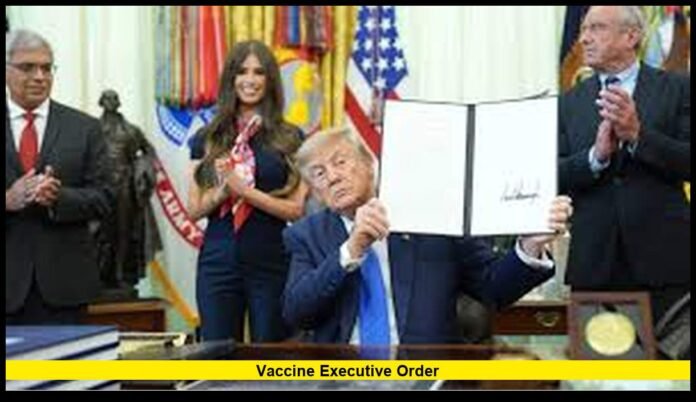

The vaccine executive order signed by President Donald Trump on August 10, 2026, calls for significant changes to U.S. childhood immunization recommendations, including a narrower group of vaccines recommended for all children and a new approach to administering measles, mumps and rubella vaccines. The order also directs federal health officials to pursue additional vaccine research and develop plans affecting how childhood shots are given.
The action is the latest development in the Trump administration’s effort to change federal vaccine policy. It follows an earlier executive order from May that instructed federal health officials to realign core childhood vaccine recommendations with practices in other developed countries.
The White House described the latest action as a move toward what it calls “gold standard” childhood vaccine recommendations. The order places greater emphasis on individualized medical decisions and changes the federal framework for determining which vaccines should be routinely recommended to all children.
What the Latest Vaccine Executive Order Changes
President Trump signed the order at the White House on Monday, August 10. The action focuses on federal recommendations rather than directly creating a nationwide vaccination requirement for children.
One of the most notable changes involves the number of childhood vaccines considered part of the core recommendations.
The administration is moving toward a system in which 11 vaccines are recommended for all children. Other vaccines will instead fall under risk-based recommendations or shared clinical decision-making.
That represents a substantial change from the broader federal recommendations used previously.
The new approach does not mean that vaccines outside the core group disappear. Instead, their use can depend more heavily on an individual child’s circumstances and discussions between parents and health professionals.
The order also calls for changes in how vaccines are administered.
The administration wants childhood vaccines to be given during separate medical visits rather than routinely administering multiple vaccines during the same appointment.
The MMR vaccine has become the clearest example of this policy.
MMR Vaccine at the Center of the New Policy
The combined measles, mumps and rubella vaccine has been a major focus of the administration’s latest action.
MMR protects children against three separate infectious diseases. Under the new policy direction, federal officials are being instructed to pursue individual vaccines for measles, mumps and rubella rather than relying on the combined MMR product.
The order also calls for the individual vaccines to be administered during separate medical visits.
That would represent a major change from the established use of the combined MMR vaccine in the United States.
Individual measles, mumps and rubella vaccines are not currently available as routine separate products in the U.S. The executive order therefore directs federal officials to work toward making those options available.
The administration’s position is that separating vaccines would provide parents with additional choices.
Medical organizations have strongly challenged that approach. They have raised concerns that requiring multiple appointments could make vaccination more difficult for families and could create delays in completing immunization.
The issue has received particular attention because measles cases have risen sharply in the United States during 2026.
The 11 Core Childhood Vaccines
The administration has identified 11 diseases for which childhood vaccination remains part of the core federal recommendation.
They include:
- Measles
- Mumps
- Rubella
- Polio
- Diphtheria
- Tetanus
- Pertussis
- Haemophilus influenzae type b
- Pneumococcal disease
- Human papillomavirus
- Varicella
The policy separates these vaccines from others that had previously been part of broader routine recommendations.
The distinction is important for parents. A vaccine being outside the core group does not necessarily mean that a child should not receive it.
Instead, the federal framework increasingly uses categories based on individual risk and clinical discussions.
The administration has specifically moved vaccines involving hepatitis B, influenza and COVID-19 away from a universal recommendation for every child.
Other vaccines are also being evaluated through risk-based or shared-decision approaches.
What Shared Clinical Decision-Making Means
The term “shared clinical decision-making” has become increasingly important in the new federal vaccine framework.
Under this approach, vaccination is not automatically treated as a universal recommendation for every child in the same way.
Instead, parents and healthcare professionals consider factors that may affect an individual child’s risk.
Those factors can include age, medical circumstances, exposure risks and other relevant considerations.
The concept gives physicians and families a greater role in determining whether a particular vaccine is appropriate.
However, it also means that families may receive different recommendations depending on their circumstances.
The federal government is therefore moving away from a single broad recommendation structure toward a more divided system.
Hepatitis B, Influenza and COVID-19 Recommendations
The treatment of several vaccines has attracted particular attention.
Hepatitis B vaccination is no longer included among the vaccines recommended universally for every child under the administration’s revised framework.
Influenza vaccination has also moved away from universal childhood recommendation.
COVID-19 vaccination is likewise outside the core group.
These changes do not mean the vaccines have been banned or removed from medical care.
Instead, the federal recommendation framework determines how they are categorized.
Parents can still discuss these vaccines with healthcare providers, especially when a child has circumstances that could increase the risk of infection or complications.
The distinction between availability and recommendation is therefore essential when interpreting the new policy.
The Order Does Not Automatically Rewrite State Vaccine Laws
One of the most important issues for American families is the difference between federal recommendations and state requirements.
The federal government can establish recommendations for vaccination through its health agencies. States, however, retain significant authority over requirements involving school attendance and other settings.
A presidential executive order does not automatically eliminate every state vaccination requirement.
That means parents should not assume that the new federal policy immediately changes the list of vaccines required by their local school district.
State laws continue to play a major role.
Requirements can also vary from one state to another. Some states have broader requirements, while others provide different exemptions or rules.
For families trying to determine what their children need before the new school year, state health departments and schools remain important sources of information.
Why the Timing of the Order Matters
The new policy comes during a serious measles outbreak in the United States.
Measles is highly contagious and can spread quickly among people without immunity.
The country has experienced a major increase in measles cases during 2026. The number of reported cases has already exceeded the total recorded during the previous year.
That makes the administration’s decision to restructure MMR recommendations particularly significant.
The MMR vaccine protects against measles, mumps and rubella through a combined product that has been part of routine childhood immunization for decades.
The administration’s plan to separate those components has therefore generated intense debate among doctors and public-health organizations.
Critics argue that requiring separate appointments could increase logistical barriers.
Parents may have to arrange additional visits, take more time away from work and manage additional opportunities for missed appointments.
Supporters of the administration’s approach argue that families should have more control over how vaccines are administered.
Read More – List of Joe Biden Executive Orders (2021–2025): Complete Guide, Policies, and Impact
Medical Groups Challenge the Changes
Major medical organizations have pushed back against the administration’s revised approach.
The American Academy of Pediatrics continues to support established childhood vaccination practices and has not adopted the administration’s new framework as its preferred approach.
Medical professionals have also questioned the decision to separate the MMR vaccine.
Their concerns focus heavily on practical consequences.
A combined vaccine allows children to receive protection against three diseases through a single product. Separating the components could require additional visits.
Doctors also worry that additional appointments can create more opportunities for delays.
This concern becomes more important when families already experience difficulty accessing pediatric healthcare.
Transportation, work schedules, appointment availability and insurance issues can all affect whether children receive vaccines on time.
Sen. Bill Cassidy Opposes the Policy
The new policy has also produced criticism from Republican Sen. Bill Cassidy of Louisiana.
Cassidy is a physician and has publicly challenged the administration’s vaccine changes.
He has argued that vaccination decisions should be guided by medical professionals and evidence rather than presidential directives.
Cassidy’s opposition is notable because the criticism comes from within Trump’s own party.
His response highlights the broader political debate over the appropriate role of the White House in federal vaccination policy.
The disagreement is not limited to one political party. Medical professionals, public-health organizations and lawmakers have expressed different views about the changes.
The Role of Robert F. Kennedy Jr.
Health and Human Services Secretary Robert F. Kennedy Jr. has been a central figure in the administration’s vaccine policy.
Kennedy has supported a broader reassessment of childhood vaccination recommendations and has repeatedly called for additional vaccine research.
The August executive order gives HHS significant responsibilities in carrying out the administration’s new direction.
The department must develop plans related to vaccine administration, research and the availability of individual vaccines.
HHS is also responsible for working within federal law as the administration implements the new recommendations.
The latest action therefore does not complete every part of the policy immediately.
Instead, it directs federal agencies to undertake additional work.
The May Executive Order Set the Stage
The August action follows an executive order signed by Trump in May 2026.
That earlier order directed the federal government to realign U.S. core childhood vaccine recommendations with practices in other developed countries.
It instructed the Centers for Disease Control and Prevention and its vaccine advisory process to review federal childhood recommendations.
The May order established the policy direction that preceded the latest changes.
The August action goes further by formally outlining the administration’s new framework and directing additional steps involving the childhood vaccine schedule.
Together, the two actions represent a continuing effort to restructure federal vaccine recommendations.
Vaccine Safety and Autism Claims
The latest vaccine debate also includes renewed discussion about vaccine safety and autism.
Trump and Kennedy have questioned the relationship between childhood vaccines and autism.
However, the August order does not establish new scientific evidence proving that vaccines cause autism.
The administration has called for more research into vaccine safety and childhood health.
That research directive is separate from establishing a scientific conclusion.
Vaccine safety is evaluated through clinical studies, surveillance systems and ongoing research. Claims about vaccine risks require scientific evidence rather than political declarations.
The autism issue has become one of the most controversial parts of the administration’s broader vaccine agenda.
What Parents Need to Know Now
For parents, the most important point is that the August 10 executive order does not mean every child’s vaccination schedule changes overnight.
The order directs federal agencies to implement a new policy framework.
Federal recommendations can influence healthcare practice, insurance coverage and public-health policy, but state requirements remain a separate matter.
Parents should therefore consider several factors when evaluating their child’s vaccination status:
- Current state requirements
- School or daycare rules
- The child’s medical history
- Recommendations from the child’s healthcare provider
- The federal recommendations currently in effect
- Any applicable risk-based vaccination guidance
Families should not assume that a federal policy announcement automatically changes their state’s requirements.
The practical impact can vary depending on where a child lives and which healthcare system the family uses.
What Happens Next
Federal health officials now have to carry out the directives contained in the executive order.
That includes developing plans for individual measles, mumps and rubella vaccines and examining how separate vaccination visits could work.
Federal agencies also face the task of implementing the revised recommendation structure.
The administration’s approach is likely to remain an important issue for healthcare providers and families throughout the remainder of 2026.
Legal and administrative questions also remain relevant because federal vaccine recommendations operate within a broader system of federal and state authority.
The order can direct executive-branch agencies, but it does not automatically give the president power to rewrite every state vaccination law.
Why the New Policy Is Significant
The latest action represents one of the most consequential changes to federal childhood vaccine policy under the Trump administration.
The government is moving from a broad universal recommendation structure toward a smaller core group combined with risk-based and shared-decision categories.
At the same time, the administration is seeking to change how vaccines are administered.
The proposed separation of the MMR vaccine is especially significant because it would require a different approach from the one routinely used in the United States.
The changes are also occurring during a period of elevated measles activity, adding urgency to the national debate.
For parents, doctors and state officials, the key issue will be how the new federal recommendations interact with existing medical practices and state requirements.
Bottom Line
President Trump’s August 10 executive order marks a major new step in the administration’s effort to reshape childhood vaccine recommendations in the United States. It calls for 11 vaccines to remain in the core group for all children while moving several others toward risk-based or shared clinical decision-making.
The order also directs federal officials to pursue separate measles, mumps and rubella vaccines and promote separate medical visits for childhood shots.
The policy does not automatically eliminate state vaccination requirements or make vaccines outside the core group unavailable. Its implementation will depend on federal agency action, healthcare practices and the laws governing vaccination in individual states.
What do you think about the latest changes to U.S. childhood vaccine recommendations? Share your thoughts in the comments and stay informed as the policy develops.