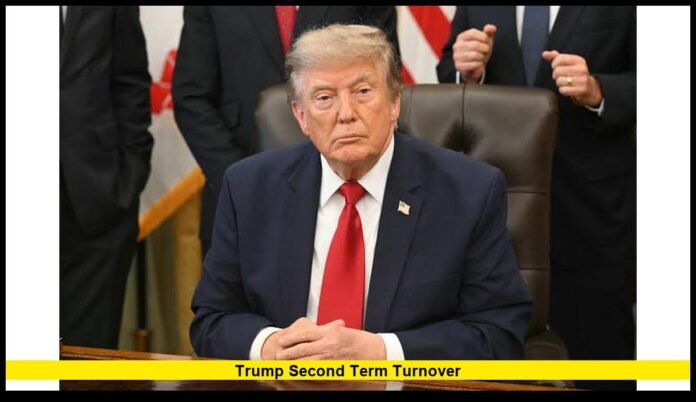

The pace of trump second term turnover has become one of the defining political stories of President Donald Trump’s current administration. Since returning to the White House in January 2025, Trump has overseen a series of leadership changes involving Cabinet officials, senior advisers, and heads of major federal agencies. While every administration experiences staffing transitions, the number of departures during Trump’s second term has attracted significant attention across Washington and beyond.
Personnel changes influence how government departments function, how policies are carried out, and how quickly new priorities move from the White House into federal agencies. By mid-2026, independent tracking of executive branch appointments shows that Trump’s administration has experienced one of the fastest rates of turnover among Senate-confirmed officials during the opening stage of a modern presidency.
For political observers, lawmakers, and voters, these developments offer insight into how the administration is evolving as it advances its policy agenda.
Why Presidential Turnover Matters
Every new administration begins with hundreds of political appointments. Presidents select Cabinet secretaries, deputy secretaries, agency administrators, ambassadors, White House advisers, and numerous other senior officials to help lead the executive branch.
Over time, many of these officials leave office. Some resign voluntarily, while others retire, accept new roles, or are replaced by the president.
Leadership turnover matters because these officials oversee some of the nation’s largest institutions. Their responsibilities include managing federal employees, enforcing laws, developing regulations, implementing executive policies, and responding to national challenges.
When experienced officials depart, administrations must quickly identify successors to maintain continuity and avoid delays in decision-making.
Although turnover is expected in every presidency, unusually frequent changes often become a subject of national political discussion.
The Beginning of Trump’s Second Administration
Donald Trump returned to office in January 2025 after winning a second, non-consecutive presidential term. Entering the White House with previous presidential experience, his administration moved quickly to implement campaign priorities across immigration, trade, border security, energy production, economic policy, and federal workforce reform.
Many early appointments reflected that experience. Several officials had served during Trump’s first administration, while others came from Congress, state governments, conservative policy organizations, the private sector, or military service.
Because many appointees already understood Trump’s governing style, some analysts initially expected greater stability than during his first term.
Instead, the administration gradually experienced a growing number of departures across multiple agencies during its first eighteen months.
Trump Second Term Turnover Has Become a Defining Trend
By July 2026, the number of Senate-confirmed officials leaving office had surpassed the pace recorded during the comparable period of Trump’s first presidency.
Independent trackers monitoring executive branch appointments reported that approximately twenty-seven Senate-confirmed officials had exited their positions during the administration’s first eighteen months.
That level of turnover exceeded comparable periods under several recent presidents.
The departures have not been concentrated within one department. Instead, they have occurred across numerous agencies responsible for domestic policy, economic management, law enforcement, veterans’ services, national security, and public administration.
Political scientists often evaluate administrations by examining leadership stability, average tenure of senior officials, and the speed with which vacancies are filled. On several of those measures, Trump’s current administration has generated substantial attention.
Which Departments Have Seen Leadership Changes?
Staffing transitions have affected multiple Cabinet departments and executive agencies.
Departments experiencing notable leadership changes include:
- Department of Homeland Security
- Department of Justice
- Department of Labor
- Department of Veterans Affairs
- Department of Energy
- Department of Health and Human Services
- Department of the Treasury
In addition to Cabinet agencies, changes have occurred within the Executive Office of the President, where senior advisers, communications officials, and policy coordinators have also departed or shifted responsibilities.
Because each department manages different national priorities, leadership transitions can influence the pace of policy implementation.
Cabinet Secretaries Play a Critical Role
Cabinet secretaries serve as the president’s principal advisers while managing large federal organizations.
Each secretary oversees thousands—or in some cases hundreds of thousands—of employees responsible for carrying out federal programs.
When a Cabinet secretary leaves office, the administration typically follows one of two paths.
A permanent replacement may be nominated and confirmed by the Senate, or an acting official may temporarily lead the department until confirmation is completed.
Some transitions occur relatively quickly, while others require months depending on the Senate confirmation process.
Even during periods of transition, departments continue their daily operations under career civil servants and interim leadership.
White House Personnel Continue to Change
Beyond Cabinet departments, staffing changes inside the White House remain an important aspect of the administration.
Senior advisers influence nearly every major presidential decision.
Their responsibilities include:
- Legislative strategy
- Speech preparation
- Communications
- National security coordination
- Domestic policy development
- Economic planning
- Political outreach
As presidential priorities evolve, administrations frequently reorganize responsibilities among senior advisers.
Some officials move into different roles inside government, while others leave public service altogether.
Because advisers work directly with the president, changes inside the West Wing often receive significant media attention.
Read More – Trump Cabinet Members: Who Serves in Donald Trump’s Administration in 2026?
The Growing Use of Acting Officials
One of the most discussed aspects of trump second term turnover is the increased reliance on acting officials.
Federal law allows qualified government officials to temporarily perform the duties of vacant leadership positions.
Acting leaders help agencies continue functioning while permanent nominees undergo Senate confirmation.
Supporters argue that acting appointments provide flexibility and allow presidents to maintain momentum when vacancies arise.
Critics counter that extended reliance on acting officials may reduce long-term planning and limit congressional oversight because acting leaders have not completed the Senate confirmation process for those specific positions.
Several agencies have operated under acting leadership during portions of Trump’s second term while permanent nominations remained pending.
Reasons Officials Leave Office
Every personnel departure has its own circumstances.
Officials may leave government for professional, personal, or administrative reasons.
Common factors include:
- Retirement
- Family considerations
- Career opportunities
- Presidential leadership decisions
- Organizational restructuring
- Policy disagreements
- Completion of assigned objectives
In some situations, officials publicly announce their resignations months in advance.
In others, departures occur with little notice following administrative changes or presidential decisions.
Because each case is unique, it is not accurate to attribute every departure to a single cause.
Comparing the First and Second Trump Administrations
Trump’s first administration became widely known for frequent personnel changes, particularly among senior White House advisers.
The second administration began with expectations that prior governing experience would create greater organizational stability.
Many returning officials were already familiar with Trump’s policy priorities, management style, and decision-making process.
Despite those expectations, turnover accelerated during the first year and a half of the second presidency.
By mid-2026, the administration had recorded more Senate-confirmed departures during the comparable period than Trump’s first term.
That comparison has become one of the central themes in discussions about executive branch management.
How Turnover Affects Government Operations
Federal agencies are designed to continue operating regardless of political leadership changes.
Career civil servants remain responsible for carrying out many day-to-day functions, ensuring continuity across administrations.
Nevertheless, leadership transitions can influence agencies in several ways.
Potential effects include:
- Delays in launching new initiatives
- Changes in policy priorities
- Organizational restructuring
- Shifts in regulatory strategy
- New management approaches
- Revised operational goals
The practical impact often depends on how quickly replacements assume office and whether policy direction changes under new leadership.
Some transitions occur smoothly with minimal disruption.
Others require additional time as incoming officials review existing programs and establish new priorities.
Senate Confirmation Remains an Important Process
Many senior executive branch positions require Senate confirmation before officials can permanently assume office.
Confirmation hearings provide lawmakers an opportunity to examine nominees’ qualifications, policy views, management experience, and plans for leading federal agencies.
The process also allows senators to question nominees about issues affecting their departments.
When confirmations move quickly, agencies regain permanent leadership sooner.
If the process takes longer, acting officials may continue leading departments until votes occur.
As vacancies arise during Trump’s second administration, the Senate continues considering nominations for several important positions.
Political Reactions to Staffing Changes
Leadership turnover naturally generates different political interpretations.
Supporters of President Trump often argue that personnel changes allow the administration to better align agencies with presidential priorities and improve implementation of campaign commitments.
Critics argue that frequent departures can complicate long-term planning and reduce institutional stability.
Government management specialists generally focus less on political arguments and more on measurable indicators, including vacancy rates, leadership tenure, confirmation timelines, and administrative continuity.
These indicators help researchers compare different presidential administrations over time.
Public Interest Continues to Grow
The American public follows staffing changes because federal officials oversee policies that affect everyday life.
Leadership transitions can influence decisions involving:
- Border security
- Immigration enforcement
- Tax administration
- Veterans’ services
- Healthcare programs
- Energy development
- Economic regulation
- National security
- Labor policy
Although career employees maintain government operations, senior political leaders establish priorities and direct major initiatives.
As a result, changes at the top often receive widespread public attention.
Latest Developments in 2026
As of July 2026, leadership transitions continue across several areas of the executive branch.
Independent analyses still show that Trump’s administration has experienced one of the highest rates of Senate-confirmed official departures during the opening eighteen months of a modern presidency.
Several departments remain under temporary leadership while permanent nominees move through the Senate confirmation process.
The White House continues announcing nominations and personnel decisions as vacancies arise.
At this time, there has been no official indication that the administration plans to significantly change its overall staffing strategy.
Personnel decisions remain an ongoing part of the administration’s efforts to manage federal departments and implement its policy agenda.
Looking Ahead
Personnel turnover is an unavoidable part of governing, but the pace and scale of leadership changes often shape public perceptions of an administration.
The story of trump second term turnover reflects more than a list of resignations or appointments. It highlights how presidential administrations adapt to changing priorities, respond to policy challenges, and reorganize leadership over time.
Whether future staffing changes slow or continue at the current pace will become clearer as the administration moves deeper into its second term. New nominations, Senate confirmations, and additional appointments will continue influencing the operation of federal agencies and the implementation of national policy.
For Americans following developments in Washington, leadership transitions remain an important measure of how the executive branch functions during one of the most closely watched presidencies in recent history.
Stay informed as the administration continues to evolve, and share your perspective on how leadership changes shape the direction of the federal government.