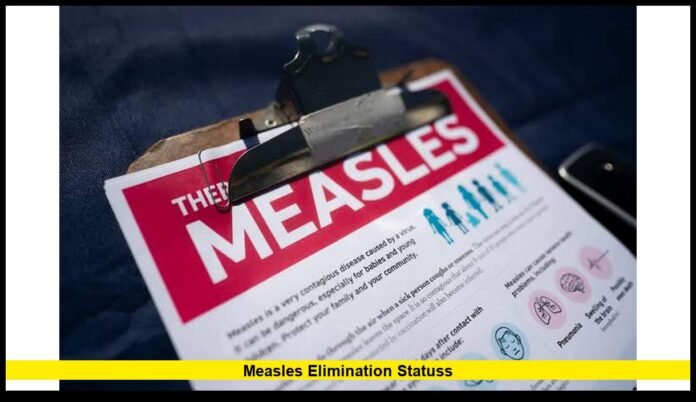

The measles elimination status of the United States has become a major public health concern following the country’s loss of its official measles-free designation in November 2026. After more than two decades without continuous domestic transmission, the highly contagious virus has become re-established, creating a significant challenge for federal health authorities, state governments, and healthcare professionals.
The Pan American Health Organization (PAHO) announced on November 17, 2026, that the United States, Mexico, and Bolivia had lost their national measles elimination status. The decision followed evidence that the same measles virus genotype and lineage had circulated continuously within each country for at least 12 months.
The announcement represents a serious reversal for the United States, which achieved measles elimination in 2000 through extensive vaccination programs, disease monitoring, and coordinated public health initiatives.
The latest figures underline the scale of the problem. The Centers for Disease Control and Prevention (CDC) reported 5,412 confirmed measles cases in the United States during 2026 as of November 12. Across the Americas, more than 58,000 confirmed infections and 82 deaths had been reported by November 13.
Although the loss of elimination recognition does not mean every American community is experiencing an outbreak, it demonstrates that the virus has regained a sustained presence in the country. Health authorities are now focusing on closing vaccination gaps, improving disease detection, and interrupting transmission.
Key Points Summary
╔════════════════════════════════════════════════════════════════════╗
║ – The United States lost its measles elimination designation on November 17, 2026. ║
║ – The country had maintained measles elimination status since 2000. ║
║ – The CDC reported 5,412 confirmed measles cases in 2026 as of November 12. ║
║ – Mexico and Bolivia also lost their elimination designations in November 2026. ║
║ – Canada previously lost its status in November 2025 following prolonged transmission. ║
║ – The Americas reported 58,213 confirmed cases and 82 deaths as of November 13, 2026. ║
║ – MMR vaccination, stronger surveillance, and rapid outbreak control are central to restoring elimination. ║
╚════════════════════════════════════════════════════════════════════╝
Why Did the United States Lose Its Measles-Free Status?
The decision followed an assessment by PAHO’s Measles, Rubella and Congenital Rubella Syndrome Elimination Regional Monitoring and Re-Verification Commission.
The commission met between November 10 and November 13, 2026, to evaluate the epidemiological situation across the Americas. Its assessment determined that endemic measles transmission had become re-established in the United States, Mexico, and Bolivia.
Under the applicable international criteria, a country loses its measles elimination designation when the same virus genotype and lineage circulate uninterrupted for at least 12 months.
In the United States, the transmission chain began on January 20, 2025, and continued beyond the required period.
This distinction matters because eliminating measles does not mean that a country will never report another infection. Imported cases can still occur when travelers become infected abroad. A country can retain its elimination designation if it successfully prevents those imported infections from developing into sustained domestic transmission.
The latest decision confirms that the United States did not interrupt the transmission chain within the required timeframe.
Consequently, the country has lost a public health achievement that represented more than 26 years of progress against a highly contagious disease.
How Many Measles Cases Have Been Reported in 2026?
The United States has experienced a substantial increase in measles infections during 2026.
According to CDC figures updated on November 13, the country had recorded 5,412 confirmed cases as of November 12. Of these, 5,394 were reported by 47 jurisdictions, while another 18 involved international visitors.
The CDC also reported 43 new outbreaks during 2026. Approximately 96% of all confirmed infections were associated with outbreaks, including outbreaks that began in 2025 and continued into the following year.
The figures represent a considerable increase compared with previous years.
| Year | Confirmed U.S. measles cases |
|---|---|
| 2024 | 285 |
| 2025 | 2,289 |
| 2026 | 5,412 as of November 12 |
The increase is especially concerning because measles had become relatively uncommon in the United States following widespread childhood immunization.
The 2026 total already exceeds the number reported throughout 2025 by a substantial margin.
These figures also show why public health officials are concerned about transmission continuing across multiple jurisdictions. Even when individual outbreaks are contained, other communities can remain vulnerable if vaccination coverage is insufficient.
The CDC continues updating its national surveillance information as additional confirmed infections are reported.
Which Other Countries Have Lost Measles Elimination Status?
The United States is part of a broader regional measles resurgence affecting several countries.
PAHO confirmed that Mexico and Bolivia also lost their national elimination designations on November 17, 2026.
Canada experienced a similar setback in November 2025 after prolonged transmission following an outbreak that began in October 2024.
These developments have affected the wider Americas region, which had regained its measles elimination designation in 2024 after interrupting endemic transmission in Brazil and Venezuela.
However, Canada’s loss of status in 2025 resulted in the loss of the regional designation.
The latest developments involving the United States, Mexico, and Bolivia have made efforts to restore elimination more challenging.
The current situation can be summarized as follows:
| Country | Latest elimination development |
|---|---|
| United States | Lost national status in November 2026 |
| Mexico | Lost national status in November 2026 |
| Bolivia | Lost national status in November 2026 |
| Canada | Lost national status in November 2025 |
Despite these setbacks, PAHO has emphasized that the situation can be reversed.
Countries can regain recognition by interrupting endemic transmission, strengthening vaccination programs, and demonstrating through reliable surveillance that the virus is no longer circulating continuously.
Measles Outbreak Across the Americas Reaches Concerning Levels
The resurgence is not limited to the United States.
PAHO reported 58,213 confirmed measles cases and 82 deaths across the Americas as of November 13, 2026. During the corresponding period in 2025, the region had recorded 12,806 confirmed infections.
The substantial increase highlights the growing difficulty of controlling measles when multiple countries experience outbreaks simultaneously.
International travel can contribute to the spread of infections, particularly when people travel between areas with different vaccination coverage levels.
The problem becomes more serious when infected individuals enter communities where many residents have not received the recommended vaccine doses.
PAHO has called for stronger cooperation among national governments, public health agencies, laboratories, and healthcare providers.
Its recommendations include identifying communities with low immunity, conducting regular searches for suspected infections, improving laboratory testing, and responding quickly when outbreaks emerge.
The organization also stresses that national vaccination averages can conceal significant differences between individual communities.
A country might report relatively high overall vaccination coverage while certain counties, neighborhoods, or population groups remain insufficiently protected.
What Is Causing the Increase in Measles Infections?
Several factors have contributed to the recent increase in measles cases.
One of the most important concerns is declining vaccination coverage among children.
The CDC has reported that MMR vaccination coverage among U.S. kindergartners declined from 95.2% during the 2019–2020 school year to 92.7% during the 2023–2024 school year.
This decline has left more children vulnerable to infection.
The consequences can be particularly serious when vaccination gaps are concentrated within particular communities.
1. Declining Childhood Vaccination Rates
Routine childhood immunization is one of the strongest protections against measles.
When children miss recommended vaccine doses, the number of susceptible individuals increases. If the virus enters a community with insufficient immunity, infections can spread rapidly.
2. Vaccine Hesitancy and Misinformation
Conflicting information about vaccines has contributed to uncertainty among some families.
Public health professionals continue encouraging parents to discuss vaccine safety, effectiveness, and individual medical circumstances with qualified healthcare providers.
3. International Travel
People can become infected while traveling abroad and bring measles into the United States.
Imported infections are not automatically evidence of endemic transmission. However, they can trigger domestic outbreaks when exposed individuals are not adequately protected.
4. Uneven Access to Immunization
Some families experience difficulties obtaining routine healthcare services because of transportation problems, financial barriers, limited clinic availability, or disruptions in medical care.
Improving access to vaccination services remains an important part of outbreak prevention.
5. Delayed Identification of Infections
Early identification is essential for preventing additional infections.
When suspected cases are not recognized quickly, infected individuals may expose other people at schools, healthcare facilities, workplaces, and public gatherings.
Why Is the MMR Vaccine Essential for Preventing Measles?
The measles, mumps, and rubella vaccine, commonly called the MMR vaccine, remains the most effective protection against measles.
Two doses provide approximately 97% protection against the disease, while one dose provides approximately 93% protection.
The CDC generally recommends that children receive their first dose between 12 and 15 months of age and their second dose between 4 and 6 years of age.
Adults without evidence of immunity may also need vaccination, depending on their medical history, occupation, travel plans, and individual risk factors.
Maintaining at least 95% coverage with both recommended doses in every community is an important public health target.
This level of protection helps reduce the likelihood that an infected person will trigger a large outbreak.
Vaccination also protects people who cannot receive certain vaccines for medical reasons and infants who are too young for their first routine dose.
Families who are uncertain about their vaccination records should speak with a healthcare professional to determine whether additional protection is needed.
What Are the Symptoms and Health Risks of Measles?
Measles is a highly contagious viral disease that primarily affects the respiratory system before producing a characteristic skin rash.
Symptoms generally appear between 7 and 14 days after exposure, although the timing can vary.
Early symptoms commonly include:
- High fever
- Persistent cough
- Runny nose
- Red and watery eyes
- Sensitivity to light
- Small white spots inside the mouth
A red rash typically develops several days after the initial symptoms. It usually begins on the face and spreads downward to the neck, chest, arms, and legs.
Although some people recover without major complications, measles can cause severe illness.
Potential complications include pneumonia, ear infections, severe diarrhea, dehydration, and encephalitis, which is inflammation of the brain.
In rare cases, measles can cause permanent neurological damage or death.
The disease can be particularly dangerous for infants, young children, pregnant women, and people with weakened immune systems.
Another concern is that measles can weaken the immune system for an extended period, making individuals more vulnerable to other infections.
Anyone who suspects they may have measles should contact a healthcare provider before visiting a medical facility. Calling ahead allows medical staff to arrange appropriate infection-control precautions.
How Is the CDC Responding to the Loss of Elimination Status?
The CDC has committed to stopping ongoing outbreaks and restoring the country’s elimination designation.
In a joint statement released on November 17, 2026, the agency outlined its priorities for strengthening vaccination, surveillance, and outbreak response.
The federal government has provided approximately $100 million in additional funding since August to support prevention and response activities through much of 2027.
The funding includes:
- $50.2 million through the Strengthening Vaccine-Preventable Disease Prevention and Response cooperative agreement.
- $49.8 million through the Epidemiology and Laboratory Capacity cooperative agreement.
These resources are intended to help state, local, tribal, and territorial health departments identify communities at increased risk and strengthen their ability to respond to outbreaks.
The CDC is also supporting local authorities through epidemiological assistance, laboratory expertise, and technical guidance.
Several states, including Pennsylvania and New York, have requested additional federal assistance for their outbreak responses.
Other priorities include improving data sharing, identifying transmission patterns, increasing access to vaccination, and working with trusted community organizations.
The overall objective is to prevent new transmission chains from becoming established and help vulnerable communities receive appropriate protection.
Can the United States Regain Its Measles Elimination Designation?
Yes. Losing elimination status does not permanently prevent a country from achieving it again.
The United States previously demonstrated that sustained immunization campaigns and effective public health programs can interrupt endemic measles transmission.
However, restoring the designation will require more than a temporary reduction in reported cases.
The country will need to demonstrate that sustained domestic transmission has been interrupted and provide sufficient epidemiological and laboratory evidence for independent verification.
The process will involve several important priorities:
- Increasing MMR vaccination coverage among children and eligible adults.
- Identifying communities with significant immunity gaps.
- Improving access to affordable and convenient immunization services.
- Strengthening laboratory testing and virus sequencing.
- Detecting suspected infections quickly.
- Investigating outbreaks and tracing potential exposure.
- Coordinating federal, state, and local public health responses.
- Maintaining reliable disease surveillance.
The United States is also expected to submit a corrective action plan outlining the measures it will take to stop transmission and restore elimination.
The country must demonstrate sustained interruption of the relevant endemic transmission chain before its designation can be restored.
Canada has also interrupted the transmission chain associated with its previous loss of status and is working toward re-verification.
What Should Americans Expect in the Coming Months?
The coming months will be important for determining whether measles transmission can be brought under control.
Public health authorities will continue monitoring reported infections, investigating outbreaks, and identifying communities where vaccination coverage remains insufficient.
Families should review their immunization records and consult healthcare professionals about recommended protection.
Schools and childcare facilities also have an important role in maintaining vaccination awareness and following applicable public health requirements.
Healthcare providers must remain alert to symptoms, particularly when patients report recent travel or possible exposure to infected individuals.
The loss of national elimination recognition does not mean that measles will necessarily become widespread throughout every state. However, it does demonstrate that the country can no longer rely on its previous elimination achievement as evidence that sustained domestic transmission is absent.
Preventing additional infections will require consistent attention to vaccination, early diagnosis, and coordinated outbreak management.
Conclusion: A Major Public Health Challenge for the United States
The United States’ loss of its measles-free designation marks a significant setback after more than two decades of successful disease control.
With 5,412 confirmed cases reported during 2026 as of November 12, the resurgence demonstrates how quickly a preventable disease can regain a foothold when vaccination gaps and prolonged transmission occur.
The developments in Mexico and Bolivia, together with Canada’s earlier loss of status, also highlight the need for stronger regional cooperation throughout the Americas.
Nevertheless, the situation is not irreversible. The MMR vaccine remains highly effective, and public health authorities have established strategies for interrupting transmission and rebuilding community protection.
Restoring elimination will depend on sustained vaccination coverage, reliable disease monitoring, timely outbreak investigations, and public cooperation.
What are your thoughts on the United States losing its measles-free designation after 26 years? Share your opinion in the comments and follow our coverage for the latest developments in public health and vaccination efforts.