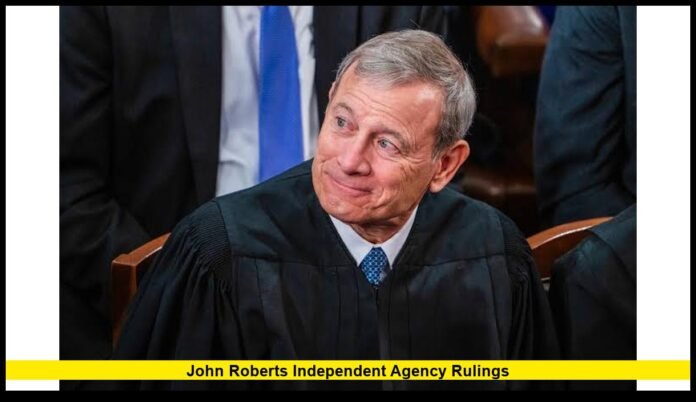

The Supreme Court delivered one of its most significant constitutional decisions in decades when Chief Justice John Roberts wrote a landmark opinion that reshaped the relationship between the White House and independent federal agencies. The ruling changed a legal framework that had existed since the 1930s and immediately affected how presidents can oversee officials leading many of the nation’s most powerful regulatory bodies.
The decision is already regarded as a turning point in administrative law because it alters the balance of power between Congress and the executive branch. While the Court strengthened presidential authority over many independent agencies, it also drew an important constitutional distinction for the Federal Reserve, preserving its longstanding independence in matters involving monetary policy.
The consequences extend well beyond Washington. Businesses, financial markets, regulators, lawmakers, and future administrations will all feel the effects of the Court’s interpretation of executive power. As additional cases work their way through the federal courts, legal experts expect this ruling to shape government operations for many years.
Why the Decision Became a Historic Moment
For nearly a century, many independent federal agencies operated under statutory protections that prevented presidents from removing commissioners or board members without a legally recognized reason.
Congress created these protections to reduce political influence over agencies responsible for enforcing complex federal laws. Independent regulators were expected to make decisions based on expertise rather than shifting political priorities.
That long-established structure changed dramatically after the Supreme Court reconsidered whether those protections were consistent with the Constitution’s separation of powers.
The Court concluded that officials exercising executive authority generally must remain accountable to the president, fundamentally changing how future administrations may supervise federal agencies.
Understanding Independent Federal Agencies
Independent agencies occupy a unique place within the federal government.
Unlike Cabinet departments that report directly to the president, these agencies traditionally operate with a greater degree of autonomy. Many are led by bipartisan commissions whose members serve staggered terms extending beyond a single presidential administration.
Examples include agencies responsible for regulating financial markets, labor relations, consumer protection, communications, and trade practices.
Congress originally designed this structure to promote continuity, stability, and independent decision-making regardless of which political party controlled the White House.
For decades, that arrangement was viewed as an important safeguard against excessive political influence in technical regulatory matters.
The Constitutional Question Before the Court
The dispute centered on whether Congress can restrict a president’s authority to remove officials leading independent agencies.
The issue gained national attention after President Donald Trump removed Federal Trade Commission Commissioner Rebecca Slaughter before her term expired.
Federal law had long limited presidential removal of FTC commissioners except for specific causes such as inefficiency, neglect of duty, or misconduct.
The legal challenge asked the Supreme Court to determine whether those restrictions were compatible with Article II of the Constitution, which vests executive power in the president.
The Court ultimately decided that Congress cannot significantly limit the president’s ability to remove officials who exercise executive authority on behalf of the federal government.
Chief Justice John Roberts’ Constitutional Reasoning
Writing for the majority, Chief Justice Roberts emphasized that executive power ultimately belongs to the president.
The opinion explained that federal officials carrying out executive responsibilities must remain accountable to the nation’s elected chief executive.
According to the Court, preventing presidents from removing these officials interferes with their constitutional duty to faithfully execute federal law.
The majority concluded that the Constitution requires meaningful presidential supervision over executive officers, making broad statutory removal protections unconstitutional in many circumstances.
This reasoning marked a major shift in the Court’s interpretation of executive authority and represented one of the most significant constitutional rulings involving the separation of powers in recent decades.
The End of a Longstanding Legal Precedent
One of the most notable aspects of the decision was the Court’s decision to overrule Humphrey’s Executor v. United States, a landmark 1935 case that had shaped independent agency governance for generations.
That earlier ruling allowed Congress to create independent commissions whose members could not be dismissed simply because a president disagreed with their policy views.
For more than ninety years, the decision served as the constitutional foundation supporting dozens of independent agencies across the federal government.
By overturning that precedent, the Supreme Court signaled that constitutional interpretation must take precedence over historical practice when the two conflict.
The ruling immediately became one of the Roberts Court’s most consequential departures from established precedent.
A New Standard for Presidential Authority
The Court’s decision significantly increases presidential control over many executive agencies.
Future presidents now have broader authority to replace agency leaders whose policy priorities differ from those of the administration.
Supporters believe this change improves democratic accountability because voters elect presidents to oversee the executive branch.
Under this view, the public can more effectively judge presidential performance when agency leaders answer directly to the White House.
The decision also reflects the constitutional theory often called the unitary executive, which maintains that executive authority ultimately belongs to a single elected president rather than independent commissions insulated from political oversight.
Read More – Joe Manchin’s Shift to Independent Politics: A Timeline of His Political Journey
Federal Agencies Most Likely to Feel the Impact
Although additional litigation will determine the full scope of the ruling, many independent agencies may experience important operational changes.
Among those expected to be affected are:
- Federal Trade Commission
- Securities and Exchange Commission
- National Labor Relations Board
- Federal Communications Commission
- Consumer Product Safety Commission
- Federal Energy Regulatory Commission
- Merit Systems Protection Board
Agency leadership transitions could become more frequent following presidential elections, allowing incoming administrations to implement policy priorities more quickly.
Why the Federal Reserve Was Treated Differently
On the same day, the Supreme Court reached a different conclusion regarding the Federal Reserve.
The Court preserved protections for Federal Reserve governors, recognizing the institution’s distinctive constitutional and economic role.
Unlike many regulatory agencies, the Federal Reserve is responsible for managing monetary policy, supervising aspects of the banking system, and promoting financial stability.
The majority concluded that these responsibilities justify maintaining a greater degree of institutional independence.
This distinction reassured financial markets that political changes would not immediately alter the nation’s central bank through presidential removal decisions.
The separate treatment of the Federal Reserve has become one of the most discussed features of the Court’s opinions.
Immediate Effects Across Washington
Federal agencies quickly began evaluating how the ruling could affect leadership structures, decision-making processes, and ongoing litigation.
The decision also increased attention on vacancies, commissioner appointments, and future personnel changes.
Government lawyers are expected to review numerous statutes governing independent agencies to determine whether existing removal protections remain constitutionally valid.
Meanwhile, lawmakers may consider legislative changes aimed at adapting agency structures to the Court’s new constitutional framework.
How Businesses May Be Affected
Companies operating in heavily regulated industries could experience a different regulatory environment after future presidential elections.
Because agency leadership may now change more easily, regulatory priorities could shift faster than they did under the previous system.
Businesses involved in banking, telecommunications, technology, energy, labor relations, securities, healthcare, and consumer protection may need to monitor leadership transitions more closely.
Although federal laws themselves remain unchanged unless Congress acts, the way agencies interpret and enforce those laws can vary between administrations.
This could result in more noticeable policy shifts whenever presidential control changes.
Supporters Welcome Greater Accountability
Supporters of the ruling argue that the Constitution clearly places executive authority under presidential supervision.
From this perspective, voters elect presidents to oversee the executive branch, making direct accountability an essential feature of democratic government.
Advocates also contend that independent agencies accumulated enormous regulatory authority over time while remaining insulated from direct political responsibility.
They believe the Court restored constitutional principles by ensuring executive officials answer to the nation’s elected leader.
Many constitutional scholars who favor a stronger presidency described the ruling as a logical application of Article II.
Critics Raise Concerns About Agency Independence
Opponents argue that reducing independence could expose regulatory agencies to greater political pressure.
They warn that agencies responsible for enforcing technical laws may experience increased turnover whenever administrations change.
Some critics also believe bipartisan commissions provide valuable continuity that helps businesses and consumers operate under stable regulatory expectations.
Others worry that faster leadership changes could produce less predictable regulatory policies across different presidential administrations.
Despite those concerns, the Supreme Court concluded that constitutional structure ultimately outweighs policy arguments favoring agency independence.
Connection to Earlier Roberts Court Decisions
The ruling reflects a broader judicial trend that has emerged over several years.
The Roberts Court has repeatedly examined the constitutional limits of administrative agencies and executive authority.
Previous decisions addressed topics such as:
- Judicial review of agency regulations
- Separation of powers
- Congressional delegation of authority
- Administrative rulemaking
- Executive oversight
Together, these cases demonstrate the Court’s continued focus on defining constitutional boundaries for the modern administrative state.
The latest ruling builds upon that body of law while establishing a new standard for presidential supervision of executive officials.
What Happens Next
Although the constitutional question regarding removal authority has been resolved, many practical issues remain.
Federal courts will continue determining how broadly the decision applies to different agencies.
Future lawsuits may address agencies with unique statutory structures or specialized responsibilities.
Congress could also respond by revising laws governing agency organization and leadership.
Presidents from both political parties are expected to rely on the decision when making future appointments and personnel changes throughout the executive branch.
As new disputes arise, courts will likely clarify where constitutional limits remain and whether additional exceptions exist beyond the Federal Reserve.
Long-Term Impact on the Federal Government
The ruling is expected to influence presidential administrations for generations.
Incoming presidents may now exercise greater authority over regulatory agencies early in their terms, potentially accelerating policy implementation.
Independent commissions could gradually resemble executive departments more closely in terms of presidential oversight.
At the same time, the Federal Reserve’s protected status demonstrates that the Court still recognizes circumstances where institutional independence serves important constitutional and governmental interests.
The decision therefore creates both a broad rule and an important exception, ensuring continued legal debate over how executive authority should operate within the federal government.
Because the ruling overturned one of the most influential administrative law precedents in American history, legal scholars expect its effects to be studied for decades.
Future Supreme Court cases will likely build upon this foundation as new constitutional questions emerge involving executive power, congressional authority, and the structure of federal agencies.
For government officials, regulated industries, legal professionals, and the American public, the decision marks a defining chapter in the ongoing evolution of constitutional law and the balance of powers established by the nation’s founding framework.
How do you think this Supreme Court decision will influence the future of federal agencies and presidential authority? Share your thoughts in the comments and stay informed as new legal developments continue to unfold.