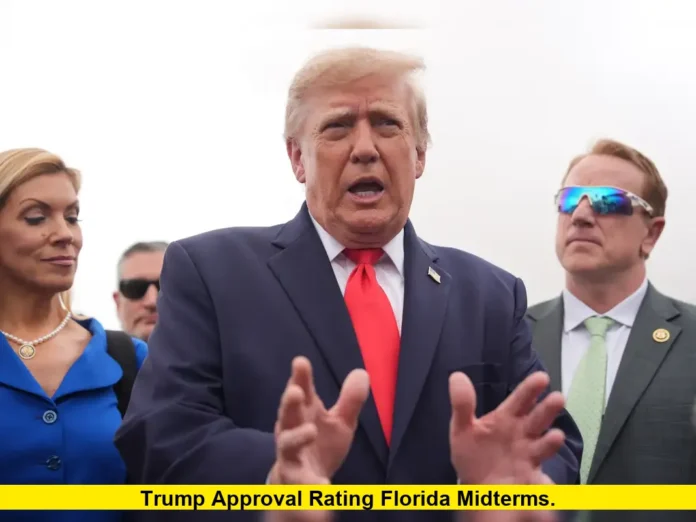

The Trump approval rating Florida midterms debate has taken on added importance as new polling reveals a divided electorate ahead of the November 3, 2026, elections. A recent Florida voter poll reported by NBC 6 South Florida found that 48% of respondents approved of President Donald Trump’s job performance, while 48% disapproved. Another 4% were unsure.
The results offer a direct measure of Trump’s standing among Florida voters and provide a useful starting point for understanding the state’s midterm political environment. They also show why national approval figures should not automatically be applied to Florida, where the electorate has its own political characteristics and priorities.
Separate October surveys have examined the Florida governor’s race and the special U.S. Senate election. Those polls measure candidate preferences rather than presidential approval, but they help explain the political context surrounding the president’s standing in the state.
The key distinction is that Trump’s approval rating measures voters’ assessments of his performance, while the midterm results will depend on candidates, local issues, party identification and voter turnout.
Latest Trump Approval Rating in Florida
The latest direct Florida approval poll identified in the research was reported by NBC 6 South Florida in October 2026. Its results showed an even split among respondents on Trump’s job performance.
| Polling measure | Result |
|---|---|
| Approve of Trump’s job performance | 48% |
| Disapprove of Trump’s job performance | 48% |
| Not sure | 4% |
The poll also revealed differences among demographic and political groups. Republicans approved of Trump’s performance by 83% to 14%, while Democrats disapproved by 88% to 12%. Among independents, 55% disapproved and 36% approved.
The demographic findings also varied. Men approved of Trump’s performance by 55% to 41%, while women disapproved by 54% to 43%. White respondents approved by 60% to 37%, while Black respondents disapproved by 86% to 11%. Hispanic respondents disapproved by 49% to 45%.
These results illustrate the differences within Florida’s electorate. The statewide 48% approval figure does not mean that every region or demographic group views the president similarly.
The results should also be interpreted within the poll’s own methodology. The approval figures represent respondents’ views during the survey period, not the final voting preferences of everyone who will participate in November.
What October Estimates Reveal About Trump’s Standing
A separate state-level analysis published in October by State Navigate estimated Trump’s net approval in Florida at approximately minus 13 percentage points. The model’s reported range extended from roughly minus 18 to minus 8 percentage points.
Net approval represents the percentage approving of a president minus the percentage disapproving. A negative figure means disapproval exceeds approval in the modeled estimate.
However, this result should not be confused with the direct Florida survey that reported 48% approval and 48% disapproval. The two measurements use different approaches and may cover different populations.
The modeled estimate provides another way to examine state-level political sentiment, but it does not replace a direct survey of Florida voters.
For readers tracking the Trump approval rating Florida midterms issue, the distinction is important. Direct polling measures responses collected from a sample, while statistical models estimate public opinion using available data and modeling assumptions.
Both can provide useful information, provided the results are described accurately.
Read Also
Trump approval rating California midterms: Latest Poll Numbers and 2026 Election Outlook
Trump Approval Rating Texas Midterms: Latest Polls and October 2026 Election Updates
Why Trump’s Approval Rating Matters for Florida’s Midterms
Florida is an important state in national politics, and its congressional races will contribute to determining control of the U.S. House and Senate.
Trump won Florida in the 2024 presidential election, and Republicans have maintained a strong position in statewide politics. Nevertheless, a president’s earlier electoral performance does not guarantee that voters will express the same preferences in a midterm election.
Midterms often produce a different electorate from presidential contests. Turnout patterns, local concerns, candidate quality and satisfaction with the administration can all affect the results.
Trump’s approval rating offers one indicator of the political environment. It can help explain how voters view the administration, but it cannot independently establish how they will vote for Congress or statewide offices.
Florida also contains different political communities. The priorities of voters in Miami-Dade County may differ from those of voters in the Panhandle, Tampa Bay, Orlando or rural North Florida.
A statewide poll combines these views into a single result. District-level surveys and local election data are necessary to understand differences between individual contests.
Florida Governor’s Race: Byron Donalds and David Jolly
The Florida governor’s race is one of the most closely watched statewide contests of the 2026 election cycle. Republican Byron Donalds and Democrat David Jolly are competing for the office being vacated by term-limited Governor Ron DeSantis.
An October YouGov survey of 3,813 likely voters, conducted from September 28 through October 5, found Donalds leading Jolly by 47% to 45%.
A Mason-Dixon Polling & Strategy survey conducted October 1 found Donalds ahead by 48% to 41%. In contrast, a Change Research survey conducted September 25–27 reported Jolly leading Donalds, 48% to 46%.
These differences show why individual polls should be considered alongside their field dates, sampling methods and other methodological details.
The October surveys measure support for the gubernatorial candidates, not Trump’s job approval. They nevertheless provide context for understanding the political environment in which the president’s party is competing.
Donalds is a Republican aligned with Trump’s political movement, while Jolly is a Democrat who previously served in Congress as a Republican before changing his party affiliation.
Voters may consider the candidates’ policy positions, experience and priorities for Florida when making their decisions. Trump’s approval may be relevant to some voters, but it is only one element of the governor’s race.
The Florida Senate Race Adds Another Important Test
Florida’s special U.S. Senate election is another major contest in the 2026 midterms. Republican Ashley Moody is facing Democrat Angie Nixon.
The race matters because the outcome will help determine the balance of power in the Senate. Florida’s result will be considered alongside other Senate contests across the country.
An October YouGov survey found Moody leading Nixon by 49% to 44% among likely voters. A St. Pete Polls survey conducted October 5–7, however, reported a closer contest, with Moody receiving 47% and Nixon 45%.
A September survey by Change Research also found a narrow race, reporting Moody at 48% and Nixon at 47%.
These findings show that the reported margin varies across surveys. They do not establish the eventual result, and the percentages should not be treated as presidential approval figures.
Moody’s position as a Republican candidate places the contest within the broader debate about the party’s relationship with Trump. Republican voters who support the administration may also favor Republican candidates, but voters do not always choose the same party across every race.
Likewise, Democratic candidates must build support around their own platforms rather than assume that disapproval of the president automatically translates into votes for them.
The Senate race is therefore a separate contest that requires its own polling analysis.
Florida’s Economy and Cost of Living Could Shape Voter Decisions
Economic issues remain important to voters across the country, and Florida is no exception.
Housing costs, insurance premiums, property taxes, transportation expenses and everyday prices can influence how households assess political leadership. Florida’s housing market and property insurance system are particularly relevant to many residents.
National economic policies can affect these concerns, but state policies and local market conditions also matter. Voters may distinguish between decisions made in Washington and those made by Florida’s governor or legislature.
Republican candidates may emphasize tax policy, economic growth, business investment and efforts to reduce regulation. Democratic candidates may focus on housing affordability, insurance costs, wages and access to public services.
The president’s approval rating can reflect broader satisfaction or dissatisfaction with economic conditions. Yet a statewide approval figure cannot identify precisely which issue is responsible for a particular voter’s opinion.
Campaigns will seek to connect their policy proposals to the concerns voters consider most urgent. The effect of those arguments will depend on the candidates, the issues and the voters who participate.
Independent Voters Could Be Important in Competitive Races
Florida’s independent and unaffiliated voters are another group to watch in the 2026 election cycle.
In the recent Change Research survey, 63% of voters who were not affiliated with either major party disapproved of Trump’s job performance. That result indicates substantial dissatisfaction among unaffiliated respondents in that survey.
However, independent voters are not a uniform political group. Some lean Republican, others lean Democratic, and some make their decisions based on individual candidates or specific issues.
The Florida approval poll also found that independents disapproved of Trump by 55% to 36%. Although the exact figures differ between surveys, both results show that disapproval exceeded approval among the independent voters surveyed.
That does not mean all these voters will support Democratic candidates. Presidential approval and candidate choice are different measurements.
For Republicans, the challenge is to maintain support among their core voters while competing for unaffiliated voters. Democrats face a different challenge: turning dissatisfaction with the administration into support for their own candidates.
The results of individual races will depend on how campaigns address these differences and how voters respond.
Florida’s Changing Voter Registration Landscape
Florida’s voter registration figures provide additional context for the midterms.
Recent reporting on state registration data has highlighted a Republican advantage over Democrats in active registered voters. The Republican registration lead has grown in recent years, even as Democrats recorded a modest monthly registration gain in September.
Registration data and approval ratings measure different things. Party registration indicates how voters formally identify, while approval surveys measure their views of the president’s performance.
A registered Republican may disapprove of Trump, just as an unaffiliated voter may approve of him. Registration alone cannot establish a person’s voting intentions.
The same distinction applies to election results. A party’s registration advantage does not guarantee that every registered voter will participate or vote for that party’s candidates.
For a complete assessment of Florida’s midterms, readers should consider registration trends alongside polling, turnout information and candidate-specific surveys.
How to Read the Latest Florida Polls Before Election Day
As November 3 approaches, several considerations can help readers interpret new polling accurately.
- Check the field dates. A survey published in October may have collected responses in late September.
- Identify what the poll measures. Presidential approval, Senate preferences and governor preferences are different measurements.
- Review the sample. Results among likely voters may differ from results among registered voters or all adults.
- Compare multiple surveys. Differences between polls can reflect methodology and sampling uncertainty rather than a genuine change in opinion.
- Separate direct polls from models. Modeled approval estimates are not the same as newly collected survey responses.
These distinctions are especially important when a headline presents a single number without explaining its source or methodology.
The latest direct Florida approval survey found an even split between approval and disapproval. The October state-level model, meanwhile, estimated negative net approval. Those findings should be reported separately rather than combined into a single number.
New surveys may provide a clearer picture of whether Trump’s standing is changing as Election Day approaches. Until then, the available figures provide a snapshot rather than a definitive measure of how every Florida voter will behave.
Final Outlook on Trump’s Approval Rating and the Florida Midterms
The latest direct Florida approval poll identified in this research found that 48% of respondents approved of Trump’s job performance, 48% disapproved and 4% were unsure. October’s modeled state-level estimate showed negative net approval, offering a separate perspective on the president’s standing.
Meanwhile, polls of the governor’s race and special Senate election show varying levels of support for the candidates. These contests will be shaped by local concerns, campaign strategies, party identification and turnout, as well as the broader national political environment.
The Trump approval rating Florida midterms topic remains relevant because it helps readers understand public opinion toward the president in a major state. However, approval numbers alone cannot predict individual election results.
The most useful approach is to follow new Florida-specific approval polls while evaluating the governor’s and Senate races separately. That distinction provides a clearer picture of what the available evidence actually shows.
Share your thoughts in the comments and stay updated for the latest verified polling developments ahead of the 2026 Florida midterm elections.