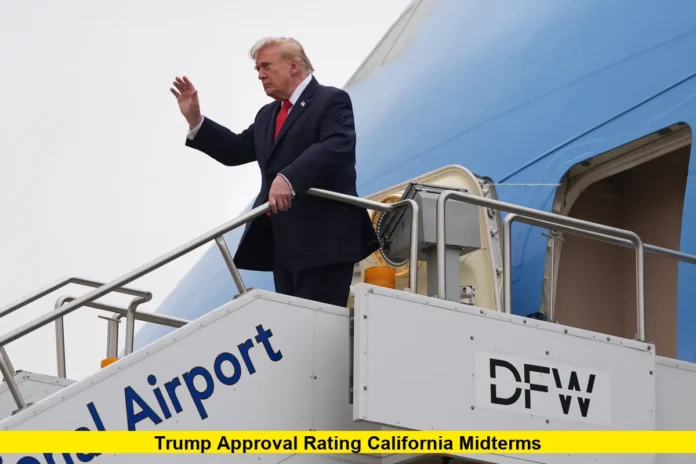

The Trump approval rating California midterms debate has gained new attention following a September 2026 poll that found President Donald Trump’s approval among California voters at 27%, compared with 73% who disapproved. The survey, released by the University of California, Berkeley’s Institute of Governmental Studies, provides a recent statewide measure of Trump’s standing as voters prepare for the November 3 midterm elections.
The findings offer an important snapshot of California’s political climate. However, presidential approval is not the same as support for individual candidates, and the numbers should not be treated as a prediction of election results. California voters will evaluate congressional candidates, statewide offices and ballot measures alongside their views of the president.
The latest available evidence also raises a significant question: how much does Trump’s standing influence Republican candidates in a state where Democrats hold a substantial statewide electoral advantage? The answer depends on the race, the candidates, local issues and which voters participate.
Latest Trump Approval Rating in California
The most recent directly relevant statewide survey identified in the research was released on September 30, 2026. It showed that Trump’s approval rating had reached a new low among California voters.
| Polling measure | September 2026 result |
|---|---|
| Approve of Trump’s job performance | 27% |
| Disapprove of Trump’s job performance | 73% |
| Survey organization | UC Berkeley Institute of Governmental Studies |
| Release date | September 30, 2026 |
The results indicate that disapproval exceeded approval by 46 percentage points. The poll also found that Trump’s strong approval had fallen to 14%, while strong disapproval had reached 64%.
These figures describe California voters’ views of the president, not their preferences in individual congressional or statewide races. They also reflect the survey period rather than a daily measurement of public opinion.
As of October 12, the research reviewed for this article did not identify a newer published statewide survey providing a direct Trump approval percentage for California. An updated statistical model published in October offers additional context, but its estimates should not be confused with the results of a newly conducted statewide poll.
What the Latest Poll Reveals About Trump’s Standing
California has consistently leaned Democratic in recent presidential elections. Trump’s approval numbers reflect that political environment, but the latest survey also indicates changes within his own party.
A September poll conducted by Berkeley’s Institute of Governmental Studies found that 76% of California Republicans approved of Trump’s performance. That figure was down from 83% in the previous year’s survey.
The intensity of support also declined. Only 44% of California Republicans said they strongly approved of Trump’s job performance, compared with 57% in August 2025.
These findings offer an important distinction between approval and enthusiasm. A voter can continue to support a president while feeling less strongly about his performance.
That distinction matters during midterm elections, when campaigns must motivate supporters to participate. Strong approval may encourage political engagement, while weaker enthusiasm can create a different challenge for candidates who depend on a president’s political base.
The results do not establish that Republican voters will abandon their party. They show that approval within the state’s Republican electorate has weakened compared with earlier measurements.
Read Also-Trump Approval Rating Texas Midterms: Latest Polls and October 2026 Election Updates
Why Trump’s Approval Rating Matters for the California Midterms
The 2026 midterms will determine control of the U.S. House and Senate, while California voters will also decide statewide and local contests.
California’s presidential approval numbers provide context for these elections, particularly in congressional districts where candidates face competitive races. However, the statewide figure does not tell the whole story.
Republicans and Democrats compete in different political environments across California. Democratic candidates generally operate in areas with substantial Democratic support, while Republicans have stronger positions in many conservative communities and districts.
A statewide approval rating averages these different environments together. It cannot show how voters in an individual congressional district feel about the president.
For that reason, anyone following the Trump approval rating California midterms discussion should distinguish three measurements:
- Presidential approval: Whether Californians approve or disapprove of Trump’s performance.
- Congressional preference: Which party or candidate voters support in House and Senate elections.
- Statewide candidate preference: Which candidate voters favor in contests such as the California governor’s race.
These measurements can influence one another, but they are not interchangeable. A voter who disapproves of Trump may still consider a Republican congressional candidate, while a voter who approves of him may choose a Democrat for a particular office.
The practical significance of presidential approval depends on how it interacts with the candidates and issues on each ballot.
California’s Congressional Races and the National Political Environment
California has an important role in determining control of the House because it elects 52 voting members of Congress. Even modest changes in a handful of competitive districts can matter in a closely divided chamber.
The statewide approval numbers do not establish how those individual races will turn out. District-level polling, candidate quality, campaign spending, incumbency and local concerns all affect congressional contests.
National polling provides additional context. A Pew Research Center survey conducted September 28 through October 4 and released October 8 found that Trump’s national job approval stood at 30%, with 63% of registered voters saying the president was a factor in their congressional vote.
The national results are not a substitute for California-specific polling. They do, however, show that presidential approval is an important part of the broader political environment ahead of the midterms.
For California Republicans, the challenge involves maintaining support among conservative voters while competing in districts where the electorate may be more politically mixed. Democratic candidates may emphasize their differences with the administration, but they must also address the issues facing their own constituents.
The eventual outcome will depend on individual contests rather than the statewide approval figure alone.
The California Governor’s Race Adds Another Dimension
California’s gubernatorial election is another major contest in the November 2026 cycle. Democrat Xavier Becerra and Republican Steve Hilton are competing to succeed Governor Gavin Newsom, who cannot seek another consecutive term because of the state’s term limits.
A September Berkeley IGS poll conducted in partnership with the Los Angeles Times found Becerra leading Hilton by 58% to 33% among likely voters. The survey was conducted September 15–20.
More recent polling in October has also measured the governor’s race. A survey conducted October 2–3 by David Jay Wolfson reported Becerra at 45.7% and Hilton at 40.1%. The poll surveyed 1,020 likely voters.
These results differ substantially, illustrating why readers should examine field dates, pollsters, sampling methods and sponsorship before comparing individual surveys. The October survey was conducted for Hilton’s campaign, a relevant consideration when assessing its context.
Neither result measures Trump’s approval rating. Instead, the surveys provide separate information about the candidates competing for California’s governorship.
The connection to the president is political rather than mathematical. Trump’s standing could shape how some voters view Republican candidates, but the governor’s race also centers on California’s economy, housing affordability, energy costs, taxes, public safety and state government priorities.
Becerra and Hilton must persuade voters based on their own records, policy proposals and campaigns. Presidential approval alone cannot explain their support levels.
Cost of Living Is Central to California Voters’ Concerns
Economic concerns are likely to remain important throughout the midterm campaign. California households face significant expenses related to housing, transportation, insurance, utilities and everyday necessities.
A September Berkeley IGS survey found that reducing California’s high cost of living ranked among voters’ most important priorities for the next governor. Opposition to the Trump administration was another prominent concern.
These findings illustrate how state and national issues can overlap. Voters may evaluate the president based on federal economic policies while judging California’s elected officials on housing, taxes, infrastructure and state spending.
Republicans may argue that their economic policies can reduce costs or encourage investment. Democrats may focus on affordability programs, public services and their opposition to federal policies they consider harmful to California.
Voters will assess these arguments differently depending on their financial circumstances and political priorities.
The relationship between economic dissatisfaction and Trump’s approval rating also requires careful interpretation. A voter who reports financial pressure does not necessarily blame the president, and disapproval of the administration does not automatically translate into support for a particular Democratic candidate.
Reliable analysis must distinguish what surveys measure from what campaigns hope voters will conclude.
California’s Republican Voters Remain an Important Group
Although Democrats have a statewide registration and electoral advantage, California still has a substantial Republican electorate.
The decline in Trump’s approval among California Republicans deserves attention because it suggests that changes in public opinion are not limited to voters who traditionally oppose him.
The September findings showed lower overall approval and reduced strong approval within the Republican group compared with earlier measurements. They do not, however, establish that Republican voters have changed their party identification or their voting intentions.
Republican candidates may seek to strengthen support by emphasizing economic issues, public safety, immigration and opposition to Democratic policies. They may also highlight differences between state and federal responsibilities.
Democratic candidates, meanwhile, may use Trump’s approval figures to frame their campaigns around disagreements with the administration.
Both approaches depend on the specific electorate and the issues voters consider most important. California’s Republican voters are not a uniform group, and statewide findings cannot capture every regional or demographic difference.
What October Data Say About Trump’s Approval in California
An October update from State Navigate, published October 11, provided modeled estimates of Trump’s net approval across states. Its California estimate placed net approval in a range of approximately minus 51 to minus 38.4 percentage points, with a midpoint of minus 45.3 points.
This is a model-based estimate, not a new direct survey reporting the percentage of Californians who approve of Trump.
Net approval is calculated by subtracting disapproval from approval. A negative value means that disapproval exceeds approval within the measurement. However, a modeled net-approval estimate should not be converted into an exact approval percentage without additional information.
The October model supports the broader conclusion that Trump’s standing in California remains negative. The September Berkeley IGS survey remains the clearer direct polling reference identified in the research for this article.
Readers should be cautious about headlines that describe every October polling update as a new approval poll. A statistical model can incorporate existing information and estimate current sentiment, but it does not necessarily represent a newly interviewed sample of California voters.
For the most accurate reporting, the source, field dates and measurement type should accompany any numerical claim.
How to Follow New California Approval Polls Before Election Day
New surveys could provide a clearer picture of Trump’s standing as the November 3 election approaches. Several details are especially important when evaluating them.
First, check whether the survey actually asks California voters whether they approve or disapprove of Trump’s job performance. A poll about congressional candidates or the governor’s race cannot answer that question directly.
Second, review the survey dates. A poll published in October may have collected responses in September, so the release date does not necessarily indicate when voters expressed their opinions.
Third, examine the sample. Results from registered voters, likely voters and all adults may differ because these groups are not identical.
Finally, compare multiple credible surveys where possible. Small changes between polls can reflect sampling uncertainty rather than a genuine shift in public opinion.
California’s political environment can also differ considerably by region. Statewide approval figures are useful for understanding the broader electorate, but congressional district polls may provide more relevant information about specific races.
Final Outlook on Trump’s Approval Rating in California
The latest direct statewide survey identified in the research found that 27% of California voters approved of Trump’s performance and 73% disapproved. The September Berkeley IGS findings also showed reduced approval and weaker enthusiasm among California Republicans compared with earlier measurements.
October’s modeled net-approval estimate provides additional context, but it should not be presented as a new direct poll. The latest governor’s race surveys likewise measure candidate preferences rather than presidential approval.
The key takeaway is that Trump’s standing offers useful context for the 2026 California midterms, but it cannot determine individual election outcomes. Congressional contests, the governor’s race and other elections will depend on candidates, local issues, turnout and voters’ decisions at the ballot box.
As additional surveys become available, the most reliable approach is to separate direct approval polling from candidate polling and modeled estimates.
Share your thoughts in the comments and stay updated for the latest verified developments in California polling and the 2026 midterm elections.