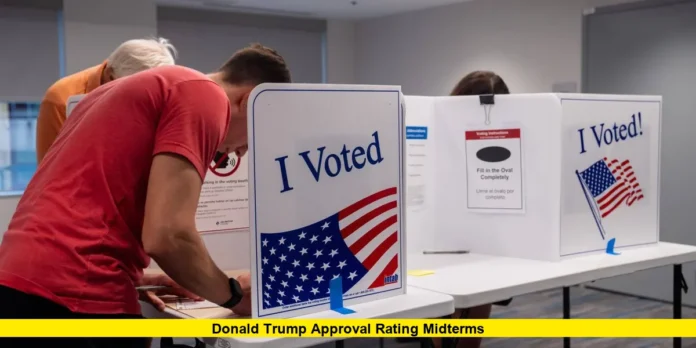

The donald trump approval rating midterms debate has become increasingly important as the November 3, 2026, midterm elections approach. The latest polling shows that President Donald Trump’s job approval has fallen to some of the lowest levels of his second term, raising questions about how his popularity could affect Republican candidates competing for control of Congress.
A Pew Research Center survey conducted September 28 through October 4 found that 30% of Americans approved of Trump’s job performance, while 68% disapproved. The findings also indicate that voters increasingly view the president as a factor in their congressional choices, making his standing an important part of the national midterm campaign.
However, presidential approval ratings do not automatically determine election results. Local candidates, economic conditions, turnout, campaign strategies, and the competitiveness of individual races will all influence the outcome. Understanding the latest numbers requires looking beyond a single poll to examine the broader political environment.
Latest Donald Trump Approval Rating Ahead of the 2026 Midterms
Trump enters the final stretch before Election Day facing a difficult polling environment. Recent national surveys show more Americans disapprove of his performance than approve, although the precise figures differ among pollsters because they use different samples, questions, and methodologies.
The Pew Research Center’s October findings are particularly notable because the survey places Trump’s approval at 30%, his lowest level of his second term in that organization’s polling. Disapproval reached 68%, indicating a substantial gap between the president’s supporters and critics.
A separate Reuters/Ipsos poll, conducted September 30 through October 5, put Trump’s approval at 32% and disapproval at 65%. Although the results differ slightly from Pew’s figures, both surveys point toward a similar conclusion: Trump’s national approval is under pressure shortly before the midterm elections.
The difference between individual polls is important. One survey should not be treated as a definitive measurement of every American voter’s opinion. Pollsters interview different groups of people, and their estimates can vary because of sampling error, weighting decisions, and changes in the respondents surveyed.
Nevertheless, when multiple surveys indicate that disapproval substantially exceeds approval, the broader pattern deserves attention.
For Republicans, the central challenge is whether their candidates can maintain support among voters who approve of Trump’s leadership while appealing to independents and other voters who have become dissatisfied with his administration.
For Democrats, low presidential approval offers an opportunity to present the midterms as a referendum on the administration’s direction. Turning that opportunity into victories, however, requires candidates to build support in their own districts and states.
How Trump’s Approval Rating Could Affect the Midterm Elections
The relationship between presidential approval and congressional elections is one of the most important factors to watch in 2026. Midterm elections often serve as an early public judgment of a president’s performance, particularly when voters are dissatisfied with economic conditions or the direction of national policy.
The latest polling suggests Democrats have an advantage in the national House vote preference. In the Pew Research Center survey, 44% of registered voters said they would support a Democratic candidate for the House, compared with 36% who preferred a Republican candidate. Another 15% were undecided.
That eight-point difference indicates a challenging environment for Republicans, but it should not be confused with a prediction of the final seat count. The national popular vote and the distribution of votes across congressional districts are different measures. A party can win the national vote by a substantial margin without winning every competitive district.
The impact of Trump’s approval rating will also vary geographically. Republicans running in strongly conservative districts may remain competitive even when the president’s national numbers are weak. Candidates in closely divided suburban districts, however, could face greater pressure to demonstrate independence from unpopular administration policies.
Democrats must also address their own challenges. A national polling advantage does not guarantee that supporters will turn out, that candidates will perform equally well in every state, or that campaign messages will resonate with local voters.
Ultimately, Trump’s approval rating is a significant indicator of the political climate, rather than a standalone forecast of the November results.
Voters Are Increasingly Connecting Their Congressional Votes to Trump
One of the most revealing findings in recent polling is the extent to which Americans connect their votes for Congress with their views of the president.
The October Pew survey found that 63% of registered voters considered Trump a factor in their congressional vote. More respondents described their choice as a vote against him than as a vote in his favor.
The breakdown was notable:
- 44% viewed their congressional vote as a vote against Trump.
- 19% viewed it as a vote for Trump.
- 36% said Trump was not a factor in their decision.
These figures suggest that the president’s influence extends beyond his own job approval. His supporters may view Republican congressional candidates as partners in advancing his agenda, while opponents may see Democratic candidates as a way to limit his influence.
This dynamic creates both opportunities and risks for the two parties.
Republican candidates can benefit from Trump’s ability to energize his core supporters. However, candidates may also struggle when voters associate them with policies that have become unpopular.
Democrats can use opposition to the administration to mobilize voters, but they still need to explain what they would do differently if they gained control of Congress.
The distinction matters because voters are not necessarily evaluating every congressional candidate solely on presidential performance. Some prioritize local economic conditions, candidate experience, public safety, health care, or other district-specific concerns.
The Economy and Inflation Are Central to Trump’s Political Standing
Economic concerns are likely to remain a major influence on the 2026 midterm elections. For many voters, assessments of presidential performance are closely tied to the cost of everyday necessities, employment opportunities, housing, energy, and household financial security.
The Pew survey found that 84% of registered voters considered the economy very important to their congressional vote. That included 88% of voters supporting Democratic candidates and 82% of those supporting Republicans.
This broad agreement makes economic performance a central challenge for both parties.
For the administration, improving perceptions of affordability could help strengthen its political position. Voters who see their household finances improving may become more receptive to the president’s economic arguments. Conversely, persistent concerns about prices can make it difficult for a president to persuade the public that national economic policies are working.
Recent coverage has also highlighted concerns about tariffs and their potential effects on consumer prices and businesses. In an October 12 report, the Associated Press described growing voter opposition to Trump’s tariff policies, with more than 64% of Americans in a recent poll saying he had gone too far with tariffs.
Tariffs are particularly relevant to the midterms because their economic effects can be debated in competing ways. Supporters argue that import duties can protect domestic industries and encourage manufacturing. Critics warn that businesses may pass higher import costs to consumers or absorb them through reduced margins.
For voters, the practical question is whether these policies improve economic security or make everyday purchases more expensive.
Inflation, energy costs, and employment conditions may therefore affect the president’s approval and congressional voting preferences simultaneously. Still, it would be inaccurate to attribute every change in public opinion to one policy. Voters assess the economy through a combination of personal experiences, expectations, and perceptions of national conditions.
Democratic Voter Motivation Could Be a Major Factor
Presidential approval is only part of the election equation. The willingness of voters to participate can determine whether a party converts favorable polling into actual victories.
Recent polling points to a potential advantage for Democratic enthusiasm heading into the final weeks of the campaign.
Among registered voters who supported Democratic House candidates, 63% said they were extremely motivated to vote. Among Republican candidate supporters, the comparable figure was 46%.
The survey also found that 50% of Democratic candidate supporters had given the election a lot of thought, compared with 36% of Republican candidate supporters.
These findings suggest Democratic voters were more engaged at the time of the survey. That difference could matter in closely contested races, where relatively small changes in turnout can influence the outcome.
However, stated motivation is not the same as actual turnout. People who tell pollsters they intend to vote may ultimately stay home, while voters who initially report lower enthusiasm can still participate.
Republicans also retain an important electoral base. Trump’s supporters remain a substantial part of the Republican coalition, and strong participation among those voters could help candidates overcome weaknesses in broader public opinion.
Both parties will need to translate enthusiasm into practical campaign activity, including voter registration where applicable, early voting, absentee voting, and Election Day participation.
What the Approval Numbers Mean for the House and Senate
The 2026 midterms will determine the balance of power in both chambers of Congress. Trump’s polling performance has intensified attention on whether Republicans can maintain their congressional majorities.
The House and Senate, however, present different electoral challenges.
House of Representatives
All 435 voting seats in the House are scheduled for election in 2026. This makes the national political environment especially relevant, although individual district characteristics remain crucial.
The latest national House preference figures favor Democrats, giving them a potential opening to gain seats. A president with low approval ratings can create additional difficulties for members of his party, especially in competitive districts where voters are divided over the administration.
Nevertheless, the national polling margin does not establish how many seats Democrats will win. District boundaries, candidate quality, campaign spending, turnout, and the geographic distribution of support will all influence the final outcome.
U.S. Senate
The Senate presents a different challenge because only a portion of its seats are contested during each regular election cycle.
Control of the chamber depends on the results in individual states, where political conditions can differ substantially from the national mood. A Republican candidate may remain competitive in a state where Trump is unpopular, while a Democratic candidate may struggle in a state that continues to favor Republicans.
The president’s approval rating could influence these contests by shaping the broader political environment and affecting candidate fundraising, voter enthusiasm, and campaign messaging.
However, Senate outcomes cannot be determined from a national approval figure alone. State-level polling and race-specific developments are essential to understanding which party has the clearest path to a majority.
How Trump’s Approval Compares With His Earlier Presidency
Historical comparisons can help explain why the current polling environment has attracted attention.
During Trump’s first term, his approval ratings fluctuated in response to political developments, policy decisions, and major national events. His approval was also relatively low around the 2018 midterms, when Republicans lost control of the House.
That historical experience provides context, but it does not mean the 2026 elections will follow the same pattern.
The political environment is different, the candidates have changed, and the issues influencing voters are not identical. In addition, polling methodologies and the composition of the electorate can affect comparisons across election cycles.
The latest Pew findings place Trump’s approval at a level comparable to his ratings near the end of his first term. That is a meaningful indicator of public dissatisfaction, but it does not establish the outcome of the current election.
The more useful comparison is how approval, economic perceptions, voter engagement, and congressional preferences move together in the weeks before Election Day.
If Trump’s approval improves, Republican candidates could benefit from a more favorable national environment. If it remains weak, Democrats may have additional opportunities to compete in districts that previously appeared more difficult to win.
Neither possibility is guaranteed, and late campaign developments could change the political landscape.
What to Watch Before Election Day on November 3, 2026
Several indicators will help clarify whether Trump’s current polling position translates into an electoral setback for Republicans.
Presidential approval trends: New national surveys can reveal whether his standing stabilizes, improves, or declines further. Polling averages and multiple independent surveys are generally more informative than a single result.
Congressional vote preferences: The national House vote provides a useful measure of party support, although district-level surveys are needed to understand individual races.
Economic perceptions: Voters’ assessments of inflation, employment, household expenses, and economic policy could influence their decisions in the final weeks.
Independent voters: Their preferences may prove particularly important in competitive districts and states. Changes in their support can affect the balance of close contests.
Voter enthusiasm and turnout: Campaigns must convert polling intentions into actual votes. Early voting patterns and turnout data, where available, may provide useful clues, although they do not always reveal how voters are choosing.
State and district polling: These surveys will help distinguish the national political mood from the conditions affecting individual candidates.
Following these indicators together will provide a more balanced picture than focusing exclusively on Trump’s approval percentage.
Final Outlook on Donald Trump and the 2026 Midterms
The latest polling presents a challenging picture for Trump and the Republican Party as the November 3 midterm elections approach. National surveys show approval below disapproval, Democratic candidates leading in at least one major national House preference survey, and greater stated motivation among Democratic voters.
Economic concerns, particularly the cost of living, remain central to the political debate. Trump’s role in congressional voting is also unusually prominent, with more voters in the latest Pew survey describing their choices as opposition to the president than support for him.
These developments give Democrats an opportunity to compete for congressional control, but they do not guarantee a particular result. Republicans retain a committed base, and local races will be shaped by factors that national approval polls cannot fully capture.
The most reliable assessment will come from tracking several indicators together as Election Day approaches. The donald trump approval rating midterms discussion is therefore about more than one percentage: it reflects the interaction between presidential popularity, economic confidence, party loyalty, and voters’ willingness to participate.
Share your thoughts in the comments, and stay updated for the latest developments in the 2026 midterm elections and presidential approval polling.