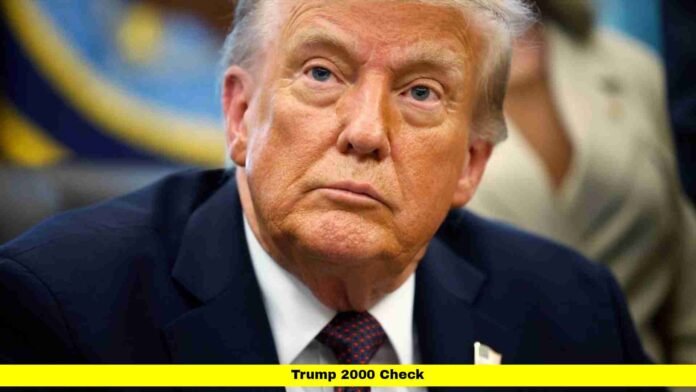

The Trump 2000 check proposal has become one of the most talked-about financial announcements in the United States this November. Former President Donald Trump recently proposed sending out $2,000 to Americans as part of what he calls a “tariff dividend”—a plan he says would return money earned from import tariffs back to U.S. citizens. As the nation watches closely, this idea has sparked both excitement and skepticism across political and economic circles.
What Is the Trump 2000 Check?
The Trump 2000 check refers to Trump’s announcement that Americans could receive a $2,000 payment funded by U.S. tariff revenue. Trump described this initiative as a “dividend” from the tariffs his administration has imposed on imported goods. According to his statement, the payment would go to “everyone except high-income people.”
He emphasized that tariffs collected from foreign imports have generated massive revenue for the country, and now, ordinary Americans should share in those gains. While the message struck a chord with millions, no official documentation or legislation has yet confirmed when or how these payments would be distributed.
Key Points Summary 🟢
- Proposal: Trump announced a $2,000 “tariff dividend” payment for eligible Americans.
- Funding Source: The payment would be financed through tariff revenue collected from imports.
- Eligibility: High-income individuals will reportedly be excluded.
- Current Status: No formal legislation or payment schedule has been released.
- Criticism: Economists question whether tariff revenue is sufficient to fund such a large-scale payout.
Why Trump Is Promoting the 2000 Check Plan Now
Trump’s proposal comes at a strategic political and economic moment. The idea of sending direct payments to Americans can have enormous appeal among voters facing inflation and high living costs.
By linking the dividend to tariff revenues, Trump is also attempting to justify the long-debated trade policies that raised import taxes on several countries. Supporters see this as an innovative way to ensure Americans directly benefit from trade enforcement, while critics view it as a populist promise designed to capture attention ahead of potential elections.
The announcement also arrives amid ongoing discussions about how tariff policies affect American consumers and businesses. The check serves as a symbolic attempt to redistribute the gains from tariffs back to citizens—especially those struggling with the rising cost of living.
How the Trump 2000 Check Would Work
While exact implementation details remain unclear, Trump outlined a few major points. The $2,000 would supposedly be distributed to all qualified Americans except for those considered high-income earners. The government would use tariff revenue collected from imported goods as the funding source for the checks.
The proposed payment is described as a dividend, not a stimulus, meaning it is meant to represent a share of the profit from tariffs rather than an emergency relief package. However, no official structure, eligibility threshold, or disbursement timeline has been provided by the administration.
Some reports suggest the checks could be distributed through direct bank deposits or as refundable tax credits, similar to how pandemic-era stimulus payments were processed. Yet, the plan has not advanced to the legislative or executive stage where such logistics would be confirmed.
Financial Reality Behind the Promise
Economists and fiscal experts have raised serious doubts about whether the Trump 2000 check could actually be funded from existing tariff revenues. Estimates suggest that even if tariffs brought in around $90 billion annually, the total cost of sending $2,000 to over 150 million Americans could exceed $300 billion.
This means that the current revenue stream from tariffs alone may be insufficient to fund such a massive payout. Without additional funding sources or significant cuts elsewhere, the program could place a major burden on federal finances.
Moreover, tariffs often lead to higher prices for imported goods, meaning U.S. consumers indirectly pay part of the cost. This could diminish the actual benefit of the $2,000 payment for many households. Economists argue that unless trade policies are carefully adjusted, the net gain for families might be smaller than anticipated.
Legal and Political Challenges
The Trump 2000 check faces both legal and procedural challenges. Redirecting tariff revenue for direct payments would likely require congressional approval. Tariff funds are traditionally used for specific government programs, and reassigning them to citizens could spark legal debates over executive authority and fiscal management.
In addition, the Supreme Court is reviewing several trade-related cases questioning whether tariffs imposed without congressional approval overstep presidential powers. If the Court limits executive authority in tariff collection or usage, it could significantly impact the feasibility of Trump’s proposed dividend.
Politically, Democrats and some Republicans have expressed skepticism about the practicality of the plan, arguing that it may be more symbolic than actionable. Still, the proposal has energized Trump’s supporters and drawn national attention to the debate over how tariff revenues should be used.
Who Could Qualify for the Trump 2000 Check
Although no finalized eligibility criteria have been released, Trump has stated that “high-income people” would not receive the payment. This suggests a possible income cap similar to previous stimulus programs.
If eligibility mirrors those past payments, the cut-off could fall around $75,000 per individual or $150,000 for joint filers. However, this is purely speculative until an official guideline is announced.
Those most likely to qualify would be:
- Middle- and lower-income individuals and families.
- U.S. citizens and legal residents.
- Individuals with valid tax identification or Social Security numbers.
Without further details, Americans are left waiting for concrete information on who qualifies, how to apply, and when payments might arrive.
Timeline of Key Events
| Date | Event |
|---|---|
| November 9, 2025 | Donald Trump announces a $2,000 “tariff dividend” via social media, excluding high-income earners. |
| November 10, 2025 | Treasury officials acknowledge the plan but confirm that no logistics or funding models have been finalized. |
| November 11, 2025 | Economists and analysts begin public debate on the financial feasibility of the plan, highlighting the gap between tariff revenue and total payout cost. |
Public Reaction to the Trump 2000 Check
The response from the public has been divided. Supporters have praised the idea as a patriotic and fair redistribution of America’s trade gains. They see it as a sign that Trump intends to prioritize American workers and families.
Critics, however, question whether the math adds up. They point out that tariffs often result in higher consumer prices and that redistributing tariff income may not fully compensate for those increased costs. Some also express concern about whether the proposal is politically motivated or designed to appeal to voters ahead of an election cycle.
Across social media, hashtags related to the Trump 2000 check have trended heavily, with thousands of users sharing opinions and speculating about when payments could start. The phrase “tariff dividend” has become a central topic in economic discussions and political talk shows throughout the week.
Economic Impact if the Plan Moves Forward
If the Trump 2000 check were implemented, it could have several potential effects on the U.S. economy. For lower- and middle-income Americans, the check would provide immediate financial relief, potentially boosting short-term consumer spending.
However, there are concerns that using tariffs as the main funding source could indirectly push prices higher, especially on imported goods like electronics, clothing, and food items. This could neutralize some of the benefits of the payout.
In broader terms, the policy could shift public perception of tariffs—from being a trade penalty to being a direct contributor to citizen welfare. It could also inspire future administrations to link tariff policies with domestic redistribution measures.
Expert Opinions on the Trump 2000 Check
Many financial analysts view Trump’s idea as ambitious but difficult to execute. They acknowledge that tariffs generate significant revenue, but not nearly enough to fund a $2,000 payment for every eligible citizen without causing a major fiscal deficit.
Legal scholars have also noted that the U.S. Constitution gives Congress power over federal spending. This means Trump’s plan would need congressional approval, even if the funds come from tariffs. The process could face long delays in debate and voting before reaching implementation.
Still, Trump’s supporters argue that the plan demonstrates creativity in finding new ways to deliver value to Americans without increasing taxes. They claim it’s an innovative model for making trade policy work for everyday citizens.
What Happens Next
The future of the Trump 2000 check depends on several key developments over the next few months. For the plan to advance, the administration would need to:
- Present a formal legislative proposal to Congress.
- Define eligibility criteria and income limits.
- Secure approval from the Treasury Department for funding allocation.
- Address potential legal challenges concerning tariff use.
Until these steps are taken, the plan remains a proposal rather than a confirmed policy. Nonetheless, it continues to dominate economic headlines and public debate as Americans wait for clarity on whether the $2,000 payment will become reality.
Final Thoughts
The Trump 2000 check proposal reflects Donald Trump’s continued effort to position himself as a champion of the American middle class. While the concept of turning tariff revenue into direct cash payments has generated considerable buzz, questions about legality, feasibility, and timing remain unanswered.
Whether or not these checks ever reach Americans’ bank accounts, the idea has already succeeded in reshaping conversations about trade, taxation, and government revenue. For now, Americans can only watch, wait, and hope that the plan—if approved—truly delivers on its $2,000 promise.
Stay tuned and share your thoughts in the comments below: would the Trump 2000 check make a difference in your household budget?