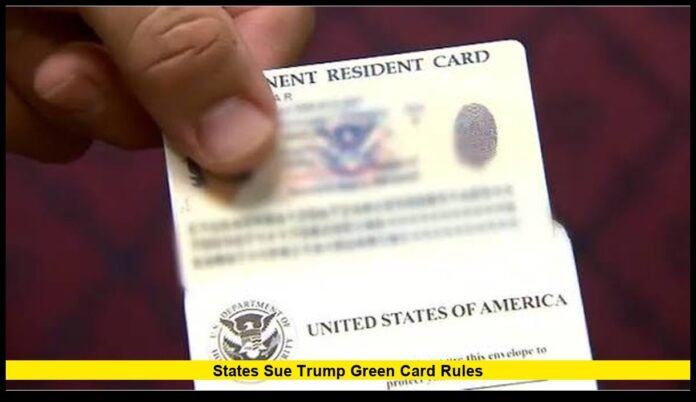

The states sue Trump green card rule dispute has intensified after 23 states and the District of Columbia, along with several major cities and counties, filed lawsuits challenging a new federal immigration policy that could make it harder for some immigrants to obtain lawful permanent residence. The lawsuits were filed on September 14, 2026, just days before the rule is scheduled to take effect.
The legal fight centers on the Trump administration’s revived public charge policy. The rule gives immigration officials broader authority to consider an applicant’s current or potential reliance on government benefits when deciding whether the person is likely to become primarily dependent on public assistance.
The Department of Homeland Security announced the final rule in July. According to U.S. Citizenship and Immigration Services, the policy rescinds the Biden-era 2022 public charge regulation and restores a broader, case-by-case approach to public-charge determinations. The rule is scheduled to become effective September 18, 2026.
Why States Are Suing the Trump Administration
The lawsuits argue that the new rule goes beyond the authority Congress gave the federal government and conflicts with the longstanding meaning of the public-charge provision in federal immigration law.
New York, California and Illinois are leading one multistate lawsuit involving 23 states and the District of Columbia. A separate lawsuit was filed by six cities and counties, including New York City, Chicago, San Francisco and Seattle. Both cases were filed in federal court in Manhattan.
The plaintiffs contend that the policy creates uncertainty for immigrant families because people may not know which forms of public assistance could affect an immigration decision.
The states also argue that the rule could discourage eligible families from seeking food assistance, health coverage and other government programs because of concerns about possible immigration consequences.
What the New Green Card Rule Does
The central issue is the federal government’s definition of a public charge.
Under U.S. immigration law, certain applicants for visas, admission or adjustment of status can be found inadmissible if immigration officials determine that they are likely to become a public charge.
The Trump administration’s new rule broadens the factors that immigration officials may consider when making that determination.
USCIS says the rescinded 2022 regulation had limited the benefits that could be considered. The agency said the new approach allows officers to evaluate all relevant facts and circumstances on a case-by-case basis.
The policy revives an approach associated with the Trump administration’s 2019 public-charge rule. That earlier policy was later abandoned, and the Biden administration implemented a narrower framework in 2022.
Could Food Stamps and Medicaid Affect Green Card Applications?
One of the biggest concerns raised by the lawsuits is the potential consideration of benefits such as SNAP food assistance and Medicaid.
Under the Biden-era framework, noncash benefits such as food stamps and Medicaid generally were not included in the public-charge determination. Cash assistance and Supplemental Security Income were among the benefits that could be considered under specified circumstances.
The new Trump administration policy removes the narrower 2022 framework and gives immigration officials greater flexibility to consider relevant public-benefit information.
That does not mean that every immigrant who receives a government benefit will automatically be denied a green card.
Instead, the policy involves an individualized determination of whether the applicant is likely to become primarily dependent on government support. Officials can consider multiple circumstances surrounding an applicant.
This distinction is important because headlines about the rule can make it appear that receiving a single benefit automatically prevents someone from obtaining permanent residency. The lawsuits and government descriptions instead focus on the broader discretion given to immigration officials.
What the Biden-Era Rule Changed
The dispute goes back several years.
During Trump’s first administration, the federal government adopted a broader public-charge policy in 2019. That policy expanded the circumstances under which certain public benefits could be considered in immigration decisions.
The Biden administration subsequently moved away from that approach and adopted a narrower regulation in 2022.
The Trump administration’s 2026 rule now rescinds the 2022 regulation and returns immigration adjudications to a broader framework.
The administration says the change is intended to reinforce the principle that immigrants should be financially self-reliant and should not become primarily dependent on taxpayer-funded government benefits. USCIS has described the change as an effort to align immigration policy with congressional intent.
States Say the Rule Creates Fear and Uncertainty
The states challenging the policy argue that the effects could extend beyond immigrants who are directly applying for green cards.
They say families could become reluctant to use benefits for which they are legally eligible because they fear those benefits could eventually affect an immigration application.
New York Attorney General Letitia James said the rule could encourage families to give up food assistance, healthcare coverage and other legally available benefits because of uncertainty surrounding immigration consequences.
The local-government lawsuit similarly argues that the policy could affect state and municipal programs by discouraging eligible residents from accessing public services.
The plaintiffs are asking the federal courts to block implementation of the rule before it takes effect.
What the Trump Administration Says
The administration’s position is that immigration officials should be able to consider relevant information when determining whether an applicant is likely to become primarily dependent on public support.
USCIS said the 2026 rule restores a broader ability to assess the circumstances of individual applicants rather than restricting officers to a limited list of benefits.
The administration has also pursued other changes affecting legal immigration during 2026, including changes to the adjustment-of-status process for people seeking green cards from inside the United States.
The public-charge rule is therefore part of a broader series of immigration-policy changes rather than an isolated adjustment to the green card system.
When Does the Rule Take Effect?
The new public-charge regulation is scheduled to take effect on September 18, 2026. USCIS has said it will also publish a revised Form I-485, the application used to register permanent residence or adjust status. The agency said older versions of the form submitted or postmarked on or after the effective date will not be accepted.
However, the lawsuits filed on September 14 could affect whether the regulation actually takes effect as scheduled.
The federal courts could issue an order blocking the rule, allowing the litigation to proceed while the government is prevented from implementing some or all of the policy.
What Happens Next in the Lawsuits?
The immediate focus will be on whether the plaintiffs can persuade a federal judge to stop the rule before its scheduled effective date.
The states and local governments are challenging the policy under the Administrative Procedure Act, arguing that the Department of Homeland Security exceeded its statutory authority and improperly departed from the historical interpretation of the public-charge provision.
The federal government will have an opportunity to defend the rule in court.
The litigation could ultimately determine whether the rule remains in place, is modified, or is blocked. Until a court issues an order changing the policy, the announced September 18 effective date remains the scheduled date for implementation.
What Green Card Applicants Should Know
People applying for lawful permanent residence should be careful about interpreting the lawsuits as an immediate automatic change to every green card case.
The new policy concerns the government’s assessment of whether certain applicants are likely to become public charges. It does not establish that every recipient of Medicaid, food assistance or another benefit will automatically lose eligibility for a green card.
At the same time, the broader policy gives immigration officials more factors to evaluate than the Biden-era framework allowed.
Applicants with pending or planned adjustment-of-status cases should therefore pay attention to official USCIS updates and developments in the federal court cases.
Immigration rules can be highly fact-specific, and applicants facing questions about benefits, adjustment of status or admissibility may need advice from a qualified immigration attorney.
States Sue Trump Green Card Rule: Latest Update
The latest development is the filing of lawsuits by a coalition of states and local governments seeking to stop the Trump administration’s new public-charge rule.
The multistate case involves 23 states and the District of Columbia, while a separate case includes six cities and counties. New York, California and Illinois are among the states leading the challenge, while New York City, Chicago, San Francisco and Seattle are among the local governments involved in the separate lawsuit.
The rule is currently scheduled to take effect on September 18, 2026.
The central legal question is whether the Trump administration can lawfully give immigration officials broader authority to consider public benefits and other financial circumstances when determining whether someone seeking permanent residence is likely to become a public charge.
The outcome of the lawsuits could determine how public benefits are treated in green card and other immigration decisions going forward.
Key Points Summary
╔════════════════════════════════════════════════════════════════════╗
║ – 23 states and the District of Columbia have sued to block the Trump administration’s new public-charge immigration rule. ║
║ – A separate lawsuit was filed by six cities and counties, including New York City, Chicago, San Francisco and Seattle. ║
║ – The rule could allow immigration officials to consider a broader range of public benefits when evaluating some green card applications. ║
║ – The Trump administration says the policy restores a broader, case-by-case public-charge assessment and promotes financial self-reliance. ║
║ – The new rule is scheduled to take effect on September 18, 2026, but the lawsuits could affect its implementation. ║
╚════════════════════════════════════════════════════════════════════╝