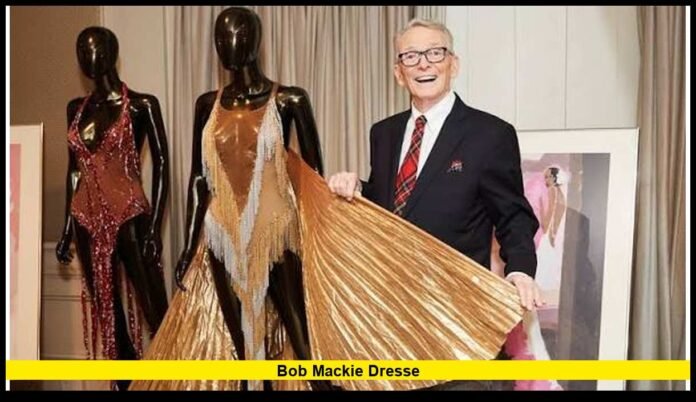

Bob Mackie dresses have long represented a distinctive kind of American glamour: sparkling, theatrical, playful and designed to command attention. From legendary stage costumes worn by Cher and Diana Ross to elegant evening gowns preserved in major museum collections, Mackie’s work helped redefine what a celebrity dress could be.
The latest update is especially significant for fashion fans. Bob Mackie died on September 14, 2026, at age 87, leaving behind one of the most recognizable design legacies in American entertainment. His death has renewed interest in the dresses, costumes and sketches that made his name synonymous with sequins, feathers, rhinestones, dramatic silhouettes and unapologetic glamour.
Who Was Bob Mackie?
Bob Mackie was an American fashion and costume designer whose career stretched across film, television, theater, music and ready-to-wear fashion. He became particularly famous for creating memorable looks for some of the biggest entertainers of the 20th century.
Mackie began his professional career as a sketch artist in Hollywood and worked with major costume designers before establishing his own reputation. His talent for translating a performer’s personality into clothing eventually led to collaborations with stars including Cher, Carol Burnett, Diana Ross, Tina Turner, Elton John, Judy Garland and many others.
His television work became an especially important part of his career. He was closely associated with The Carol Burnett Show, where costume design was often used not simply to make performers look glamorous but also to create humor, characters and unforgettable visual moments.
Over the course of his career, Mackie earned nine Emmy Awards, received three Academy Award nominations and won a Tony Award for his work associated with The Cher Show. He was also inducted into the Television Academy Hall of Fame.
What Makes Bob Mackie Dresses So Recognizable?
The strongest characteristic of Mackie’s work was his willingness to make clothing theatrical.
His designs frequently incorporated:
- Sequins and rhinestones
- Feathers and fringe
- Metallic fabrics
- Dramatic sleeves
- Plunging necklines
- Sheer panels
- Body-conscious silhouettes
- Elaborate embellishment
- Bold color combinations
- Playful and exaggerated proportions
Rather than treating a dress as a simple garment, Mackie often approached it as part of a complete performance. The clothing had to work under stage lights, communicate a personality and remain memorable from a distance.
That approach explains why so many of his best-known dresses became cultural landmarks rather than simply examples of period fashion.
Cher and the Bob Mackie Dress Legacy
Cher remains perhaps the celebrity most strongly associated with Bob Mackie dresses.
Their creative partnership produced some of the most recognizable celebrity fashion moments of the modern era. Mackie understood that Cher could carry highly revealing, elaborate and unconventional designs without allowing the clothing to overwhelm her presence.
One of their most famous collaborations was Cher’s 1974 Met Gala look, a sheer, feather-trimmed design often described as a “nude illusion” gown. The dress became an important example of Mackie’s ability to combine glamour, daring construction and theatrical spectacle.
Mackie also designed numerous costumes for Cher’s television appearances, concerts and red-carpet events. Her famous 1986 Academy Awards look, featuring black sequins, dramatic embellishment and a distinctive feathered headpiece, remains one of the defining examples of their collaboration.
The relationship between designer and performer was unusually productive because Mackie designed with Cher’s personality in mind. The result was fashion that felt specific to the wearer rather than interchangeable.
Marilyn Monroe and a Historic Hollywood Moment
Mackie’s connection to Marilyn Monroe is another important part of his legacy.
In 1962, while working with designer Jean Louis, Mackie sketched the design associated with Monroe’s famous “Happy Birthday, Mr. President” appearance for President John F. Kennedy.
The crystal-covered, figure-hugging dress became one of the most famous garments in American popular culture. Although the finished garment is closely associated with Jean Louis, Mackie’s role as the young designer who sketched the concept is an important part of the story of the iconic look.
The episode also demonstrates how Mackie’s career developed within Hollywood’s costume-design system before he became a major name in his own right.
Bob Mackie Dresses at Major Museums
Mackie’s work is not limited to celebrity photographs and television archives. His designs have entered important museum collections.
The Metropolitan Museum of Art’s Costume Institute holds Bob Mackie evening dresses dating from the 1970s and 1980s. These objects provide a useful record of how his approach to glamour developed during a period when American fashion was becoming increasingly visible on the international stage.
The Smithsonian’s National Museum of American History also documents Mackie’s work, including a dress connected to Cher’s famous 1974 Met Gala appearance.
Museum collections are particularly important because they preserve Mackie’s designs as fashion history rather than treating them solely as entertainment costumes.
The 2026 Return of Bob Mackie on the Red Carpet
Mackie’s influence continued to appear in major fashion moments even in 2026.
At the 2026 Met Gala, Sabrina Carpenter wore a gold-fringed Bob Mackie look during an outfit change inside the event. The appearance demonstrated how Mackie’s visual language—movement, shine, fringe and old-Hollywood theatricality—continues to appeal to younger performers.
The look also showed that archival Mackie designs can function in contemporary celebrity fashion without losing the identity that made them distinctive in the first place.
Bob Mackie’s Final Chapter and His Passing
The latest update surrounding Bob Mackie is his death on September 14, 2026, at the age of 87.
News of his passing brought renewed attention to the extraordinary range of his career. He had spent decades moving between television, film, Broadway, concerts, fashion collections and celebrity styling.
His work had also remained part of contemporary popular culture. Younger performers and stylists continued to revisit archival Mackie pieces, while museums and fashion institutions continued to recognize his contribution to American design.
The cause of death was not immediately disclosed in reports announcing his passing.
The JCPenney Apparel Dispute
Mackie’s name was also involved in a notable apparel-business dispute in 2026.
A legal case involving JCPenney and Mackie’s longtime business partner concerned the use of the designer’s name, signature and likeness in a clothing line. Mackie had objected to the use of his identity and argued that the collection had not been authorized by him.
The dispute was settled in July 2026, with the terms of the settlement not publicly disclosed.
The case highlighted an important issue surrounding established fashion names: protecting a designer’s identity and reputation can become increasingly complicated when a recognizable name is used across modern retail products.
Were Bob Mackie Dresses Only for Celebrities?
No. Although Mackie’s celebrity costumes are his most famous creations, his career also included ready-to-wear fashion and commercial collections.
He developed clothing that brought elements of his theatrical aesthetic into more accessible fashion. His work eventually reached consumers through retail partnerships and television shopping, helping introduce his signature glamour to audiences beyond Hollywood and Broadway.
That commercial history is important because it shows that Mackie’s influence was not limited to red carpets or stage performances. His ideas about sparkle, confidence and visual drama became part of mainstream American fashion.
Why Vintage Bob Mackie Dresses Remain Popular
Vintage Mackie pieces continue to attract attention because they are instantly recognizable and closely connected to entertainment history.
Collectors and vintage-fashion enthusiasts often look for:
- Original Bob Mackie labels
- Dramatic evening gowns
- Sequined cocktail dresses
- Beaded stage costumes
- Feather-trimmed designs
- Metallic fabrics
- 1970s and 1980s silhouettes
- Documented celebrity provenance
- Original sketches and fashion illustrations
Condition is particularly important. Sequins, rhinestones, delicate fabrics, feathers and vintage embellishments can deteriorate over time. A well-preserved example with strong provenance can be especially desirable to collectors.
Buyers should also distinguish between genuine vintage designs, later licensed products and modern garments carrying the Bob Mackie name.
Bob Mackie Dresses and the Future of American Fashion
Mackie’s influence is likely to continue well beyond his lifetime.
Today’s red carpets frequently reward dramatic fashion. Performers are increasingly interested in archival clothing, vintage references and designs with strong historical identities. Mackie’s work fits naturally into that environment because his garments were created to produce a reaction.
His approach also offers a counterpoint to minimalist fashion. Mackie believed clothing could be joyful, humorous and spectacular. His dresses were not designed to disappear into the background.
That philosophy continues to resonate with performers who use fashion as part of their public identity.
The Lasting Legacy of Bob Mackie
Bob Mackie’s greatest achievement may be the way he transformed celebrity clothing into a form of storytelling.
His designs could make a performer appear glamorous, mischievous, powerful, extravagant or deliberately outrageous. He understood that a successful costume could become inseparable from the person who wore it.
From Cher’s unforgettable stage and red-carpet appearances to Carol Burnett’s television comedy, Marilyn Monroe’s historic Hollywood moment and the continued revival of his work by contemporary stars, Mackie’s designs have remained remarkably visible.
His death in 2026 marks the end of a major chapter in American fashion history, but the dresses themselves remain part of the visual language of entertainment. They continue to appear in museums, archives, auctions, red carpets and fashion retrospectives.
For anyone searching for the most memorable examples of American celebrity fashion, Bob Mackie dresses remain an essential part of the story.
Key Points Summary
╔════════════════════════════════════════════════════════════════════╗
║ – Bob Mackie died on September 14, 2026, at age 87, leaving a major legacy in American fashion and costume design. ║
║ – His most famous work includes dazzling dresses and costumes created for Cher, Carol Burnett, Diana Ross and other entertainment icons. ║
║ – Mackie’s signature style featured sequins, rhinestones, feathers, fringe, metallic fabrics and theatrical silhouettes. ║
║ – His designs are preserved in major museum collections, including the Metropolitan Museum of Art and the Smithsonian. ║
║ – Sabrina Carpenter’s 2026 Met Gala appearance helped demonstrate the continuing relevance of Mackie’s archival fashion. ║
╚════════════════════════════════════════════════════════════════════╝