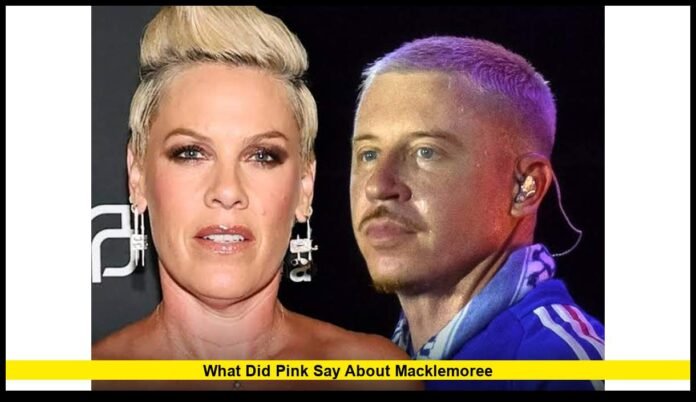

The question what did Pink say about Macklemore has become a major entertainment talking point after the singer addressed the backlash surrounding the rapper’s recent pro-Palestinian performances during Ed Sheeran’s U.S. tour. What began with Pink sharing a critical social media post quickly developed into a much larger debate involving political expression, Jewish identity, Palestinian rights, antisemitism and the role of musicians in addressing international conflicts from a concert stage.
Pink’s response ultimately went far beyond a brief reaction to Macklemore. In a lengthy personal statement, she explained that she felt misrepresented by the reaction to her social media activity and wanted people to understand her position in her own words.
The controversy has continued to grow, particularly after Macklemore was removed from the remaining U.S. dates of Sheeran’s tour following objections from venues over his political remarks.
How the Controversy Started
The dispute began after Macklemore appeared as an opening act during Ed Sheeran’s concerts at MetLife Stadium in New Jersey earlier this month.
Macklemore used his performance to make a strong political statement about the Israel-Gaza conflict. He performed his protest song “Hind’s Hall” and used the concert platform to express support for Palestinians.
The rapper also called for Palestinian freedom and spoke directly to Jewish members of the audience. His remarks were intended to distinguish criticism of Israel and its government from criticism of Jewish people.
The performance received a strong response from the crowd, but it also generated criticism from groups and individuals who argued that a major concert should not be used to deliver such politically charged messaging.
Pink subsequently shared an Instagram Story containing criticism of Macklemore’s performance.
That single social media action quickly placed the singer at the center of the controversy.
What Pink Initially Shared
Pink did not initially publish a lengthy explanation of her own position.
Instead, she reposted material from a social media account that criticized Macklemore’s performance and objected to the political content presented during the concert.
The repost was interpreted by many people as Pink personally endorsing every statement contained in the original material.
The reaction was immediate.
Some people praised Pink for speaking out. Others accused her of unfairly attacking Macklemore and suggested that her response amounted to opposition to Palestinian advocacy.
As criticism intensified, Pink began responding to the broader discussion and eventually released a detailed statement explaining what she actually believed.
That clarification became much more significant than the original repost.
Pink Says the Repost Did Not Represent Everything She Believes
One of the central points of Pink’s explanation was that she did not write the original post she shared.
She acknowledged that the wording included statements she would not necessarily have used herself.
Pink argued that social media can make complicated political disputes appear far simpler than they really are. According to her explanation, sharing somebody else’s post should not automatically mean that she agrees with every word, argument or characterization contained within it.
This distinction became especially important because much of the online reaction focused on assumptions about her political beliefs.
Pink said she wanted people to judge her based on what she personally says rather than on words written by someone else.
Her longer response was therefore an attempt to move the conversation away from the original repost and toward her own position.
Pink Explained Her Jewish Identity
Pink also made her Jewish identity a major part of her response.
She explained that she was born Jewish and had never attempted to hide that part of her background.
The singer said that many people had quickly reached conclusions about her political beliefs simply because she had shared criticism of Macklemore and because of her Jewish identity.
Pink objected to that approach.
She argued that being Jewish does not mean she automatically supports every action taken by the Israeli government. At the same time, she said she should be allowed to discuss Jewish fear, safety and identity without being accused of supporting violence against Palestinians.
That distinction is one of the most important elements of her statement.
Pink Says She Does Not Speak for Israel
Pink was also careful to separate her personal views from the Israeli government.
She made clear that she does not speak for Israel or for any government.
Instead, she described her position as one centered on protecting innocent people while recognizing the rights and humanity of Palestinians.
She reiterated that she considers Hamas a terrorist organization while also saying Palestinians deserve a future that recognizes their humanity and aspirations.
Her comments attempted to reject the idea that supporting Palestinian civilians and caring about Jewish safety must automatically be opposing positions.
For Pink, the issue was more complicated than choosing one side of a political argument.
Her Main Concern Was the Concert Environment
Pink’s criticism of Macklemore was not simply about the words “Free Palestine.”
That distinction was particularly important in her explanation.
She said she wanted to be able to describe her reaction to the performance without being accused of supporting genocide or rejecting Palestinian rights.
Her concern centered on how she believed the performance affected Jewish people attending the concert.
Macklemore’s performance included political imagery connected to the war in Gaza, as well as his protest song and remarks about Palestinian freedom.
Pink viewed the combination of the imagery, the political message and the setting as something that could make Jewish members of the audience feel frightened or targeted.
She said that people should be able to acknowledge that fear without immediately dismissing it as propaganda.
Pink Was Not Calling for Macklemore to Be Silenced
Another important part of Pink’s statement was her position on free speech.
She did not say Macklemore should be prohibited from expressing his political views.
She also did not say that artists should be prevented from discussing Palestine, Israel or other international issues.
Instead, Pink emphasized that Macklemore had the right to speak, while she also had the right to explain why his presentation made her uncomfortable.
That distinction helped shape the second stage of the controversy.
The debate was no longer simply about whether Macklemore’s remarks were appropriate. It became a broader discussion about whether musicians can disagree publicly without demanding that the other person lose their platform.
Pink’s position was that disagreement should remain possible.
Pink Pointed to Her Own History of Political Activism
Pink also defended herself against suggestions that she had suddenly become unwilling to take political positions.
Throughout her career, the singer has spoken about controversial subjects, including war, LGBTQ+ rights and other social issues.
In her statement, she recalled her history of expressing unpopular opinions even when doing so generated criticism.
She pointed to her 2006 song “Dear Mr. President” as an example of her willingness to criticize political leadership.
Her broader argument was that she had spent years standing up for causes she believed in, including issues involving children and marginalized communities.
Therefore, she rejected the idea that her criticism of Macklemore meant she had abandoned her history of activism.
Why Pink Mentioned Macklemore’s Earlier Controversy
Pink also brought up a previous controversy involving Macklemore.
The rapper had faced criticism years ago after appearing in a costume that was widely condemned as an antisemitic stereotype.
Macklemore apologized for that incident.
Pink said she had accepted his apology at the time and moved forward.
Her decision to mention the episode in the current controversy showed that she was viewing Macklemore’s recent performance in the context of his previous actions.
However, she did not present the earlier controversy as the only reason for her current concerns.
Instead, she connected it with what she saw as the impact of the MetLife Stadium performance.
Macklemore’s Message Was Focused on Palestine
Macklemore has been publicly outspoken about Palestinian rights for years.
During his performances with Sheeran, he continued that position.
He performed “Hind’s Hall,” a song released in support of pro-Palestinian student demonstrations and criticism surrounding the war in Gaza.
He also used the concert stage to call for freedom for Palestinians and to express opposition to other forms of oppression.
During one performance, Macklemore directly addressed Jewish audience members.
His message was that criticism of Israel should not automatically be treated as criticism of Jewish people.
That distinction was central to his own defense.
However, Pink disagreed with the way he delivered the message and said Jewish people should be allowed to explain their own feelings about the performance.
The Controversy Expanded Beyond Pink and Macklemore
What started as a disagreement between two musicians soon became part of a much larger public debate.
Advocacy organizations criticized Macklemore’s use of the concert stage for political messaging.
Supporters of the rapper defended his decision to speak about Palestinian suffering and argued that musicians should not be expected to remain silent about humanitarian crises.
Pink’s comments then created another layer of the discussion.
Some people viewed her position as a defense of Jewish audiences. Others argued that she was unfairly criticizing Macklemore for supporting Palestinians.
The debate became increasingly intense on social media, where short clips and individual comments were circulated without the broader context of the musicians’ positions.
Macklemore Was Removed From the Remaining U.S. Tour Dates
The controversy took a significant turn on September 14, when it was reported that Macklemore would no longer appear on the remaining U.S. dates of Ed Sheeran’s tour.
The decision followed objections from venues over Macklemore’s political statements.
Tour organizers said continuing with the rapper could create problems for upcoming shows because some venues were unwilling to host performances featuring him.
That development dramatically increased the attention surrounding the dispute.
Macklemore has continued to defend his decision to speak about Palestine, while the controversy over his removal has raised new questions about artistic freedom and the commercial realities facing major concert tours.
What Pink’s Comments Mean in the Larger Debate
Pink’s response illustrates how difficult it has become for public figures to discuss the Israel-Gaza conflict without being placed immediately into one political category.
Her statement attempted to hold several positions at once.
She said Hamas is a terrorist organization.
She said Palestinians deserve dignity, humanity and a future.
She said innocent lives must be protected.
She said she does not represent the Israeli government.
And she also said Jewish people should be allowed to discuss fear and antisemitism without being dismissed.
These positions do not fit easily into a simple social media argument.
That complexity appears to be exactly what Pink wanted people to understand.
Pink Says People Do Not Have to Agree With Her
Toward the end of her statement, Pink addressed people who were angry with her.
She essentially argued that disagreement has always been part of being a public figure.
Fans do not have to agree with every political opinion she expresses.
At the same time, she believes they should listen to what she actually says rather than assigning beliefs to her based on a repost or her Jewish identity.
She also emphasized that people from different communities can be frightened by the same conflict for different reasons.
That message was directed not only at Macklemore’s supporters but also at people who felt caught between competing political narratives.
Why This Story Continues to Attract Attention
The controversy has become particularly significant because both Pink and Macklemore have established reputations for speaking about social and political issues.
Neither artist is known for completely avoiding difficult subjects.
That makes their disagreement more consequential than a typical celebrity social media dispute.
Macklemore believes his platform can be used to highlight Palestinian suffering.
Pink believes she should be able to criticize how that message is presented while defending the concerns of Jewish audience members.
The removal of Macklemore from the remaining U.S. tour dates has added another dimension, turning the dispute into a debate over whether political expression can have professional consequences in the entertainment industry.
What Did Pink Say About Macklemore? The Main Takeaway
So, what did Pink say about Macklemore after the controversy erupted?
Pink initially shared criticism of Macklemore’s pro-Palestinian concert performance, but she later made clear that the original social media post was not entirely written in her own words.
Her longer statement focused on her Jewish identity, her concern about how Macklemore’s performance affected Jewish concertgoers and her belief that innocent people on all sides deserve protection.
She rejected the idea that she was demanding Macklemore be silenced and emphasized that Palestinians deserve humanity and a future.
At the same time, she defended her right to say that the performance frightened her and people close to her.
The dispute has now become part of a much larger conversation about music, politics, free speech and the responsibilities of performers when addressing one of the world’s most divisive conflicts.
With Macklemore now removed from the remaining U.S. dates of Sheeran’s tour, the debate is unlikely to disappear quickly. Instead, it may continue to shape conversations about political expression at concerts and the increasingly complicated relationship between entertainment and activism.
╔════════════════════════════════════════════════════════════════════╗
║ – Pink clarified that the social media post she shared criticizing Macklemore did not represent every word of her own views. ║
║ – She said her concerns centered on the impact of Macklemore’s concert presentation on Jewish audience members. ║
║ – Pink emphasized that Palestinians deserve humanity, dignity and a future while also condemning Hamas and antisemitism. ║
║ – She said she was not calling for Macklemore to be silenced and defended his right to express his views. ║
║ – Macklemore was removed from the remaining U.S. dates of Ed Sheeran’s tour after venues objected to the controversy surrounding his political remarks. ║
╚════════════════════════════════════════════════════════════════════╝