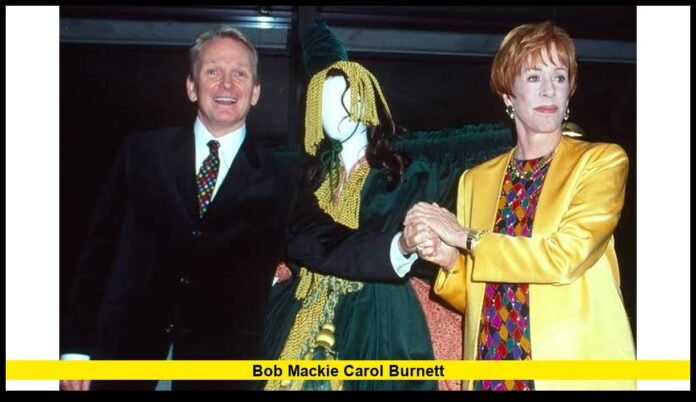

The story of bob mackie carol burnett remains one of the most memorable collaborations in American television, combining a legendary comedian’s fearless performances with a costume designer’s extraordinary imagination. Bob Mackie, who died at age 87 on September 14, 2026, created some of the most recognizable looks in entertainment, but his work with Carol Burnett holds a particularly special place in television history.
For viewers who remember The Carol Burnett Show, Mackie’s costumes were far more than clothing. They helped establish characters, sharpen punchlines, create visual comedy and transform ordinary sketches into unforgettable moments. His ability to understand Burnett’s comic instincts made him an unusually important part of the show’s creative identity.
Bob Mackie’s Death Brings Renewed Attention to His Career
Mackie’s death has prompted widespread recognition of a career that stretched across television, film, Broadway and fashion.
The designer was known for his spectacular use of sequins, feathers, rhinestones, beads and elaborate silhouettes. He created memorable looks for performers including Cher, Diana Ross, Tina Turner, Dolly Parton, Barbra Streisand and Madonna. His work earned nine Emmy Awards, a Tony Award and three Academy Award nominations.
Yet alongside the glamorous gowns and stage costumes was another side of Mackie’s talent: comedy.
That talent became particularly visible on The Carol Burnett Show, where he remained closely involved for the program’s entire 11-season run.
Mackie’s approach was unusual because he could make a costume look glamorous while simultaneously making it funny. He understood that a comedian might need a ridiculous silhouette, an exaggerated hat or an intentionally awkward outfit to communicate a character instantly.
That understanding made him a perfect creative partner for Burnett.
How Carol Burnett and Bob Mackie Began Working Together
Burnett’s relationship with Mackie began before The Carol Burnett Show premiered in 1967.
Burnett had seen Mackie’s costume work on television and was impressed by the visual quality of his designs. She and her husband sought him out for the new CBS variety program.
Mackie was still relatively young at the time, but he quickly demonstrated that he understood exactly what Burnett needed.
The show was not a conventional sitcom. Every episode could contain movie parodies, musical performances, recurring characters, celebrity appearances, elaborate production numbers and rapid costume changes.
That meant Mackie needed to design for many different purposes.
One costume might have to look elegant from a distance. Another might need to exaggerate Burnett’s body language. A third could exist almost entirely to deliver a punchline.
Mackie embraced all of those challenges.
Costumes Became Part of Carol Burnett’s Comedy
One of the reasons the Burnett-Mackie partnership worked so well was that Burnett understood how much information a costume could provide.
When she stepped onto the stage wearing a particular outfit, the audience could immediately understand something about the character.
Mackie often exaggerated small details to create that effect.
A skirt could be made unusually tight to produce a comic walk. A hairstyle could become part of the joke. A hat could make a character appear ridiculous before she said a word.
This was especially effective because Burnett was a highly physical performer. Her facial expressions, posture, movement and timing were central to her comedy.
Mackie’s designs gave her another performance tool.
Rather than restricting her, the right costume helped Burnett discover how a character should move.
The “Went With the Wind” Dress Became Television History
No discussion of their collaboration is complete without the famous curtain dress from the 1976 “Went With the Wind” sketch.
The segment was a parody of Gone With the Wind, with Burnett playing Starlet O’Hara, a deliberately exaggerated version of Scarlett O’Hara.
The original concept was relatively simple. Burnett would appear wearing curtains, referencing the famous scene in which Scarlett fashions a dress from the drapes at Tara.
Mackie decided the idea could be made much funnier.
Instead of simply allowing the curtains to hang around Burnett, he incorporated the curtain rod into the costume itself. The rod remained visibly attached across her shoulders, while the green velvet material formed the dress.
A valance was also transformed into a headpiece.
The result was absurd, theatrical and immediately understandable.
It was exactly the kind of visual gag that could become funnier simply because the audience could not believe what they were seeing.
Why the Curtain Dress Worked So Well
The genius of the costume was its simplicity.
Viewers instantly recognized the reference to Gone With the Wind. But the sight of Burnett walking onto the stage with the curtain rod still attached transformed the familiar movie moment into pure slapstick.
The costume also worked with Burnett’s performance style.
She did not need to explain why the dress was funny. The visual did the work.
That allowed the dialogue and reactions from the other performers to build on the joke rather than establish it.
The costume eventually became so famous that it was preserved by the Smithsonian’s National Museum of American History.
That recognition helped elevate it beyond the world of television props. It became an artifact of American popular culture and an example of how costume design can contribute directly to comedy.
The Smithsonian Preserved an Iconic Mackie Creation
The curtain dress was donated to the Smithsonian in 2009 by Mackie and Burnett.
Its preservation is significant because relatively few television costumes become cultural artifacts. Most are designed for a particular production and then disappear after filming.
The Burnett costume was different.
Its recognizable design, connection to a landmark television program and importance to comedy history made it worthy of preservation.
The costume demonstrates Mackie’s ability to take an established visual idea and push it into something completely unexpected.
It also captures a defining characteristic of The Carol Burnett Show: the willingness to take familiar entertainment and parody it without losing the affection audiences had for the original material.
Mackie Designed for Characters, Not Just Stars
Mackie’s work with Burnett also demonstrates the difference between fashion design and costume design.
Fashion often asks whether an outfit is beautiful, fashionable or flattering.
Costume design asks a different question: What does this clothing tell the audience about the person wearing it?
Mackie understood the distinction.
For Burnett, he could create intentionally unflattering outfits when the character demanded it. He could exaggerate proportions or use unusual materials if doing so strengthened the performance.
The goal was not always beauty.
The goal was character.
That principle helped make Mackie’s work so effective in comedy.
Eunice and Other Memorable Characters
Burnett’s recurring characters gave Mackie additional opportunities to develop recognizable visual identities.
Eunice is one of the clearest examples.
The character’s appearance became inseparable from her personality. The clothes suggested an everyday woman rather than a glamorous television star, helping Burnett disappear into the role.
Mackie understood that recurring characters needed visual consistency.
Audiences should be able to recognize a character almost immediately.
That recognition was particularly valuable in a variety program where sketches could change rapidly.
A costume became shorthand.
The audience saw the outfit and knew who had arrived.
The Importance of Quick Costume Changes
The production demands of The Carol Burnett Show were enormous.
A single episode could require performers to appear as several different characters. Musical numbers required additional wardrobes, while celebrity guests could bring their own costume requirements.
Mackie therefore had to think beyond individual outfits.
He had to consider timing, movement, construction and backstage practicality.
Burnett and the other performers sometimes needed to change costumes extremely quickly between scenes.
Mackie’s work had to accommodate the pace of television production without sacrificing visual impact.
That combination of artistry and practicality was one of his greatest strengths.
Bob Mackie’s Humor Was Central to His Design Style
Mackie became internationally known for glamorous celebrity fashion, but his own descriptions of his career frequently emphasized the pleasure he found in making people laugh.
That quality distinguished him from designers who focused exclusively on conventional beauty.
He could create an extravagant gown for a singer and then design a deliberately ridiculous costume for a comedy sketch without treating either assignment as less important.
For Mackie, both required imagination.
This versatility eventually became one of the defining characteristics of his career.
His Work With Cher Became Another Major Legacy
Although Burnett’s television costumes remain essential to Mackie’s story, his career expanded dramatically beyond the comedy show.
His partnership with Cher became one of the most influential designer-performer relationships in popular culture.
Mackie created costumes that emphasized Cher’s individuality and helped establish her daring visual identity.
His work with Diana Ross, Tina Turner, Dolly Parton and other performers similarly demonstrated his ability to build a complete visual world around a performer.
The common thread was confidence.
Mackie’s costumes rarely attempted to make performers disappear.
Instead, they amplified their personalities.
Mackie’s Influence Extended Across Generations
Mackie’s designs did not disappear with the era in which they were created.
Decades after his most famous television work, archival Mackie pieces continued appearing on contemporary performers.
Younger entertainers have repeatedly returned to his designs for red-carpet appearances, performances and special events.
That renewed interest demonstrates the enduring quality of his work.
What might once have looked like an exaggerated television costume can later appear as a source of inspiration for modern fashion.
His influence has therefore crossed generations.
Carol Burnett’s Connection to Mackie’s Legacy
Burnett’s career is inseparable from the visual world Mackie helped create.
Her performances supplied the personality and comic timing, while Mackie’s designs gave those performances an additional visual dimension.
Their collaboration also represented an unusually close relationship between performer and costume designer.
Burnett trusted Mackie to understand what would make a character work.
Mackie understood that Burnett was willing to look silly if the joke demanded it.
That mutual trust created opportunities that might not have been possible with a performer concerned primarily with appearing glamorous.
Why Their Collaboration Still Matters
The legacy of the Burnett-Mackie partnership goes beyond a collection of famous costumes.
It demonstrates how television comedy can be strengthened when every element of production works toward the same joke.
Writing, acting, staging, music, makeup and costume all contribute to a successful sketch.
Mackie understood his role as part of that larger process.
His costumes were not isolated fashion statements. They were components of a performance.
That philosophy explains why some of his creations remain recognizable decades later.
Bob Mackie’s Legacy After His Death
Mackie’s death at 87 marks the passing of one of the most influential American costume designers of the modern entertainment era.
His career included television, movies, Broadway productions, fashion collections and celebrity wardrobes. He also helped establish a visual language in which glamour could coexist with humor and theatrical exaggeration.
For Carol Burnett, his contribution was particularly meaningful because his costumes became part of some of her most beloved characters.
The curtain dress remains the clearest symbol of their partnership.
It is funny even without dialogue, instantly recognizable even without context and still capable of making audiences smile decades after it first appeared.
That is an extraordinary achievement for a costume.
The Enduring Place of Bob Mackie and Carol Burnett in Television History
The enduring fascination with bob mackie carol burnett comes from more than two famous names appearing together in the credits of a classic television show.
Their collaboration represented a rare meeting of performance and design.
Burnett possessed extraordinary comic timing and a willingness to transform herself for a joke. Mackie possessed the imagination to create costumes that could turn those transformations into visual events.
Together, they helped establish a standard for television costume comedy that remains influential.
Mackie’s career may ultimately be remembered for many things: his dazzling celebrity designs, his Broadway achievements, his awards and his contribution to American fashion.
But for millions of television viewers, one image will always stand apart.
Carol Burnett walking down the staircase in a green curtain dress, with the curtain rod still resting across her shoulders, perfectly captures what made Mackie special.
He knew that fashion could be glamorous.
He knew it could be dramatic.
Most importantly, he knew it could be funny.
And through his work with Carol Burnett, he proved that a costume could become a character, a punchline and a piece of television history all at once.
As audiences revisit Bob Mackie’s remarkable career following his death, his unforgettable work with Carol Burnett remains a lasting reminder of the magic created when comedy and costume design meet at exactly the right moment.