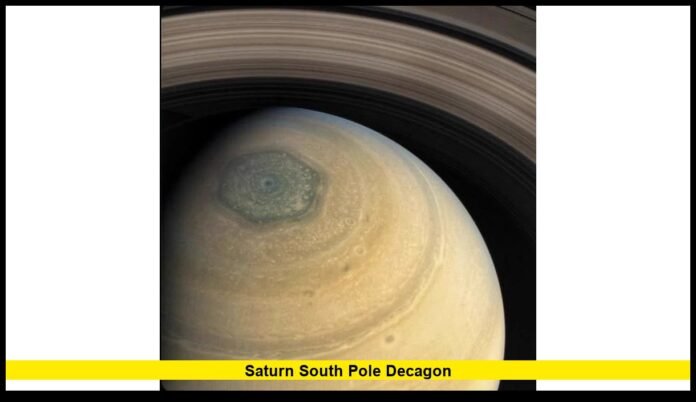

saturn south pole decagon observations are giving astronomers a remarkable new look at Saturn’s atmosphere. NASA’s Hubble Space Telescope has identified a giant, evolving 10-sided atmospheric wave surrounding the planet’s south pole. The discovery, reported in September 2026, marks the first time scientists have observed a large regular-sided jet pattern in Saturn’s southern hemisphere.
The structure is especially significant because Saturn’s north pole has hosted its famous six-sided atmospheric pattern for more than 40 years. The newly identified southern feature resembles that northern structure in broad terms, but its behavior is very different.
Hubble observations show that the southern pattern was already present in subtle form in 2023. It became more noticeable during later observations and was clearly defined in images obtained in 2025. Scientists can now track how the feature changes over time rather than
You can also explore our latest coverage of Winter 2026–2027 snowfall predictions for an early look at expected snow trends across the United States.studying only a single moment.
Hubble Reveals the Ten-Sided Pattern
The discovery comes from observations made through NASA’s Outer Planet Atmospheres Legacy program, or OPAL. The long-running program has allowed astronomers to photograph the outer planets repeatedly and compare their atmospheres over many years.
That continued monitoring was essential for Saturn’s southern pole.
Earlier observations did not show a comparable long-lasting polygon in the region. Hubble’s newer images changed that picture. When scientists reviewed observations dating back to 2023, they found evidence that the unusual atmospheric structure had already begun developing.
A particularly clear observation came from Hubble on August 29, 2025. The Wide Field Camera 3 captured Saturn’s south polar region at several wavelengths.
One filter produced an especially clear view of the ten-sided pattern.
The structure is not a physical object. It is an atmospheric wave embedded within one of Saturn’s powerful jet streams.
That distinction is important. The apparent sides and corners come from organized motion in the atmosphere rather than from a solid formation.
What Makes the Decagon So Unusual
A decagon has ten sides, and Saturn’s newly identified structure has a distinctly polygonal appearance.
The wave surrounds the southern polar region and is centered near 63 degrees south latitude. Its shape can be seen most clearly in certain Hubble observations.
Scientists also found that its position changes slightly when viewed at different wavelengths.
That shift provides useful information.
Different wavelengths allow Hubble to examine different atmospheric levels. The changing position therefore indicates that the feature extends through multiple layers rather than existing only at one thin level of clouds.
The observation gives researchers a rare opportunity to examine a large atmospheric structure in three dimensions.
Saturn lacks a solid surface beneath its visible atmosphere. Its clouds and gases form layers that move and interact at different depths. A wave that reaches across several atmospheric levels can therefore reveal information about the planet’s broader circulation.
A Giant Atmospheric Feature
The scale of the structure makes the discovery even more remarkable.
The ten-sided pattern stretches across an enormous region of Saturn’s southern atmosphere. Its individual sides reach thousands of miles across, making the structure comparable to the scale of an entire terrestrial planet.
That enormous size comes from Saturn’s atmospheric environment.
The planet is a gas giant with powerful winds, rapid rotation, and vast atmospheric currents. Its jet streams can travel at hundreds of miles per hour.
The decagon exists within one of those high-speed currents.
The wave itself moves much more slowly than the surrounding jet stream. Scientists estimate that its eastward movement is roughly 6 miles per hour.
That difference shows that the visible polygon is not simply a cloud formation racing around the planet. It represents a large-scale wave pattern embedded in a much faster atmospheric flow.
The South Pole Was Not Always Easy to Study
Saturn’s seasons helped make the discovery possible.
The planet takes about 29 Earth years to orbit the Sun. Its tilted axis creates seasonal changes across the northern and southern hemispheres.
Those changes affect how much of Saturn’s southern polar region can be observed from Earth.
As the southern hemisphere became increasingly favorable for observation, astronomers began obtaining clearer ground-based images. Scientists and dedicated amateur observers noticed subtle changes around the pole.
In 2024, planetary scientist Agustín Sánchez-Lavega and amateur astronomers Trevor Barry and Jean-Paul Oger identified an unusual undulating band in ground-based images.
The feature was not immediately obvious as a ten-sided structure.
Additional observations in 2025 provided stronger evidence. Hubble then supplied sharper images that allowed researchers to identify the organized polygonal pattern more confidently.
The discovery demonstrates the value of repeated observations. A feature that looks like a vague atmospheric disturbance in one image can become much more recognizable when scientists compare images from several years.
The Northern Hexagon Provides a Unique Comparison
Saturn’s north pole has hosted one of the most famous atmospheric formations in planetary science.
The northern hexagon is a six-sided wave surrounding the planet’s north pole. NASA’s Voyager spacecraft photographed the feature during its Saturn encounters in 1980 and 1981.
Since then, spacecraft and telescopes have repeatedly observed it.
The northern structure has remained remarkably stable for decades.
The newly identified southern decagon behaves differently.
Its shape has become more pronounced over the relatively short period covered by the recent observations. Its vertices also shift over time, and the structure shows signs of ongoing atmospheric change.
The contrast gives scientists two major polygonal patterns on the same planet.
| Characteristic | South Polar Decagon | North Polar Hexagon |
|---|---|---|
| Shape | 10 sides | 6 sides |
| Hemisphere | Southern | Northern |
| Atmospheric setting | Powerful jet stream | Powerful jet stream |
| Earliest recent evidence | 2023 | Voyager-era observations |
| Behavior | Evolving and moving | Long-lived and comparatively stable |
| Scientific value | Shows an active developing pattern | Shows long-term atmospheric stability |
The comparison could help researchers understand why Saturn’s polar jet streams can produce different geometric patterns.
The Decagon Moves Through Saturn’s Atmosphere
The movement of the southern feature is one of its defining characteristics.
Scientists have measured eastward motion of roughly 6 miles per hour. That is far slower than the surrounding jet stream, which can reach approximately 260 miles per hour.
The decagon also shows changes in the positions of its vertices.
Those variations demonstrate that the structure is dynamic rather than fixed.
The pattern can maintain an organized shape while individual sections shift. This behavior is consistent with a large atmospheric wave embedded in a rapidly moving current.
The researchers have also identified a roughly 32-day oscillation associated with the movement of the decagon’s vertices.
Such measurements give scientists a way to track the feature mathematically.
Instead of relying only on visual comparisons, researchers can measure its movement, shape, and changes across time.
Different Wavelengths Reveal Different Atmospheric Levels
Hubble does more than produce attractive images of Saturn.
Its instruments can observe the planet using different wavelengths of light. Each wavelength interacts differently with Saturn’s atmosphere and can reveal structures at different levels.
That capability proved important for the southern decagon.
The structure appears at multiple atmospheric levels, and its apparent position changes depending on the wavelength used.
This provides evidence that the wave has vertical extent.
Scientists can therefore study not only its horizontal shape but also how the atmospheric pattern behaves at different heights.
That information can help explain how energy and momentum move through Saturn’s atmosphere.
It also gives researchers a better way to compare the southern decagon with the northern hexagon.
Why the Pattern Appears Now
The timing of the discovery is one of the biggest scientific questions surrounding Saturn’s southern atmosphere.
Hubble and other observations did not show evidence of a comparable long-lived southern polygon during earlier decades.
NASA’s Cassini spacecraft spent 13 years studying Saturn from orbit, from 2004 through 2017. Its extensive observations did not reveal a structure like the current decagon.
That means the feature either developed after the relevant Cassini observations or remained too subtle to identify at that time.
Hubble’s observations confirm that the structure existed by 2023.
The observations do not establish exactly when the atmospheric wave first formed.
However, the available record shows that it emerged within a relatively recent period compared with Saturn’s much older northern hexagon.
That makes the discovery especially valuable because scientists can study the feature while it is changing.
An Atmospheric Wave, Not a Storm
The term “storm” can make Saturn’s decagon sound like a giant hurricane.
That would be misleading.
The structure is an atmospheric wave within a jet stream. Its geometry comes from the way the jet’s flow organizes itself around the polar region.
Saturn has many storms and atmospheric disturbances, but the decagon represents a much larger circulation pattern.
The feature also differs from an isolated cloud system because it extends around the pole and maintains a regular multi-sided structure.
Its behavior reflects the dynamics of a planetary-scale atmospheric current.
This distinction helps explain why the structure can remain visible even while the gases making up Saturn’s atmosphere continue moving rapidly.
What Computer Models Can Tell Scientists
Researchers are using atmospheric models to investigate how polygonal jet patterns can form.
Fluid dynamics provides a framework for understanding the behavior.
When atmospheric currents flow around a rotating planet, waves can develop along their boundaries. Under particular conditions, those waves can become organized into distinct patterns.
Computer simulations allow scientists to test whether modeled jet streams can reproduce the shape and movement observed on Saturn.
The models can also help researchers examine interactions between atmospheric currents and nearby vortices.
The goal is not simply to reproduce an attractive ten-sided shape. Scientists want the models to match measurable properties such as the pattern’s speed, oscillation, position, and vertical structure.
Those comparisons can show which physical processes best explain the observations.
The Decagon Offers a Rare Chance to Watch Change in Real Time
Planetary scientists rarely get to watch the formation of a major atmospheric structure from its early stages.
Usually, researchers discover a feature after it has already existed for years or decades.
Saturn’s southern decagon is different.
Hubble’s historical record shows subtle evidence beginning in 2023. Later observations reveal that the pattern became increasingly distinct.
That creates a valuable scientific timeline.
Researchers can now continue observing the feature and measure whether it becomes stronger, changes shape, moves differently, or eventually loses its organized structure.
Every new observation can add another point to that timeline.
The northern hexagon provides a long-term example of stability. The southern decagon provides an example of an atmospheric structure undergoing change.
Together, they offer an unusually useful comparison on the same planet.
Future Observations Will Track Saturn’s Southern Atmosphere
Astronomers plan to continue studying Saturn’s south pole with space-based and ground-based observations.
Hubble will remain useful for high-resolution images that can reveal changes in the wave’s shape and motion.
NASA’s James Webb Space Telescope can provide complementary infrared observations. Those measurements can help scientists investigate Saturn’s atmosphere at wavelengths that reveal different physical properties.
Continued observations will also help researchers determine how the decagon behaves as Saturn moves through its seasonal cycle.
The southern polar region will receive increasing seasonal sunlight in the years ahead, giving scientists another opportunity to examine how Saturn’s atmosphere responds to changing solar conditions.
Researchers can compare observations from different seasons to determine how the jet stream and its embedded wave change.
What the Discovery Means for Saturn Science
The southern decagon adds an important new feature to Saturn’s atmospheric record.
For decades, the northern hexagon was the planet’s best-known example of a large polygonal jet pattern. Now scientists have identified a second major structure with a different number of sides and very different behavior.
The discovery challenges the idea that Saturn’s northern hexagon is the only large polygonal pattern associated with its polar atmosphere.
More importantly, the southern feature demonstrates that Saturn can generate organized geometric waves in another part of its atmosphere.
The structure also shows why long-term planetary monitoring matters.
A single telescope image might have revealed an unusual band. Years of observations instead reveal an evolving atmospheric system.
That distinction changes the scientific value of the discovery.
Astronomers can now measure how the pattern develops and compare those observations with atmospheric models.
Saturn’s South Pole Has Become a New Atmospheric Laboratory
The discovery of the ten-sided wave gives researchers a new reason to watch Saturn’s southern hemisphere closely.
The feature is large, measurable, and changing. Its movement can be tracked, its shape can be compared over time, and its appearance at different wavelengths can reveal information about different atmospheric layers.
The contrast with the northern hexagon makes the research even more useful.
One pole provides a long-lived six-sided pattern. The other now provides a developing ten-sided wave.
Both occur within powerful jet streams, yet their behavior differs significantly.
That combination gives planetary scientists a rare natural experiment on a gas giant.
As Hubble and other observatories continue watching Saturn, each new observation can help reveal how these enormous atmospheric currents organize themselves.
For now, the confirmed discovery is clear: Saturn’s southern hemisphere contains a giant, evolving ten-sided atmospheric wave, and scientists are tracking its changes to better understand the complex dynamics of the ringed planet.
What do you think about Saturn’s newly observed 10-sided polar pattern? Share your thoughts and stay tuned for the latest developments in Saturn research.