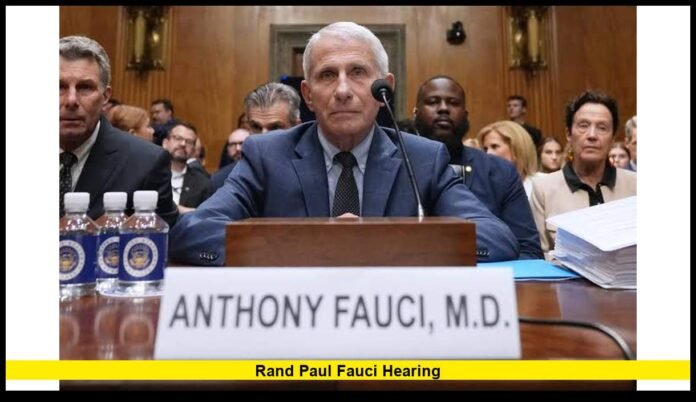

The rand paul fauci hearing brought Anthony Fauci back before the U.S. Senate on July 29, 2026, but the highly anticipated appearance produced a constitutional confrontation instead of another lengthy debate over COVID-19. Fauci invoked his Fifth Amendment right against self-incrimination and declined to answer substantive questions from senators as Sen. Rand Paul continued his investigation into pandemic origins, federal research funding and Fauci’s previous testimony to Congress.
The hearing took place before the Senate Homeland Security and Governmental Affairs Committee, which Paul chairs. Fauci appeared under subpoena after years of clashes with the Kentucky Republican over coronavirus research connected to Wuhan, China.
Paul entered the hearing seeking answers about research funding, government decision-making and statements Fauci made during previous congressional appearances. Fauci, however, made clear at the outset that he would not provide the testimony Paul wanted.
His decision immediately became the central event of the hearing.
Fauci Invokes the Fifth Amendment Before the Senate Committee
Fauci told the committee that he would follow the advice of his attorneys and invoke his Fifth Amendment protection against self-incrimination.
The Fifth Amendment allows a person to refuse compelled testimony that could potentially expose that person to criminal liability. Invoking the constitutional protection does not establish guilt or prove that a crime occurred.
Fauci pointed to Paul’s previous efforts to seek criminal consequences against him while explaining his position.
Paul has repeatedly accused Fauci of giving false testimony to Congress about federally supported coronavirus research. Fauci has consistently rejected that accusation and maintained that his earlier testimony was truthful.
That history created a dramatically different atmosphere from their earlier Senate encounters.
Instead of debating individual scientific claims, Fauci largely declined to participate in substantive questioning.
Why Rand Paul Subpoenaed Anthony Fauci
Paul has spent years investigating the origins of COVID-19 and federal support for coronavirus research.
A major focus involves grants from the National Institutes of Health to EcoHealth Alliance, a U.S.-based nonprofit organization. Some grant funding supported research involving bat coronaviruses conducted with scientists at the Wuhan Institute of Virology.
The existence of federally supported research involving coronaviruses in Wuhan has been documented.
The much more contentious questions concern how that research should be classified, what risks it presented and whether it had any connection to the emergence of SARS-CoV-2.
Fauci has rejected claims that NIH-funded experiments created the virus responsible for the pandemic.
Paul has challenged Fauci’s interpretation of the research for years. Their disagreement became especially intense over the definition of gain-of-function research.
The senator ultimately subpoenaed Fauci to appear before the committee.
1,141 Pages of Fauci’s Pandemic-Era Diary Released
Another major development arrived shortly before the hearing.
Paul released 1,141 pages of Fauci’s diary covering the pandemic years. The records span from December 2019 through December 2022.
The material provides an extensive account of Fauci’s schedule, conversations, meetings and observations during the COVID-19 crisis.
The documents attracted immediate attention because they cover the period when scientists and government officials were trying to understand a new coronavirus spreading rapidly around the world.
They also contain references to discussions about possible origins of the virus.
Paul has used portions of the records to support his argument that Congress still needs answers about what federal officials knew and discussed during the pandemic.
The records, however, do not establish the origin of SARS-CoV-2.
COVID-19 Origins Remain a Central Issue
The origin of COVID-19 remains unresolved.
Two broad possibilities have dominated the debate: natural transmission from animals to humans and a laboratory-associated incident.
U.S. intelligence agencies have not reached a unanimous conclusion.
The FBI has favored a laboratory-related explanation. The CIA has also assessed a laboratory origin as more likely while attaching low confidence to that judgment.
Other parts of the U.S. intelligence community have reached different conclusions, including assessments favoring natural transmission.
These distinctions matter.
An intelligence assessment with low confidence does not constitute definitive proof. It indicates uncertainty based on the available intelligence.
Scientists have also continued examining evidence surrounding the earliest known cases and the circumstances of the outbreak in Wuhan.
The July 29 hearing did not settle the origin question because Fauci declined to provide substantive testimony.
Read More – Fauci Diary Entries Put COVID Origins, Private Discussions and Senate Testimony Back in Focus
The Gain-of-Function Dispute Explained
Gain-of-function research remains one of the most important issues behind the conflict between Paul and Fauci.
In broad scientific usage, the term can describe experiments that alter an organism in ways that provide new or enhanced characteristics.
Federal oversight rules, however, have used more specific standards when identifying research involving particularly dangerous potential pandemic pathogens.
That difference has fueled years of disagreement.
Paul argues that NIH-supported coronavirus experiments involving researchers in Wuhan should be considered gain-of-function research.
Fauci has maintained that the work being discussed during his previous congressional testimony did not fall under the relevant federal regulatory definition.
Their disagreement became nationally prominent during Senate hearings in 2021.
Paul accused Fauci of lying to Congress.
Fauci denied it and defended his testimony.
The dispute continued after Fauci left government service.
Why Fauci’s Earlier Senate Testimony Still Matters
Fauci served as director of the National Institute of Allergy and Infectious Diseases for 38 years before leaving government at the end of 2022.
His role placed him at the center of the federal response to COVID-19.
He regularly appeared at White House briefings, congressional hearings and media interviews. His visibility made him one of America’s most recognizable public-health officials.
It also subjected his statements to intense scrutiny.
Paul has returned repeatedly to Fauci’s earlier testimony about NIH-supported research.
The senator argues that documents obtained since those hearings raise questions about whether Fauci accurately characterized the research.
Fauci continues to reject claims that he deceived lawmakers.
The rand paul fauci hearing represented Paul’s latest attempt to question him directly about those issues.
Fauci’s Fifth Amendment decision meant the committee received few substantive answers from him.
Biden’s 2025 Pardon Adds Another Legal Dimension
Former President Joe Biden granted Fauci a preemptive pardon in January 2025 shortly before leaving office.
Biden said at the time that issuing a pardon should not be interpreted as an acknowledgment that Fauci committed wrongdoing.
The action was intended to protect Fauci from potential prosecutions that Biden viewed as politically motivated.
The pardon later became relevant to Paul’s continuing investigation.
Despite receiving it, Fauci invoked the Fifth Amendment at Wednesday’s hearing on the advice of his attorneys.
His legal position reflected concerns about possible exposure connected to testimony given after the pardon.
The pardon therefore did not eliminate the legal considerations surrounding his 2026 congressional appearance.
Fauci Has Not Been Charged Over COVID-19 Origins
The legal status of Fauci remains an essential distinction in coverage of the dispute.
Paul has made serious allegations against the former NIAID director and has sought criminal scrutiny of his previous statements.
Fauci denies wrongdoing.
He has not been criminally charged with causing the COVID-19 pandemic, creating SARS-CoV-2 or funding the creation of the pandemic virus.
No established finding has shown that Fauci personally caused the pandemic.
Likewise, the July 29 Senate hearing did not establish that NIH-supported research produced SARS-CoV-2.
The hearing centered on congressional oversight and Paul’s investigation.
Those facts remain separate from the political arguments surrounding Fauci.
David Morens Case Draws Attention to Federal Records
Another figure connected to the broader congressional investigation is David Morens, a former senior adviser to Fauci.
Morens became a focus of scrutiny over government communications and federal records connected with pandemic-related discussions.
His situation intensified congressional interest in how officials preserved communications during the COVID-19 response.
The controversy surrounding federal records is relevant to Paul’s broader investigation because lawmakers have sought emails, documents and other communications involving government scientists.
However, allegations or legal proceedings involving another official do not establish wrongdoing by Fauci.
The cases and claims must be evaluated separately.
The Hearing Came Amid Changes to Federal Research Policy
The Fauci appearance also occurred as the federal government tightened its approach to potentially dangerous biological research.
The Trump administration announced new restrictions involving federal funding for dangerous gain-of-function research.
That policy development gave the Senate debate additional significance.
Questions surrounding high-risk pathogen research extend beyond Fauci and Paul.
Researchers need to study viruses to understand how they spread, mutate and threaten humans. That work can contribute to vaccines, treatments and pandemic preparedness.
At the same time, experiments involving dangerous pathogens create biosafety and biosecurity concerns.
Federal policymakers must balance potential scientific benefits against those risks.
COVID-19 turned what had once been a relatively specialized policy debate into an issue receiving national political attention.
What the July 29 Hearing Confirmed
Despite the lack of substantive testimony from Fauci, several major facts emerged clearly from the proceeding.
Fauci appeared before the Senate Homeland Security and Governmental Affairs Committee under subpoena.
Paul chaired the hearing.
Fauci invoked his Fifth Amendment protection and declined substantive questioning.
The proceeding centered on COVID-19 origins, federal research funding and Fauci’s earlier statements to lawmakers.
Paul also entered the hearing after releasing 1,141 pages of Fauci’s pandemic-era diary.
At the same time, the proceeding did not determine the origin of COVID-19.
It did not prove that federally funded research created SARS-CoV-2.
Nor did the hearing establish that Fauci committed a crime.
Why Fauci’s Decision Changed the Hearing
Previous confrontations between Paul and Fauci became famous for direct exchanges.
The two men argued about masks, pandemic policies, research and the origins of COVID-19.
Their July 2026 encounter followed a different path.
Fauci’s invocation of the Fifth Amendment largely prevented another extended scientific argument.
That transformed the event from a conventional oversight hearing into a debate involving constitutional rights, congressional authority and potential legal exposure.
Paul continued presenting his concerns.
Fauci maintained his constitutional position.
As a result, many of the questions lawmakers hoped to address remained unanswered when the hearing concluded.
What Comes Next for Rand Paul’s Investigation
The end of Fauci’s testimony does not necessarily end congressional examination of pandemic-era decisions.
Paul’s committee can continue reviewing documents and gathering testimony from other witnesses.
Lawmakers can also examine federal grants, agency communications and records related to coronavirus research.
The released diary provides investigators with another large collection of material from the pandemic period.
Still, future action will need to distinguish documented evidence from political claims.
COVID-19’s origin remains one of the most consequential unanswered questions from the pandemic.
Finding a reliable answer matters beyond the political dispute between Paul and Fauci.
A clearer understanding of how the pandemic began could influence laboratory safeguards, research oversight, wildlife surveillance and preparations for future outbreaks.
For American readers, the July 29 hearing offered a reminder that Washington’s examination of the pandemic remains active years after the initial emergency.
Paul continues seeking answers about research and government accountability.
Fauci continues denying allegations that he misled Congress.
His decision to invoke the Fifth Amendment means their long-running dispute remains unresolved, while the larger scientific question of exactly how SARS-CoV-2 first reached humans also remains unsettled.
The Senate hearing may have ended without the answers lawmakers sought, but the debate over COVID-19 origins, research oversight and government accountability continues. Share your view in the comments and stay updated as new confirmed developments emerge.