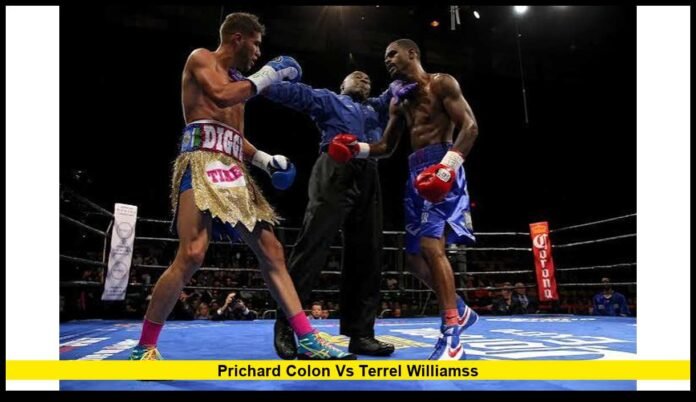

The prichard colon vs terrel williams bout began as a meeting between two undefeated young boxers with aspirations of reaching the top of the sport. Instead, the October 17, 2015 contest in Fairfax, Virginia, became one of boxing’s most heartbreaking stories. Prichard Colón suffered a devastating brain injury after the fight and never returned to professional competition. More than a decade later, his family confirmed that Colón died on August 13, 2026, at the age of 33, bringing renewed attention to the fight that permanently changed his life.
╔════════════════════════════════════════════════════════════════════╗
║ – Prichard Colón died on August 13, 2026, at age 33, after more than a decade of severe complications following his 2015 fight. ║
║ – Colón entered his final professional bout undefeated at 16-0, including 13 victories by knockout. ║
║ – Terrel Williams also entered the contest unbeaten and recorded a disqualification victory after nine rounds. ║
║ – The ninth round featured two knockdowns of Colón and became the final competitive round of his career. ║
║ – Colón suffered a serious brain hemorrhage after the contest and required emergency surgery. ║
║ – He spent 221 days in a coma and subsequently required extensive assistance and long-term rehabilitation. ║
║ – His family’s legal action later raised questions about ringside medical care and the responsibilities of those involved in the event. ║
║ – Colón’s death in 2026 has renewed worldwide discussion about boxing safety, head trauma and fighter protection. ║
╚════════════════════════════════════════════════════════════════════╝
Who Was Prichard Colón Before the Tragedy?
Prichard Colón Meléndez was born in Florida and represented Puerto Rican boxing throughout his amateur and professional career. Nicknamed “Digget,” he developed a reputation as one of the sport’s promising young prospects.
Colón was not simply another inexperienced fighter entering the professional ranks. He had an impressive amateur background and won a gold medal at the 2010 Pan American Youth Championships. His combination of size, speed and punching ability helped generate considerable attention after he turned professional.
He made his professional debut in 2013 and quickly developed a reputation for staying active. Rather than waiting months between appearances, Colón frequently returned to the ring, building his record while gaining experience.
By the time he faced Terrel Williams in 2015, Colón had accumulated 16 victories without a defeat. Thirteen of those wins had come by knockout.
His most significant victory before the Williams fight came against former world champion Vivian Harris. Colón stopped Harris in the fourth round in September 2015, a result that further increased expectations surrounding his future.
At just 23 years old, Colón appeared to be moving toward bigger opportunities.
His career trajectory changed completely one month later.
The 2015 Fight in Fairfax, Virginia
The bout took place at EagleBank Arena in Fairfax, Virginia, on October 17, 2015.
Williams was also undefeated, making the contest an intriguing matchup between two prospects looking to establish themselves. Colón entered with a 16-0 record, while Williams had built an unbeaten record of his own.
The fight was contested over a scheduled 10 rounds.
Colón appeared comfortable during the early stages. He used his reach and boxing ability to work from the outside, and early observers saw him controlling significant portions of the contest.
But the fight gradually became more competitive.
One of the major controversies involved punches that landed toward the back of Colón’s head. Punches to this area are prohibited under boxing rules because of the serious risks associated with blows behind the head.
The referee intervened during the contest and penalized Williams for one such infraction.
Colón also committed a serious foul of his own when he landed a low blow. He was penalized two points for the incident.
The contest therefore developed into a difficult and increasingly physical encounter.
Neither fighter could have known how dramatically the night would change after the ninth round.
What Happened in the Ninth Round?
The ninth round proved decisive.
Williams managed to hurt Colón and scored two knockdowns during the round. It was the first time Colón had been officially knocked down as a professional.
By the end of the round, Colón was clearly exhausted and had absorbed significant punishment.
Then came one of the strangest moments of the evening.
When Colón returned to his corner after the ninth round, his team began removing his gloves. The scheduled contest had another round remaining, but his corner apparently believed the fight had ended.
Officials realized that Colón was not prepared to return for the tenth round.
Because he failed to answer the bell, the fight was stopped and Williams was awarded a victory by disqualification.
The official result remains unusual because Williams did not win by knockout or decision. Instead, Colón’s corner’s failure to have him ready for the tenth round resulted in the disqualification.
At that point, however, nobody outside the ring could fully appreciate what had happened to Colón medically.
Colón’s Condition Deteriorated After the Fight
The most serious events occurred after the contest.
Colón became increasingly unwell in the dressing room. He experienced symptoms that included vomiting and dizziness, and medical attention was required.
He was transported to a hospital in the Fairfax area.
Doctors discovered severe bleeding inside his skull. Emergency surgery was performed to address the pressure and damage caused by the brain injury.
What had started as a boxing contest between two undefeated prospects had become a medical emergency.
Colón survived the surgery, but the damage was catastrophic.
He eventually spent 221 days in a coma.
When he emerged from the coma, he faced an entirely different life.
He could no longer live independently as the young professional athlete he had been before the fight. His family became responsible for much of his daily care, and rehabilitation became a central part of his life.
His mother, Nieves Colón, played an especially important role in his care and recovery.
More Than a Decade of Rehabilitation
For years after the injury, Colón’s family continued working with him through rehabilitation and therapy.
Images and updates shared by his family showed efforts to help him regain physical abilities and communication skills. His progress was often measured in small steps rather than dramatic recoveries.
The story became known well beyond boxing.
Fans who had never watched Colón fight learned about the young boxer who had entered the ring with a perfect professional record and dreams of becoming a champion.
His situation also highlighted the extraordinary responsibilities placed on families caring for people with severe brain injuries.
For Colón’s loved ones, the fight did not end when the referee stopped the contest.
The consequences continued every day.
Questions About Boxing Safety
The tragedy raised difficult questions about fighter safety.
Boxing officials, referees, ringside doctors, trainers and promoters all have important responsibilities when a fighter displays signs of distress.
One of the central concerns surrounding Colón’s case was whether his condition should have been recognized earlier and whether he should have been allowed to continue after complaining about blows to the back of his head.
It is important to distinguish established facts from allegations made during later legal proceedings.
The available record shows that Colón suffered a devastating brain injury following the fight and that concerns were subsequently raised about how the bout was handled. His family later pursued legal action involving medical and promotional personnel.
Those legal claims became part of the broader debate about whether adequate safeguards were in place that night.
The tragedy also demonstrated why symptoms such as dizziness, confusion, vomiting and unusual behavior after head trauma should be treated as medical emergencies.
The Lawsuit Filed by Colón’s Family
In 2017, Colón’s parents filed a lawsuit seeking more than $50 million in damages.
The legal action focused on allegations involving the ringside medical response and other responsibilities surrounding the event.
The lawsuit attracted considerable attention because it attempted to examine what happened before, during and immediately after the fight.
However, the existence of a lawsuit does not by itself establish that every allegation was proven. The case involved complex legal questions, and its history became a separate part of the larger Colón story.
For the family, the legal battle was secondary to the enormous challenge of caring for their son.
They continued to support Colón while his condition remained severely compromised.
What Happened to Terrel Williams?
Terrel Williams’ career took a very different path after the fight.
He officially improved his professional record to 15-0 with the victory, but the result quickly became overshadowed by Colón’s medical emergency.
Williams later expressed sympathy for Colón and his family. He also maintained that he never intended to cause the kind of harm that ultimately occurred.
The aftermath followed Williams for years.
Rather than becoming known primarily for his unbeaten record or other professional achievements, his name became permanently associated with the Fairfax fight.
That reality illustrates another painful dimension of the story.
Colón’s family endured the consequences of his devastating injury, while Williams had to live with being the opponent in a fight that ended in tragedy.
The two men entered the ring as competitors.
The aftermath affected both of their lives in profoundly different ways.
Why the Fight Continues to Generate Debate
The controversy surrounding the contest has never been limited to the official result.
Fans have repeatedly discussed the back-of-the-head punches, the referee’s decisions, the medical response and the circumstances surrounding Colón’s removal from the arena.
Some online discussions have also attempted to assign personal blame for the entire tragedy.
Such claims should be approached carefully.
Boxing is a sport in which fighters routinely sustain head impacts, and determining exactly how a particular brain injury develops can be medically complicated. Likewise, a rule violation does not automatically establish criminal intent.
The documented history does, however, make the contest an important case study in the dangers of head trauma.
It also reinforces the importance of having qualified medical professionals available, recognizing warning signs quickly and giving officials the authority to stop a fight when a fighter may no longer be able to safely continue.
Prichard Colón’s Death in 2026
On August 13, 2026, the boxing world received the devastating news that Prichard Colón had died at age 33.
His death came more than 10 years after the fight that ended his professional career.
The news generated an immediate response throughout boxing, with organizations, fighters and fans remembering Colón and reflecting on his extraordinary resilience.
For many people, his death represented the end of a story that had remained painfully present in boxing for more than a decade.
Colón’s professional career had lasted only 17 fights.
He won 16 of them.
His lone defeat came through disqualification after his corner failed to have him ready for the tenth round against Williams.
But those numbers do not adequately describe his legacy.
His story became a reminder that a fighter is a person first and an athlete second.
The Legacy of Prichard Colón
The tragedy surrounding Colón’s career has become one of boxing’s clearest reminders of the potential consequences of repeated head trauma.
His name is now associated not only with an undefeated prospect who appeared destined for bigger fights but also with discussions about athlete welfare and the responsibility of everyone working around a boxing ring.
The circumstances of prichard colon vs terrel williams continue to be examined because they raise questions that extend beyond two fighters.
How quickly should a referee respond to complaints about illegal punches?
When should a ringside doctor intervene?
How should trainers recognize signs of neurological distress?
And what safeguards can help prevent another promising young athlete from suffering a similar fate?
There are no simple answers, but Colón’s experience has ensured that those questions remain part of the conversation.
A Career That Ended Before Its Potential Was Realized
Perhaps the most heartbreaking aspect of Colón’s story is how much remained ahead of him in 2015.
At 23, he had already developed an impressive professional record. His knockout percentage suggested considerable power, while his size and technical ability made him an attractive prospect.
He had just defeated Vivian Harris and appeared to be moving toward increasingly important fights.
Instead, one night in Virginia ended his boxing career.
The tragedy was not merely that a promising fighter lost a contest.
It was that a young man who entered the sport with championship ambitions suffered an injury that changed every part of his future.
His family spent years caring for him, supporting rehabilitation and sharing his story with the public.
After his death in 2026, those years of perseverance became an essential part of how boxing remembers him.
Remembering Colón Beyond the Ring
Prichard Colón should ultimately be remembered for more than the circumstances of his final fight.
He was a young Puerto Rican boxing talent, an undefeated professional prospect and a fighter who had already achieved meaningful success before his career was abruptly interrupted.
His family showed extraordinary commitment during more than a decade of adversity.
His story also reminds fans that every fighter who enters a ring has a life outside it, surrounded by family, friends and people who care about what happens after the final bell.
The events of October 17, 2015 cannot be changed.
But the lessons drawn from Colón’s experience can continue to influence how boxing approaches fighter safety, neurological injuries and medical decision-making.
His legacy will therefore remain larger than a single fight record.
It is a story of ambition, tragedy, family, resilience and the human cost that can accompany professional boxing.
Prichard Colón’s story remains one of boxing’s most powerful reminders of what can happen after the final bell—share your thoughts and stay with us for the latest developments from the boxing world.