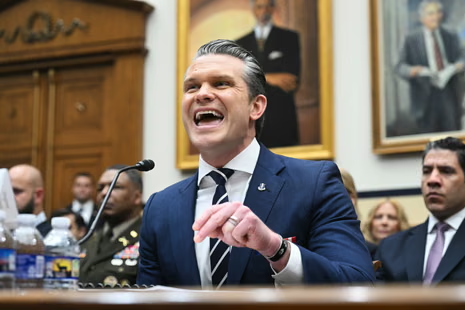

Defense Secretary Pete Hegseth faced his most intense public scrutiny yet on April 29, appearing before the House Armed Services Committee for his first congressional hearing since the United States and Israel launched military strikes against Iran. What unfolded was a six-hour marathon session packed with political fireworks, budget revelations, and pointed questions about the direction of an ongoing war.
The Hearing That Washington Was Watching
The hearing was formally scheduled to discuss the Pentagon’s fiscal year 2027 budget request, but it quickly became a wide-ranging debate on the war with Iran. Hegseth appeared alongside Chairman of the Joint Chiefs of Staff General Dan Caine and Pentagon comptroller Jules Hurst III.
From the very first moments, the tone was combative. Hegseth set the stage in his opening statement, declaring that the biggest adversary America faces is the “reckless, feckless and defeatist words of congressional Democrats and some Republicans.”
The $25 Billion Price Tag Revealed
One of the most significant revelations of the day came from the Pentagon’s own comptroller. For the first time, the Department of Defense publicly disclosed that the war had cost $25 billion so far, with most of that tied to munitions, the cost of deploying military assets to the Middle East, and equipment lost during fighting.
When pressed on whether that figure accounted for damage to US military bases in the region or the cost of restocking America’s weapons supply, Hegseth declined to confirm. Reports indicate the administration may request an additional $200 billion in supplemental funding from Congress, though no formal request has yet been submitted.
When challenged on the financial burden to American taxpayers, Hegseth pushed back with a rhetorical question: “What is it worth to ensure that Iran never gets a nuclear weapon?”
Iran’s Nuclear Programme at the Centre of Debate
Iran’s nuclear programme sat at the heart of some of the hearing’s sharpest exchanges. Representative Adam Smith, the top Democrat on the panel, confronted Hegseth over what appeared to be contradictory statements — that Iran’s nuclear programme had been “obliterated” following a prior military exchange in 2025, yet was described as an “imminent threat” in the lead-up to the current war.
Smith argued that Iran’s nuclear programme was exactly where it stood before the war began. Hegseth countered that Iranian facilities had been destroyed but that the country’s nuclear ambitions continued and it was developing what he called a “conventional shield.”
Military Firings Spark Bipartisan Tension
Lawmakers from both parties directed pointed questions at Hegseth about the Pentagon’s removal of several senior military figures, most notably General Randy George, the Army Chief of Staff. In a rare show of Republican dissent, two members of the GOP — Representatives Don Bacon and Austin Scott — broke ranks and told Hegseth directly that they disagreed with General George’s dismissal. The bipartisan pushback added a layer of complexity to what might otherwise have been a more partisan session.
One of the day’s most heated moments came when Representative John Garamendi, a Democrat, labeled the Iran conflict a “quagmire” and a “political and economic disaster at every level.” Hegseth bristled at the characterisation, accusing Garamendi of handing propaganda to America’s enemies. At one point, the hearing grew so heated that even the Republican committee chairman stepped in to bring Hegseth’s temperature down.
Representative Seth Moulton followed up by drawing a pointed parallel to the congressional blank check given to the Bush administration before the Iraq War. Hegseth, who served as an Army National Guard officer in Iraq and has previously criticised “endless wars,” dismissed the comparison as false.
The $1.5 Trillion Defence Budget Request
Beyond the Iran war, Hegseth defended the White House’s unprecedented request for a $1.5 trillion defence budget for fiscal year 2027 — the largest Pentagon budget proposal in American history. Critically, the calculations behind that request were completed before the strikes on Iran in February and do not factor in ongoing war costs.
Democrats raised serious concerns about how the administration plans to sustain that level of military spending alongside a $39 trillion national debt and $3.4 trillion in proposed tax cuts, questioning whether any coherent financial strategy exists to back the request.
Senate Hearing to Follow
Following his appearance before the House panel, Hegseth was scheduled to face the Senate Armed Services Committee the following day, Thursday, to continue defending the Pentagon’s budget request.
Where Things Stand
The US-Israel war with Iran began on February 28. Active fighting has been largely paused since April 8, with the United States imposing a naval blockade on the Strait of Hormuz. Thirteen American service members have been killed and hundreds more injured since the conflict began. Diplomatic talks remain stalled, and the White House has repeatedly threatened to resume military strikes if no meaningful progress emerges.
The April 29 hearing made one thing unmistakably clear: with a war ongoing, a record-breaking defence budget on the table, and a string of high-profile military dismissals generating controversy, Pete Hegseth’s tenure as Defence Secretary remains one of the most scrutinised — and contested — in recent American history.