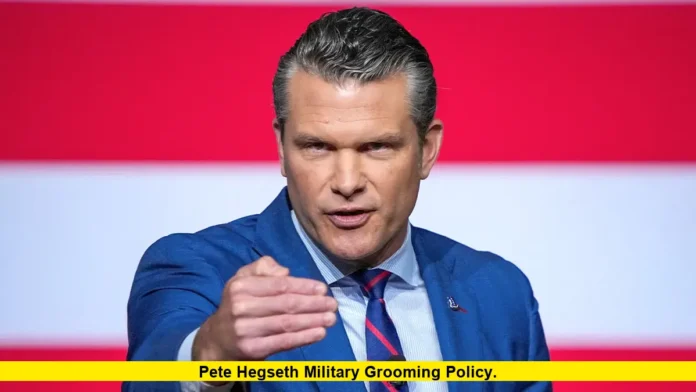

The pete hegseth military grooming policy is quickly becoming one of the most talked-about shifts inside the U.S. armed forces, as new directives reshape long-standing rules on appearance, discipline, and exemptions. Under Pete Hegseth, recent updates emphasize stricter enforcement of grooming standards—especially around facial hair—while narrowing the scope of medical waivers that once allowed flexibility for thousands of service members.
The changes are already being implemented at the unit level, particularly within the United States Marine Corps, where new timelines and enforcement mechanisms signal a broader cultural reset across the military.
If you want ongoing updates on how these rules affect service members and military readiness, keep following this topic as policies continue to evolve.
A Major Shift Toward Strict Grooming Enforcement
At the center of the pete hegseth military grooming policy is a clear directive: a return to a clean-shaven, uniform appearance across the force.
Recent guidance requires Marines with shaving exemptions—many tied to medical conditions like pseudofolliculitis barbae—to meet grooming standards within 12 months or face administrative separation.
This is a notable departure from previous policies, which allowed longer-term or even indefinite exemptions depending on medical need.
The updated approach includes:
- A one-year compliance window
- Mandatory medical treatment during that period
- Command reviews at the halfway and final stages
- Potential discharge if standards are not met
The message is unmistakable: grooming rules are no longer flexible—they are enforceable benchmarks tied directly to a service member’s future in the military.
Why the Policy Is Changing Now
The push behind the pete hegseth military grooming policy aligns with a broader philosophy voiced repeatedly by Hegseth: prioritizing discipline, uniformity, and combat readiness.
In internal defense discussions, emphasis has been placed on maintaining a “clean-shaven and neat” appearance to support operational effectiveness and cohesion.
This reflects a traditional view of military culture, where appearance is closely linked to:
- Unit discipline
- Chain-of-command authority
- Immediate readiness for deployment
Supporters argue that consistent grooming standards reduce ambiguity in enforcement and reinforce a shared identity among troops.
Real-World Impact: Who Is Most Affected
The most immediate effects of the pete hegseth military grooming policy are being felt by service members who rely on shaving waivers.
A key example involves individuals with pseudofolliculitis barbae (PFB)—a condition that disproportionately affects men with tightly curled hair, particularly Black service members.
Under the new rules:
- Treatment options (including laser hair removal) are encouraged and often covered
- Continued inability to shave after 12 months may trigger separation reviews
- The condition is not treated as a long-term exemption basis
This has raised concerns about equity and retention, especially in units where a significant percentage of personnel have historically required waivers.
Comparison: Then vs. Now
To understand the scale of change, it helps to compare previous grooming policies with the current direction:
Previous Approach
- Long-term or renewable medical waivers allowed
- Commanders had broader discretion
- Focus on accommodation and retention
Current Direction Under Hegseth
- Fixed 12-month limit on exemptions
- Centralized enforcement expectations
- Strong emphasis on compliance over accommodation
This shift signals a move away from individualized flexibility toward standardized enforcement.
The “No Beards” Philosophy Explained
Hegseth has consistently supported a clean-shaven force, framing grooming standards as a matter of operational readiness rather than personal preference.
The reasoning includes:
- Gas mask seal integrity in combat scenarios
- Uniformity under stress, reducing visual inconsistencies
- Professional image in joint and international operations
Critics, however, argue that modern warfare—with advanced equipment and diverse mission environments—may not justify such rigid standards across all roles.
Broader Context: A Pattern of Military Policy Changes
The pete hegseth military grooming policy does not exist in isolation. It is part of a wider set of reforms introduced during his tenure at the United States Department of Defense.
Recent actions reflect a broader shift toward traditional standards and centralized authority in military operations and culture. These changes have drawn attention from lawmakers, military leadership, and advocacy groups, signaling that grooming policy is just one piece of a larger transformation underway.
Supporters vs. Critics: A Growing Divide
The grooming policy has sparked strong reactions on both sides.
Supporters Say:
- Clear standards improve discipline and readiness
- Uniform appearance strengthens unit cohesion
- Reduced waivers prevent inconsistent enforcement
Critics Argue:
- The policy disproportionately impacts minority service members
- Medical realities are being overridden by rigid timelines
- Retention could suffer if experienced personnel are forced out
This divide reflects a deeper debate about the purpose of modern military standards: should they adapt to personnel diversity, or enforce a single uniform model?
Operational Consequences: Readiness vs. Retention
One of the most important questions surrounding the pete hegseth military grooming policy is its real-world impact on readiness.
Potential Benefits:
- Faster deployment readiness due to standardized appearance
- Fewer administrative inconsistencies across units
- Stronger perception of discipline in joint operations
Potential Risks:
- Loss of trained personnel due to separation
- Increased medical costs tied to treatment compliance
- Lower morale among affected service members
In practical terms, commanders may soon face a trade-off between maintaining strict standards and preserving experienced troops.
A Real-World Scenario
Consider a Marine with a long-standing shaving waiver due to PFB.
Under previous rules, that Marine could continue serving effectively with periodic medical documentation.
Under the new system:
- They must undergo treatment within 12 months
- Progress is monitored by command
- Failure to meet shaving standards could lead to discharge
This scenario illustrates how policy shifts move from abstract directives to career-defining consequences.
What Comes Next
The pete hegseth military grooming policy is still unfolding, with implementation timelines and enforcement varying slightly across branches.
Key developments to watch include:
- Whether other branches adopt identical timelines
- Legal or congressional challenges to enforcement
- Adjustments based on retention or readiness data
Given the pace of recent Pentagon changes, further refinements—or expansions—of grooming rules are likely.
Final Thoughts
The debate over grooming standards is about more than appearance—it reflects competing visions of what the modern U.S. military should be.
On one side is a push for uniformity, discipline, and tradition.
On the other is a call for flexibility, inclusion, and adaptation to diverse service members.
The outcome of this policy shift will not just determine grooming rules—it may shape the culture of the armed forces for years to come.
If you want deeper breakdowns of military policy changes and what they mean on the ground, stay tuned for more updates as this story continues to develop.
What do you think about stricter military grooming rules—do they strengthen discipline or risk losing valuable talent? Share your thoughts below.