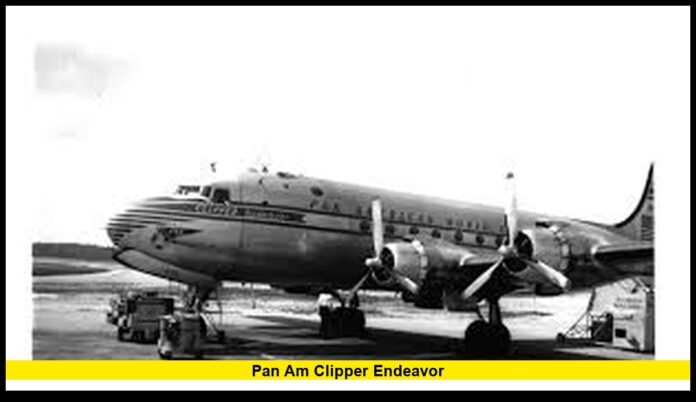

The Pan Am Clipper Endeavor has become the focus of worldwide attention after search teams confirmed the discovery of the aircraft’s wreckage more than seven decades after it disappeared beneath the Atlantic Ocean. Resting deep off the northern coast of Puerto Rico, the aircraft has remained hidden since its tragic crash in April 1952. The remarkable find brings closure to one of the longest-unsolved aircraft location cases in commercial aviation and shines a spotlight on an accident that helped shape modern airline safety.
For aviation historians, researchers, and the families connected to the tragedy, the discovery marks the end of a decades-long search. It also serves as a reminder of how advances in underwater technology continue to unlock important chapters of history that once seemed permanently lost.
A Remarkable Discovery Beneath the Atlantic
After years of planning, research, and deep-sea exploration, investigators successfully located the remains of the Douglas DC-4 that operated as Pan American World Airways Flight 526A. The aircraft was found nearly 2,000 feet below the surface of the Atlantic Ocean in waters north of Puerto Rico.
Although investigators had long believed the aircraft rested somewhere within this general region, pinpointing its exact location proved impossible for decades. Ocean depth, shifting underwater conditions, and the technological limitations of the 1950s left the aircraft undiscovered despite numerous efforts to determine its final resting place.
The recent search combined historical flight records with advanced underwater mapping technology, allowing researchers to identify the wreckage with confidence.
The Flight That Ended in Tragedy
The aircraft departed Isla Grande Airport in San Juan, Puerto Rico, on April 11, 1952. It was scheduled to fly to New York during one of the busiest travel periods of the Easter holiday.
The Douglas DC-4 carried 69 people, including passengers and crew members. Shortly after takeoff, serious mechanical problems developed that changed the course of the flight within minutes.
Investigators later determined that two engines on the aircraft’s right side lost power. Despite the emergency, the flight crew maintained control long enough to attempt a controlled water landing.
Rather than losing control in flight, the pilots successfully guided the aircraft onto the ocean surface. Their actions allowed many people to survive the initial impact.
Unfortunately, the emergency did not end there.
Why the Accident Became So Deadly
The ditching itself was considered remarkably successful under the circumstances. However, the aircraft quickly began taking on water after coming to rest on the ocean.
Passengers suddenly faced another life-threatening situation.
The evacuation became increasingly difficult as darkness, ocean conditions, and the rapidly sinking aircraft created confusion. Many passengers struggled to retrieve life jackets or reach available exits before the airplane disappeared beneath the water.
Rescue crews responded as quickly as possible, but time worked against everyone involved.
Seventeen people survived the disaster, while fifty-two lost their lives, making it one of the deadliest accidents involving a commercial aircraft ditching during that era.
A Timeline of Key Events
| Date | Event |
|---|---|
| April 11, 1952 | Flight departs San Juan, Puerto Rico |
| Minutes after takeoff | Two engines fail on the right side |
| Shortly afterward | Crew performs emergency water landing |
| Same day | Rescue efforts save 17 people |
| Following investigation | Accident leads to important airline safety improvements |
| July 2026 | Wreckage officially located beneath the Atlantic Ocean |
How the Search Finally Succeeded
Finding an aircraft after seventy-four years required far more than luck.
Researchers spent years reviewing historical documents, flight records, weather reports, witness accounts, and official investigation materials. Every detail helped narrow the search area little by little.
Once researchers established the most likely location, specialists deployed autonomous underwater vehicles capable of surveying the ocean floor with exceptional precision.
These robotic systems scanned thousands of acres beneath the Atlantic using high-resolution sonar technology.
During one of the survey missions, operators detected an object whose dimensions closely matched those of a Douglas DC-4.
Additional imaging confirmed structural features consistent with the missing aircraft, including major sections of the fuselage and tail assembly.
The discovery officially ended one of aviation history’s longest searches.
Modern Technology Made the Difference
When the accident occurred in 1952, underwater exploration technology remained extremely limited.
Search crews relied largely on estimates, visual observations, and relatively simple equipment.
Today’s technology offers capabilities that investigators decades ago could hardly imagine.
Among the tools used during the search were:
- Autonomous underwater vehicles (AUVs)
- High-resolution sonar mapping
- Digital seabed imaging
- Three-dimensional underwater modeling
- GPS-guided navigation systems
Together, these systems allowed researchers to create detailed maps of the ocean floor while identifying man-made objects hidden beneath decades of sediment.
Without these technological advances, the aircraft might have remained undiscovered for many more years.
The Legacy of Flight 526A
Although the tragedy occurred more than seven decades ago, its influence continues to affect commercial aviation around the world.
Investigators carefully examined every aspect of the accident, including passenger evacuation, emergency procedures, and survival equipment.
The lessons learned prompted several improvements that later became standard throughout the airline industry.
Among the lasting changes were:
- More comprehensive passenger safety briefings before departure
- Better demonstrations explaining how to use life jackets
- Improved emergency evacuation procedures
- Enhanced passenger awareness of emergency exits
- Stronger emphasis on crew emergency training
Today, airline passengers routinely receive safety demonstrations before takeoff without realizing that accidents like this one helped establish those practices.
Why the Aircraft Carried the Name “Clipper”
Pan American World Airways used the name “Clipper” for many of its long-distance aircraft.
The tradition dated back to the airline’s famous flying boats, which helped establish international commercial aviation during the early twentieth century.
As Pan American expanded around the world, the Clipper name became synonymous with global travel, luxury service, and technological innovation.
Each aircraft received an individual name, making them easily recognizable within the airline’s growing fleet.
The Douglas DC-4 involved in Flight 526A proudly carried one of those historic names.
Families Finally Receive Long-Awaited Answers
For relatives of those aboard the aircraft, the discovery carries deep emotional significance.
Although investigators understood what happened shortly after the accident, the precise location of the wreckage remained unknown for generations.
Many families spent decades wondering exactly where the aircraft came to rest beneath the Atlantic.
Locating the site does not erase the tragedy, but it provides an important historical answer that many believed would never come.
For some, the discovery offers a sense of closure after seventy-four years of uncertainty.
A Historic Site Beneath the Sea
The aircraft now rests as a protected historical site on the ocean floor.
Rather than being viewed simply as wreckage, the location represents an important piece of aviation history.
Marine archaeologists often treat such discoveries with great respect because they preserve valuable information about aircraft construction, emergency response, and historical events.
The site also serves as a memorial to everyone who lost their lives during the flight.
Researchers expect future documentation efforts to focus on recording the condition of the aircraft while preserving its historical significance.
Why This Discovery Matters Beyond Aviation
The successful search demonstrates how modern science continues solving historical mysteries once considered impossible.
Across the world, researchers now use similar technology to locate missing aircraft, historic shipwrecks, and other significant sites hidden beneath the ocean.
Every successful mission improves search techniques for future projects.
The methods used during this operation could eventually assist researchers investigating other long-lost aircraft from the twentieth century.
The achievement also highlights the importance of preserving historical records. Flight logs, weather reports, witness statements, and investigation files all played valuable roles in narrowing the search area.
Without decades of careful recordkeeping, even today’s advanced equipment would have faced a far greater challenge.
Remembering an Important Chapter in Airline History
Pan American World Airways played a major role in the development of international air travel throughout the twentieth century.
Its aircraft connected continents, introduced new routes, and helped make global travel more accessible.
While the airline itself ceased operations in 1991, its influence remains visible throughout the aviation industry.
The discovery of this aircraft adds another important chapter to that legacy.
It reminds the public that every major advancement in airline safety has often followed careful study of past accidents.
The lessons learned from Flight 526A continue protecting millions of travelers every year.
The Story Continues to Inspire Aviation Researchers
Interest in the aircraft has grown significantly following confirmation of the discovery.
Museums, historians, aviation enthusiasts, and researchers are revisiting the story to better understand its historical importance.
The search itself demonstrates the patience required for complex historical investigations.
Years of archival research, technological innovation, and collaboration ultimately produced results that once appeared beyond reach.
The accomplishment stands as an example of what can be achieved when historical research meets modern engineering.
Looking Ahead
Although the mystery of the aircraft’s location has finally been solved, its historical importance will continue for many years.
Researchers are expected to study the collected sonar images and underwater documentation in greater detail while preserving the integrity of the site.
The discovery also offers educators and aviation historians a unique opportunity to revisit one of commercial aviation’s defining events and explain how it influenced modern safety standards.
As technology continues advancing, similar discoveries may help answer other long-standing questions from aviation history, ensuring that important stories are not forgotten with the passage of time.
The rediscovery of this aircraft is more than the conclusion of a decades-long search. It is a powerful reminder that history can still be uncovered, even after generations have passed, and that every breakthrough deepens our understanding of the people, events, and innovations that shaped modern air travel.
What are your thoughts on this remarkable aviation discovery? Share your views in the comments and stay informed about the latest developments in aviation history.