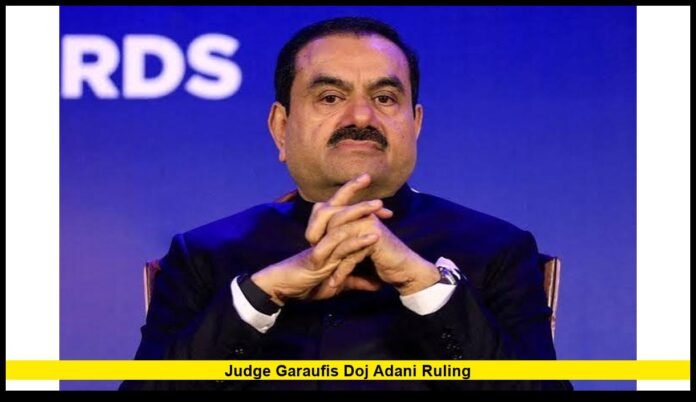

The judge garaufis doj adani ruling has brought a major development in the U.S. criminal case involving Indian billionaire Gautam Adani. On August 10, 2026, U.S. District Judge Nicholas Garaufis dismissed the criminal charges against Adani after the Justice Department asked the court to end the prosecution. However, the judge also raised serious concerns about how the DOJ reached its decision.
The ruling followed several months of legal proceedings over the government’s request to abandon the case. Garaufis did not simply approve the DOJ request without examination. He required prosecutors to provide additional explanations and looked closely at whether outside considerations influenced the decision.
The judge ultimately concluded that Adani’s previous $10 billion U.S. investment pledge did not influence the Justice Department’s decision to dismiss the charges. At the same time, he criticized the process used by Principal Associate Deputy Attorney General Trent McCotter.
The decision closes the criminal case against Adani for now, but it also leaves important questions about prosecutorial decision-making and the handling of high-profile federal cases.
Judge Garaufis Dismisses Criminal Charges Against Adani
Judge Nicholas Garaufis, who sits on the U.S. District Court for the Eastern District of New York in Brooklyn, granted the federal government’s request to dismiss the criminal charges against Gautam Adani.
The Justice Department had announced in May that it no longer wanted to devote resources to the prosecution.
The government’s request represented a major change from the position taken when federal prosecutors charged Adani in 2024.
Garaufis reviewed the request before allowing the case to end. His final decision did not amount to a declaration that the original allegations were false.
The judge specifically stated that his dismissal should not be interpreted as agreement with the Justice Department’s decision or as an opinion about the merits of the original criminal case.
That distinction is important for understanding the legal outcome.
Adani faced criminal allegations, but the case never reached a trial in which a jury could determine whether the government had proved those allegations beyond a reasonable doubt.
The dismissal instead ended the prosecution after the government asked to withdraw it.
Why the DOJ Wanted to End the Case
The Justice Department gave several reasons for seeking dismissal.
In its later filing, the government described the prosecution as primarily foreign in nature. Much of the alleged conduct occurred outside the United States.
The DOJ also argued that the case would be difficult to prove. Prosecutors said the matter did not fit the department’s current enforcement priorities.
Those arguments followed the government’s initial May request, which gave relatively little explanation.
Garaufis was not satisfied with that initial submission.
The judge ordered prosecutors to provide a fuller factual explanation before he would decide whether to approve the dismissal.
His intervention became an important part of the case because it showed that the court wanted more information before exercising its own authority over the government’s request.
The Justice Department subsequently provided additional details about its reasoning.
Garaufis Questioned the DOJ’s Decision-Making Process
The most notable criticism in the ruling involved the process used by the Justice Department.
Garaufis focused on the role of Trent McCotter, the Principal Associate Deputy Attorney General who made the decision to abandon the prosecution.
The judge questioned why McCotter reached the decision without input from prosecutors and investigators who had worked on the case.
Garaufis described the circumstances surrounding the dismissal as concerning.
The judge said McCotter appeared to have set aside the professional views of numerous officials from different federal offices and relied on his own judgment.
That criticism did not prevent the dismissal.
Instead, it highlighted the difference between the court’s concerns about the government’s process and the legal authority available to the court.
The Justice Department defended McCotter’s decision.
The department said he met with defense lawyers, consulted other Justice Department lawyers and conducted his own research and analysis before reaching his conclusion.
The $10 Billion Investment Became a Major Issue
One of the most closely examined issues involved Adani’s November 2024 pledge to invest $10 billion in the United States.
The investment commitment became relevant during the court’s review because questions arose over whether it had any connection to the government’s decision to end the prosecution.
Garaufis specifically examined that issue.
The judge ultimately said he was satisfied that the investment pledge did not influence the Justice Department’s decision to dismiss the criminal charges.
Adani addressed the matter in a sworn declaration filed with the court on July 15.
He acknowledged that he had previously promised to invest $10 billion in the United States.
Adani also said his lawyers had told Justice Department representatives that the investment could potentially form part of a resolution of the legal matters.
His attorney, Robert Giuffra, separately stated that the defendants had indicated that the Adani Group was willing to follow through with the investment pledge as part of a resolution.
Garaufis did not find that the pledge caused the DOJ to drop the criminal case.
However, the judge said he was not taking a position on whether offers of this type were ultimately appropriate.
He left the broader public-policy question to the public.
What Adani Was Originally Accused Of
The criminal case dates back to November 2024.
Federal prosecutors in New York accused Gautam Adani and several other executives of participating in a scheme involving alleged bribes to Indian government officials.
The government alleged that the defendants agreed to pay more than $250 million in bribes to obtain favorable treatment for an Indian solar-energy project.
Prosecutors also alleged that information about the alleged bribery arrangements was concealed from U.S. investors.
The charges involved alleged violations of U.S. criminal laws relating to bribery, fraud and related conduct.
Adani and the Adani Group have consistently denied wrongdoing.
Adani himself never appeared in a U.S. courtroom to respond personally to the criminal charges.
The case remained pending while legal discussions continued between the defense and the Justice Department.
The eventual decision by federal prosecutors to abandon the prosecution changed the direction of the case.
The 2026 DOJ Request Was Unusual
The Justice Department’s move to abandon such a high-profile white-collar prosecution attracted considerable attention.
Federal prosecutors have broad discretion when deciding whether to pursue criminal cases. Yet a request to terminate a major prosecution after an indictment has already been returned can require judicial review.
That is why Garaufis did not immediately approve the government’s first request.
The judge wanted prosecutors to provide enough information for the court to understand the government’s reasoning.
His June 2026 order required the DOJ to identify its reasons for seeking dismissal and provide factual support.
That additional review led to more court filings and ultimately brought the investment issue into sharper focus.
The process also produced a public dispute over how the Justice Department handled the decision.
By August 10, Garaufis had enough information to grant the dismissal involving Adani.
The Ruling Does Not Mean Adani Was Acquitted at Trial
The legal meaning of the dismissal is important.
Adani was not acquitted by a jury.
There was no criminal trial in which prosecutors presented their complete case and asked jurors to determine whether he was guilty.
Instead, the government asked the federal court to dismiss the indictment.
Garaufis granted that request.
Therefore, the ruling ends the federal criminal prosecution against Adani without producing a trial verdict on the original allegations.
The judge also made clear that he was not endorsing the DOJ’s explanation or making a determination about whether the original allegations had merit.
That means readers should not describe the ruling as a criminal conviction, acquittal or judicial finding that the allegations were either proven or disproven.
The actual outcome is a court-approved dismissal of the criminal charges.
Garaufis’ Concerns About Prosecutorial Authority
The case also illustrates the complicated relationship between federal prosecutors and judges.
The Justice Department has significant authority to decide which cases it wants to prosecute and which cases it no longer wants to pursue.
Courts, however, retain a role when prosecutors formally ask them to dismiss an indictment.
Garaufis examined the government’s decision without taking over the prosecution.
He ultimately recognized the limits of the judiciary’s role in reviewing a federal prosecutor’s decision to abandon charges.
That helped explain why the judge could criticize the DOJ’s internal process while still granting the dismissal.
The ruling therefore contains both judicial criticism and judicial restraint.
Garaufis expressed concern about how the decision was reached.
At the same time, he did not conclude that the court should force prosecutors to continue the criminal case against Adani.
Adani Welcomes the Decision
Adani welcomed the court’s decision.
In a statement posted on X, he said he welcomed the ruling with humility and respect for the judicial process.
The statement followed months of uncertainty over the future of the U.S. criminal prosecution.
For Adani, the dismissal removes the immediate threat posed by the federal criminal case that began with the 2024 indictment.
The ruling also provides a clear distinction between the criminal case and other U.S. legal matters involving Adani or companies associated with his business interests.
Those separate matters were not automatically eliminated by Garaufis’ decision.
Separate SEC Civil Case
The criminal prosecution should not be confused with a separate civil matter involving the U.S. Securities and Exchange Commission.
In that proceeding, Gautam Adani agreed to pay $6 million to resolve civil charges.
His nephew, Sagar Adani, agreed to pay $12 million in the separate SEC resolution.
Those payments relate to civil enforcement and are legally distinct from the criminal case that Garaufis dismissed.
The August 10 ruling therefore should not be described as resolving every U.S. regulatory issue involving the Adani Group.
The criminal charges and SEC proceedings followed separate legal paths.
Separate Adani Enterprises Sanctions Settlement
Another separate U.S. matter involved Adani Enterprises Limited.
The company agreed to pay $275 million to the U.S. Treasury Department to settle alleged violations involving Iran sanctions.
That matter also remains distinct from the criminal bribery and fraud prosecution before Judge Garaufis.
The distinction matters because the dismissal of Adani’s criminal charges does not automatically erase separate civil or regulatory resolutions.
Each proceeding has its own legal basis and outcome.
Why the Ruling Matters for U.S. Readers
The case is significant for U.S. readers because it involves the federal government’s handling of a major international white-collar prosecution.
It also highlights the limits of judicial review when prosecutors decide they no longer want to pursue criminal charges.
Garaufis’ ruling shows that a judge can demand more information from prosecutors before deciding whether to grant a dismissal.
At the same time, the court may still recognize the government’s broad authority over prosecutorial priorities.
The decision also draws attention to the challenge of prosecuting alleged conduct that occurs primarily outside the United States but allegedly affects U.S. investors or financial markets.
That issue was central to the DOJ’s explanation for abandoning the case.
Key Points From the August 10 Decision
The latest confirmed developments can be summarized simply:
- Judge Nicholas Garaufis dismissed the criminal charges against Gautam Adani.
- The Justice Department had requested the dismissal.
- The DOJ said the case was primarily foreign, difficult to prove and inconsistent with current priorities.
- Garaufis questioned the process used by Trent McCotter to reach the dismissal decision.
- The judge concluded that Adani’s $10 billion U.S. investment pledge did not influence the DOJ’s decision.
- Adani welcomed the court’s ruling.
- The dismissal was not a trial verdict on the original criminal allegations.
- Separate civil and regulatory matters involving Adani-related parties remain distinct from the criminal case.
- Garaufis requested additional information before deciding whether to dismiss charges involving other defendants.
What Happens After the Adani Ruling
The immediate result is clear: the federal criminal prosecution against Gautam Adani has been dismissed.
Garaufis’ decision also establishes an important record of the court’s concerns about the government’s handling of the case.
The judge did not endorse the DOJ’s characterization of the prosecution. He also did not issue a ruling on whether the underlying allegations were valid.
Instead, the court approved the government’s request to end the criminal case while separately criticizing aspects of the decision-making process.
The court’s treatment of the other defendants remains a separate issue.
Garaufis said the Justice Department should provide additional information before he decides whether charges against additional defendants should also be dismissed.
For Adani, however, the August 10 decision represents a major legal development.
The criminal case that began with the 2024 indictment is no longer proceeding against him.
The decision also closes a significant chapter in a U.S. prosecution that attracted international attention because of the allegations, the size of the alleged bribery scheme and the unusual decision by federal prosecutors to abandon the case.
As of August 11, 2026, the confirmed position is that Garaufis has dismissed the criminal charges against Gautam Adani, while questions about the DOJ’s decision-making process and the status of other defendants remain part of the court proceedings.
What are your thoughts on the latest Judge Garaufis decision involving Adani and the DOJ? Share your view in the comments and stay tuned for verified updates.