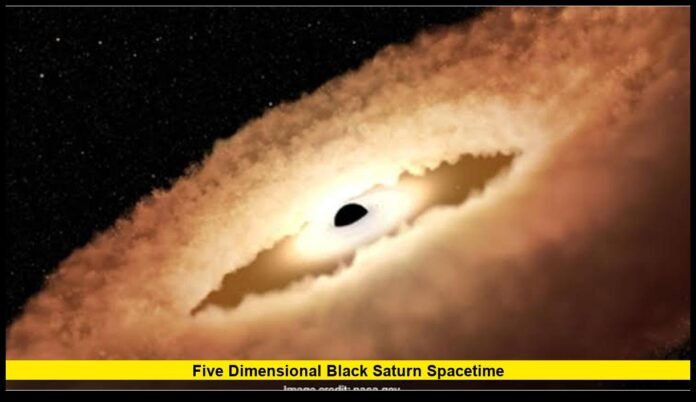

The Five dimensional black Saturn spacetime is attracting attention after a new mathematical study revealed a more complex theoretical arrangement of black holes than previously described. The research explores a strange configuration in which a spherical black hole sits inside a ring-shaped black hole, with both objects capable of rotating in two independent planes within a five-dimensional universe.
The latest development comes from theoretical physicist Jay Armas, whose research paper, Doubly-spinning Black Saturns, was posted to arXiv on November 16, 2026. The study develops a new family of mathematical solutions to Einstein’s equations, allowing scientists to investigate how black holes could behave when spacetime includes an additional spatial dimension.
The research does not report the discovery of an actual Black Saturn in space. Instead, it demonstrates how Einstein’s equations permit an unusual theoretical structure under specific mathematical conditions, providing physicists with another way to investigate gravity, black hole rotation, and higher-dimensional spacetime.
What Is Five Dimensional Black Saturn Spacetime?
A Black Saturn is a theoretical black hole configuration involving two separate black holes sharing the same surrounding spacetime. Unlike familiar black holes, which are generally described as spherical or nearly spherical in simplified models, the Black Saturn arrangement includes a central spherical black hole and a surrounding ring-shaped black hole.
The name “Black Saturn” comes from its visual resemblance to Saturn and its rings. However, the structure has nothing to do with the actual planet Saturn. It is a mathematical configuration involving black holes rather than a planet and a ring system.
In the theoretical arrangement:
- The central object: A spherical black hole positioned in the middle.
- The surrounding object: A black hole with a ring-shaped event horizon.
- The shared environment: Both black holes exist within the same gravitational spacetime.
- The rotation: Their spinning motion influences the geometry of the surrounding space and time.
- The dimensional framework: The mathematical solution requires five-dimensional spacetime, including four spatial dimensions and one time dimension.
The unusual ring-shaped black hole is one of the most important aspects of this configuration. In ordinary four-dimensional spacetime, the black hole structures familiar to astronomers are generally described with spherical or distorted spherical horizons. Five-dimensional gravity permits additional possibilities, including black holes whose event horizons have a ring-like topology.
What Is New in the Latest Black Saturn Research?
The most significant development in the latest study is the inclusion of rotation in two independent planes.
Earlier mathematical descriptions of Black Saturn configurations were more limited. The original Black Saturn solution developed in 2007 allowed the black holes to rotate, but the model was restricted to rotation in one plane.
Jay Armas’ new work expands the mathematical description. It presents a six-parameter family of stationary, asymptotically flat solutions of five-dimensional vacuum Einstein gravity.
In practical terms, the study allows the spherical black hole and the surrounding ring-shaped black hole to have more complicated rotational behavior.
The two objects can rotate in two independent directions, creating a more complete theoretical model of a five-dimensional Black Saturn.
The new solution is particularly important because higher-dimensional spacetime can permit rotational behavior that does not have a direct equivalent in our familiar three-dimensional space.
The New Research Paper and Its Current Status
The research is titled “Doubly-spinning Black Saturns” and was authored by Jay Armas.
The preprint was submitted to arXiv on November 16, 2026. It describes mathematical solutions in five-dimensional vacuum gravity and investigates configurations involving a spherical black hole surrounded by a black ring.
The study reports several important findings:
- Both black holes can rotate in two independent planes.
- The configuration belongs to a six-parameter family of mathematical solutions.
- The spherical black hole and the black ring can reach extremal states under specific conditions.
- The solutions include regular limits corresponding to previously known black hole configurations.
- The mathematical phase diagram agrees with earlier blackfold predictions.
Readers interested in the original mathematical work can explore the paper through the arXiv research preprint.
Because the research is currently available as a preprint, its publication and peer-review status should be distinguished from a fully peer-reviewed journal article.
Why Does Five-Dimensional Spacetime Matter?
The universe we experience has three familiar spatial dimensions—length, width, and height—and one dimension of time. This framework is commonly described as four-dimensional spacetime.
The Black Saturn solution, however, is constructed in five-dimensional spacetime. That means the mathematical model includes an additional spatial dimension beyond the three spatial dimensions familiar to us.
The additional dimension is not something scientists have directly observed in everyday life or through astronomical measurements. It is introduced within the theoretical mathematical framework.
Einstein’s general theory of relativity describes gravity as the curvature of spacetime caused by mass, energy, and momentum. The theory is not limited to the four-dimensional version of spacetime in its mathematical formulation. Researchers can investigate its equations in higher dimensions and discover different possible gravitational structures.
The additional spatial dimension changes the mathematical possibilities available to black holes.
In five-dimensional gravity, scientists can study:
- Ring-shaped event horizons
- Black holes rotating in two independent planes
- Multiple black hole structures
- More complicated gravitational interactions
- Different black hole equilibrium conditions
- New relationships between mass, angular momentum, and temperature
The Black Saturn is one example of how higher-dimensional mathematical models can reveal gravitational structures that are unavailable in more familiar four-dimensional settings.
How Can a Black Hole Have a Ring Shape?
A black hole is defined by its event horizon, the boundary beyond which light and matter cannot escape to the outside universe.
The event horizon does not necessarily have to be shaped like a simple sphere in every theoretical spacetime. In higher-dimensional gravity, mathematical solutions can permit more unusual horizon geometries.
A ring-shaped black hole has an event horizon with a topology resembling a donut. This structure is commonly called a black ring.
The ring can maintain its shape through rotation. Its angular momentum plays a role in supporting the configuration against gravitational collapse, although the exact balance depends on the mathematical parameters of the solution.
In the Black Saturn arrangement, the ring-shaped black hole surrounds a separate spherical black hole.
This creates an unusual geometry in which one black hole has a ring-like horizon and another has a spherical horizon. Both objects remain distinct, with their own event horizons, while their gravitational fields interact through the shared spacetime.
How the Two Black Holes Rotate in Two Planes
The newest mathematical solution allows the Black Saturn components to rotate in two independent rotational planes.
This is a key feature of five-dimensional spacetime. With an additional spatial dimension, the mathematical structure permits two independent rotations that cannot be reduced to a single rotation plane in the same way as familiar three-dimensional examples.
The central spherical black hole can have its own angular momentum. The surrounding ring-shaped black hole can also rotate, with its own rotational properties.
These rotations influence the gravitational environment surrounding the two horizons.
The new solution is not simply a model in which two black holes spin faster. It introduces a more complicated description of their rotational degrees of freedom and the relationship between their rotation, mass, gravitational fields, and horizon properties.
The ability to describe both black holes rotating in two planes allows scientists to investigate configurations that were inaccessible in the earlier singly spinning Black Saturn model.
What Is Frame Dragging and Why Is It Important?
One of the fascinating aspects of rotating black holes is their ability to influence the spacetime around them.
This phenomenon is known as frame dragging. In general relativity, a rotating massive object can cause the surrounding spacetime to twist. The effect is associated with the object’s rotation and can influence the motion of nearby matter and other objects.
The Black Saturn configuration provides an especially interesting setting for studying this effect because two separate black holes share the same gravitational environment.
The surrounding ring can influence the central spherical black hole. According to the new mathematical solution, the ring can induce rotation of the central black hole’s horizon in a plane where the central black hole may not have intrinsic angular momentum of its own.
In simpler terms, the rotation of one black hole can influence how the horizon of the other black hole behaves.
This illustrates why the two objects cannot be treated as completely isolated black holes. Their gravitational interactions are connected through the spacetime geometry they share.
Frame dragging is not merely an idea invented for the Black Saturn model. It is a recognized prediction of general relativity and has been studied in connection with rotating astronomical objects.
NASA’s black hole science overview explains how black holes influence their surroundings through gravity, matter, radiation, and the effects of spacetime near their event horizons.
What Does Extremality Mean for a Black Hole?
Another major result reported in the new Black Saturn research concerns a state known as extremality.
A black hole can have limits on the amount of angular momentum it can possess relative to its mass while maintaining a regular event horizon. When a black hole reaches an extremal condition, it sits at a mathematical boundary between possible black hole configurations and conditions under which the horizon may no longer remain intact.
The new Black Saturn solution shows that, within a particular regime, both black holes can become extremal at the same time.
This is a remarkable mathematical result because the two black holes are separate objects with distinct event horizons, yet the solution allows both to reach their extremal limits simultaneously.
In the model, the extremal condition is associated with a Hawking temperature of zero.
However, this should not be confused with a real-world black hole that has been observed to reach absolute zero. The result belongs to the theoretical mathematical description of the five-dimensional system.
Why Two Extremal Black Holes Cannot Achieve Complete Equilibrium
The study also identifies an important limitation.
Although both Black Saturn components can become extremal in the mathematical solution, the doubly extremal configuration cannot achieve complete thermodynamic equilibrium.
For full equilibrium, the black holes would need to satisfy additional conditions, including compatible rotational rates in both independent planes.
The calculations show that the required rotational matching cannot be achieved while preserving the regular Black Saturn configuration in the doubly extremal case.
This distinction matters because temperature alone does not determine whether a system is fully equilibrated.
A system involving rotating black holes may also need compatible angular velocities, as well as other thermodynamic and geometric conditions. The new study indicates that the doubly extremal Black Saturn configuration does not satisfy all of those requirements simultaneously.
The researchers therefore distinguish between the possibility of both horizons reaching extremality and the possibility of achieving complete equilibrium.
How the New Solution Connects With Earlier Black Hole Models
A major test of a new mathematical solution is whether it can reproduce known configurations under appropriate limits.
The new Black Saturn solution is significant because it admits several regular limits that connect it with previously studied black hole geometries.
These include:
- Doubly spinning Myers-Perry black holes
- Pomeransky-Sen’kov black rings
- Singly spinning Black Saturn configurations
These limits are important because they demonstrate how the more complicated solution relates to established mathematical structures in five-dimensional gravity.
The research also reports agreement with earlier predictions from blackfold methods concerning the phase diagram of these solutions.
The blackfold approach is a theoretical framework that can help physicists analyze certain extended black objects by treating them through effective descriptions. Agreement between different mathematical approaches can strengthen confidence in the consistency of a theoretical result, although it does not establish that the configuration exists in nature.
What Is the Difference Between a Black Saturn and an Ordinary Black Hole?
Black Saturn differs from the black holes astronomers commonly study in several important ways.
| Feature | Familiar Black Hole Models | Black Saturn |
|---|---|---|
| Number of horizons | Usually one | Two separate horizons |
| Geometry | Commonly spherical or distorted spherical | Spherical black hole plus ring-shaped black hole |
| Spacetime framework | Four-dimensional spacetime in standard astrophysical descriptions | Five-dimensional spacetime |
| Rotation | Often modeled with one rotational parameter | Can involve two independent rotation planes |
| Observational status | Black holes have been observed through gravitational and electromagnetic evidence | No Black Saturn has been observed |
| Scientific purpose | Describes astrophysical black holes | Explores possible higher-dimensional gravity solutions |
The comparison shows why Black Saturn is considered an unusual theoretical structure. It extends the mathematical possibilities of general relativity rather than describing a newly identified astronomical object.
Has a Five-Dimensional Black Saturn Been Discovered in Space?
No. A Black Saturn has not been discovered or confirmed by astronomers.
The latest study is a mathematical investigation of Einstein’s equations. It does not describe telescope observations, a detected gravitational-wave event, or an identified black hole system in a distant galaxy.
Astronomers have strong observational evidence for ordinary black holes through several methods, including:
- The motion of stars around massive invisible objects
- X-rays emitted by hot matter near black holes
- Gravitational waves produced during black hole mergers
- Images of black hole shadows and surrounding emission
- The effects black holes have on nearby stars, gas, and galaxies
These methods have helped scientists identify and study real black holes.
However, there is currently no confirmed observational evidence for a ring-shaped black hole surrounding a separate spherical black hole in the Black Saturn configuration described by the five-dimensional solution.
The NASA What Are Black Holes? explainer provides background on the black holes astronomers have studied and the observational evidence supporting their existence.
Does the Research Prove That an Extra Spatial Dimension Exists?
No.
The mathematical solution uses five-dimensional spacetime, but this does not mean researchers have discovered a fifth spatial dimension in the physical universe.
Higher-dimensional models are used in theoretical physics to investigate possible mathematical structures and explore whether certain gravitational phenomena could be described in frameworks extending beyond familiar spacetime.
An extra spatial dimension remains a theoretical possibility in some areas of physics, but the Black Saturn research does not provide direct evidence that such a dimension exists.
The distinction between a mathematical solution and an observational discovery is essential.
Einstein’s equations can permit configurations that scientists have not observed. The existence of a valid mathematical solution does not automatically mean nature creates that structure.
Why Scientists Study Theoretical Black Saturn Configurations
Even without observational confirmation, theoretical research can be valuable.
Black Saturn configurations allow physicists to explore how gravitational theory behaves in situations involving multiple horizons, higher dimensions, and complex rotational effects.
The new study could help researchers investigate several broader questions:
1. How does gravity behave in higher dimensions?
Five-dimensional solutions provide a mathematical environment for testing how gravitational structures change when an additional spatial dimension is introduced.
2. What kinds of black hole shapes are mathematically possible?
The ring-shaped horizon demonstrates that higher-dimensional gravity permits geometries that are more varied than the standard black hole models familiar from astrophysics.
3. How do multiple black holes interact through spacetime?
The Black Saturn arrangement provides an opportunity to study interactions between separate horizons and the influence of rotation on the surrounding gravitational geometry.
4. How are black hole rotation and temperature connected?
The extremal solutions offer a framework for studying relationships between angular momentum, horizon structure, and thermodynamic properties.
5. Can different mathematical approaches agree?
The reported agreement with earlier blackfold predictions provides a useful consistency comparison between theoretical methods.
Researchers may also use the mathematical framework as a starting point for further investigations into the behavior of light, matter, and spacetime near the horizons, although these are possible future research directions rather than confirmed findings from the current study.
Related Research on Five-Dimensional Black Holes
Black Saturn is not the only unusual configuration scientists have investigated in higher-dimensional gravity.
Researchers have studied a variety of mathematical structures involving black rings, multiple black holes, bubbles, and other spacetime geometries. These investigations help expand the understanding of what Einstein’s equations permit under different theoretical conditions.
For example, a 2024 paper published in Physical Review D investigated static equilibrium configurations involving multiple black holes and expanding bubbles in five dimensions. Its mathematical configurations included Black Saturn, black di-rings, bicycling black rings, and five-dimensional black hole binaries.
The paper demonstrates that Black Saturn configurations are part of a wider field of theoretical research exploring the possible gravitational structures of higher-dimensional spacetime.
Readers interested in this broader research can explore the Physical Review D study on static equilibrium of multi-black holes in expanding bubbles in five dimensions.
What Could Scientists Investigate Next?
The latest Black Saturn solution opens additional mathematical possibilities, but it also raises questions for future research.
Scientists may investigate how the new solution behaves under different parameter combinations, whether additional mathematical properties can be established, and how the geometry might be used to study other aspects of higher-dimensional gravity.
Potential future areas of investigation include:
- Stability: Whether particular configurations remain stable under small disturbances.
- Light propagation: How light would travel through the gravitational environment surrounding both horizons.
- Matter behavior: How matter would move near the spherical black hole and the surrounding ring.
- Horizon geometry: How the shape and structure of the two horizons change with different parameters.
- Thermodynamic properties: How temperature, angular velocity, and other black hole properties relate to each other.
- Further mathematical analysis: Whether additional regular configurations or limits can be identified.
These are research possibilities rather than results that should be attributed automatically to the current paper.
What Readers Should Watch for Next
The immediate scientific developments to watch are additional analysis of the preprint, independent examination of its mathematical results, and any future journal publication.
The paper is currently a new theoretical contribution. Further scientific scrutiny may clarify how its findings fit into the broader landscape of five-dimensional gravity and higher-dimensional black hole research.
Readers should also watch for follow-up studies exploring the stability, physical interpretation, and mathematical properties of doubly spinning Black Saturn configurations.
Any future observational claim would require a separate line of evidence. A mathematical solution alone cannot confirm that Black Saturns exist in the universe.
Frequently Asked Questions
Q1. What is five dimensional black Saturn spacetime?
Five dimensional black Saturn spacetime is a theoretical solution to Einstein’s equations involving a spherical black hole surrounded by a ring-shaped black hole. The mathematical model is constructed in five-dimensional spacetime.
Q2. What is new about the latest Black Saturn research?
The latest study by Jay Armas allows both the central spherical black hole and the surrounding black ring to rotate in two independent planes, expanding earlier Black Saturn models.
Q3. When was the new Black Saturn research released?
The preprint Doubly-spinning Black Saturns was submitted to arXiv on November 16, 2026.
Q4. Who developed the new solution?
The research was developed by theoretical physicist Jay Armas.
Q5. Can both black holes spin in two directions?
The mathematical solution allows each black hole to have rotation associated with two independent planes in five-dimensional spacetime.
Conclusion
The Five dimensional black Saturn spacetime research represents a new mathematical development in the study of higher-dimensional gravity. By allowing a spherical black hole and a surrounding ring-shaped black hole to rotate in two independent planes, the latest solution expands the theoretical possibilities of Einstein’s equations.
The study also shows that both black holes can reach extremal conditions simultaneously, while revealing that the doubly extremal configuration cannot achieve complete equilibrium. These results offer physicists a new framework for investigating black hole rotation, horizon geometry, gravitational interactions, and thermodynamic properties in five-dimensional spacetime.
Although Black Saturn remains theoretical and has not been observed in the universe, the research demonstrates how complex and unusual gravitational structures can become when scientists explore dimensions beyond the familiar four-dimensional spacetime.
What do you think about the possibility of black holes existing in such unusual configurations? Share your thoughts and stay tuned for the latest developments in theoretical physics and space science.