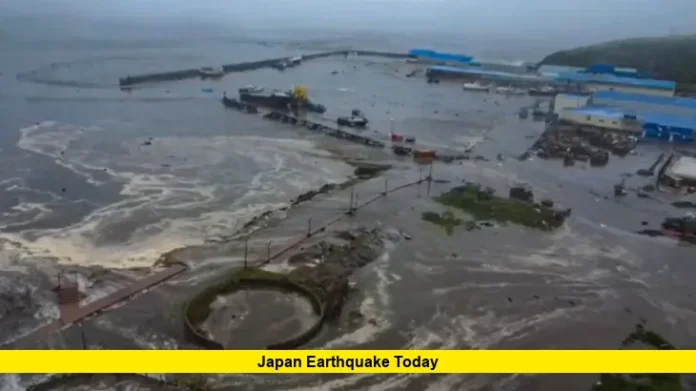

A massive earthquake struck northern Japan late Monday night, sending shockwaves across Aomori, Hokkaido and Iwate prefectures. The japan earthquake today measured 7.6 on the magnitude scale and caused immediate tsunami warnings. Coastal towns scrambled to evacuate residents, transportation ground to a halt, and emergency teams sprang into action as tremors and tsunami waves threatened safety across the region.
A Sudden, Powerful Strike Beneath the Sea
At 11:15 p.m. local time, a strong undersea earthquake erupted in the Pacific Ocean about 80 kilometers off the coast of Aomori Prefecture. The quake originated roughly 50 kilometers beneath the sea floor — a depth that often produces widespread but unpredictable shaking. The seismic intensity registered as “upper 6” on Japan’s Shindo scale, which translates to severe shaking likely to topple furniture and damage buildings.
Many coastal communities, especially around Aomori and southern Hokkaido, felt prolonged, jarring movement. In Hokkaido’s Sapporo, smartphone alerts blared as the quake rattled homes and businesses. The shaking lasted for roughly half a minute, enough time for residents to sense the full force of the tremor. In the city of Hachinohe and nearby districts, several people reportedly suffered injuries — some at a hotel where structural jolts caused objects to fall.
Within minutes, a 5.5-magnitude aftershock followed, heightening alarm and prompting authorities to keep alert levels high for potential further tremors.
Coastal Communities Brace for Tsunami Waves
Shortly after the quake, the national meteorological agency issued tsunami warnings for Aomori, Hokkaido, and Iwate prefectures. Officials cautioned that waves could reach up to 3 meters (nearly 10 feet) in height along the most exposed coastlines. In ports like Urakawa in Hokkaido and Mutsu-Ogawara in Aomori, initial waves of approximately 40 centimeters were recorded within the first hour — a stark indication of the danger.
Evacuation orders went out immediately. Residents were instructed to move to higher ground or designated emergency shelters. Harbor operations were suspended, fishing boats redirected, and coastal roadways closed to prevent tragic incidents. For many, the first wave was only the beginning; authorities reminded people that tsunami wave trains can last hours, with the most destructive surges sometimes arriving later.
In addition to the main warnings, advisories extended to peripheral regions such as Miyagi and Fukushima prefectures, as subordinate waves sometimes travel far beyond the initial danger zone.
Disrupted Transport, Power Outages, and Rapid Emergency Response
As the tsunami threat unfolded, transport networks shut down instantly. The Tōhoku Shinkansen — the bullet train line linking northern Honshu to greater Japan — suspended service pending safety checks. Local rail lines in affected areas halted operations, and early flights from northern airports were delayed due to runway and terminal inspections.
Utility companies began damage assessments after multiple reports of power outages across affected prefectures. Crews worked overnight to restore electricity, check for gas leaks, and ensure critical infrastructure remained operational. Though major structural collapses have not yet been confirmed, a number of buildings sustained damage — cracked walls, dislodged ceilings, and shattered glass were reported, especially in commercial zones near port towns.
Bridge inspectors headed out before dawn to examine overpasses and coastal routes for signs of stress or fissures. City engineers also surveyed hillsides and slopes near coastal roads, anticipating possible landslides triggered by ground shaking. In many communities, public works teams remain on high alert as daybreak reveals the full scale of the quake’s impact.
Nuclear Plants Under Watchful Eyes, Safety Protocols Engaged
All nuclear power facilities in the affected region immediately activated their seismic safety protocols. Operators conducted thorough safety checks and monitored radiation levels closely. As of now, there are no reports of anomalies or radiological leaks. Given Japan’s past experience with earthquake-induced nuclear disasters, the rapid safety response offers reassurance — but the situation remains under careful surveillance.
Government Mobilizes Emergency Task Force, Coordinates Relief
The national government responded swiftly. An emergency task force went into action to oversee damage assessment, relief efforts, and coordination among local authorities. The prime minister emphasized that public safety is the top priority and urged residents to follow evacuation orders and official guidance.
Municipalities opened dozens of emergency shelters, equipped with blankets, fresh water, and basic medical supplies. Local volunteers assisted elderly residents and families with children to relocate swiftly. Before dawn, coast guard helicopters began aerial surveys of shorelines, ports, and roads to spot visible damage, sunken vessels, or displaced debris that might signal hazards to returning residents.
Maritime agencies continue to monitor tide gauges and sea level sensors to track possible additional waves. Given the unpredictable nature of tsunami wave trains, communities remain on high alert — authorities warn that the danger may not be over yet.
Why Northern Japan Remains Vulnerable — A Geography of Risk
This region lies along the Pacific Ring of Fire, a dynamic zone where tectonic plates constantly collide and shift. Offshore from Aomori and Hokkaido, the ocean floor hosts subduction zones — where one plate is forced beneath another — building tremendous geologic strain over time. When that strain releases, it can create powerful earthquakes and tsunamis.
Although Japan has among the most advanced earthquake-resistant building codes and early-warning systems, the strength and location of this quake — offshore and under deep water — make tsunami creation more probable and more unpredictable. The japan earthquake today is a sobering reminder that even with modern technology and long experience, offshore megathrust quakes remain a formidable threat.
Experts note that in such events, tsunami wave patterns are rarely simple: the largest surge may come minutes or even hours after the first one. That unpredictability is why early and prolonged evacuation orders often mean the difference between life and tragedy.
Regional Impact and Potential Broader Effects
So far, observed tsunami activity remains localized — coastal areas in northern Japan and a few adjacent maritime zones. Officials say there is no danger to distant shores such as the U.S. West Coast, Alaska, or Canada’s Pacific coast. Nonetheless, shipping routes crossing the North Pacific have been temporarily adjusted, and fishing operations in the region remain suspended.
Local economies — already fragile in many northern towns — may face serious disruption. Ports, fisheries, seafood processing plants, and tourism operations all came to an abrupt halt. Businesses with waterfront exposure, in particular, are assessing damages or possible losses.
Infrastructure checklists now include roads, bridges, water treatment facilities, and electrical substations — all of which underwent stress from shaking and potential inundation. Full restoration may take days, and for some remote communities, longer.
What Residents Should Do — Aftershocks, Tsunami Risks, and Precautions
For residents in the affected areas, the situation remains fluid. Authorities recommend:
- Staying away from coastal areas and ports until officials officially lift tsunami warnings and confirm sea-level stability.
- Avoid returning home if your area is near the coast, especially if you live in low-lying or flood-prone zones.
- Remain alert for aftershocks and additional tsunami waves, which are common following offshore quakes.
- Keep emergency supplies at hand — including flashlights, portable chargers, drinking water, first aid kits, and essential medicines.
- Follow official local government and disaster response broadcasts for real-time updates and instructions.
If you live outside Japan but have family or friends in the affected zones: reach out to confirm their safety. Coastal towns often lose phone and internet service temporarily after quakes, but direct contact as soon as possible helps ensure everyone is accounted for.
Lessons Reinforced: Preparedness, Solid Infrastructure, Community Resilience
This earthquake once again demonstrates that even with advanced warnings, preparedness and community readiness matter most. Japan’s extensive early-warning systems, seismic-resistant buildings, and public education campaigns helped minimize chaos. But the strength and location of this quake test those systems to their limits.
For coastal communities especially, this event may prompt renewed reviews of evacuation routes, shelter availability, and disaster supply distribution. Local governments will likely inspect seawalls, breakwaters, and coastal defenses — asking whether existing infrastructure meets current tsunami threat levels.
On a national level, agencies may use data from this quake to refine tsunami models and alert protocols. The goal: better predict wave arrival times, heights, and inland reach to improve evacuation accuracy and response speed.
Even for international observers — especially other Pacific-rim nations — this quake serves as a stark reminder: megathrust earthquakes and tsunamis remain one of nature’s most unpredictable and destructive forces. Investing in early warning systems, robust infrastructure, and public awareness is not optional — it is essential.
What to Watch in the Coming Days
- Authorities will continue aerial and on-ground inspections of coastlines, harbors, roads, and bridges for structural damage or hazards.
- Tide gauges and sea-level monitoring stations will stay active to detect delayed or secondary tsunami waves.
- Aftershock activity over the next 48 to 72 hours may pose additional risks; residents should remain vigilant.
- Utility and infrastructure inspections — power lines, water supply, sewage, and railway lines — will need careful checking before services fully resume.
- Local recovery efforts will begin, including debris cleanup, temporary repairs, and stabilization of vulnerable zones.
This quake may also prompt broader national reviews of Japan’s coastal defense systems and disaster readiness plans. Given the country’s seismic history, each event becomes a chance to learn, adapt, and strengthen resilience.
Despite the midnight chaos, the swift response from authorities and the resolve of coastal communities have helped prevent a disaster worse than it might have been. As northern Japan begins the long process of recovery and rebuilding, safety remains the immediate priority, and vigilance remains essential.
Feel free to share your thoughts or experiences — and check back for updates as the situation evolves.