
Knowing HOW TO CALCULATE RMD FOR INHERITED IRA withdrawals can help beneficiaries understand their responsibilities after inheriting retirement savings. The amount that must be withdrawn depends on the original account owner’s date of death, the beneficiary’s relationship to the deceased, the type of retirement account, and the distribution rules that apply to the inheritance.
Inherited individual retirement accounts, commonly known as inherited IRAs, do not follow one universal withdrawal schedule. Some beneficiaries must take annual required minimum distributions, while others have a limited period to withdraw the entire balance. Certain surviving spouses and other eligible beneficiaries may qualify for special arrangements that provide additional flexibility.
Understanding these differences is important because missing a required distribution can result in an excise tax, while withdrawing too much from a traditional IRA in a single year can increase taxable income. A clear withdrawal strategy can help beneficiaries manage both obligations and make better use of the retirement assets they receive.
What Does an RMD Mean for an Inherited IRA?
A required minimum distribution, or RMD, is the minimum amount that must be withdrawn from a retirement account when applicable tax rules require a distribution. For an inherited IRA, the calculation depends on the beneficiary’s status and the rules governing the original owner’s account.
When an IRA owner dies, the remaining account assets generally pass to the named beneficiaries or other parties entitled to receive them. The beneficiary may be a spouse, child, sibling, friend, trust, or estate.
The inherited account usually retains its underlying tax characteristics. Money withdrawn from a traditional inherited IRA is generally taxable as ordinary income to the extent it represents untaxed funds. Qualified distributions from an inherited Roth IRA are generally tax-free.
However, tax-free treatment does not necessarily eliminate distribution deadlines. A beneficiary of a Roth IRA may still be required to empty the account within the applicable period.
The first step is to establish whether the inherited IRA requires annual withdrawals, whether the 10-year rule applies, and whether a special beneficiary exception changes the distribution schedule.
How to Calculate RMD for Inherited IRA Accounts in 2026
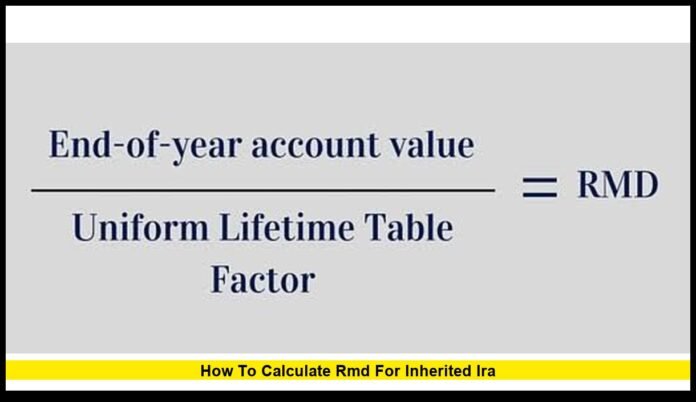
Beneficiaries who must take annual distributions based on life expectancy generally use the following formula:
RMD = December 31 account balance from the previous year ÷ Applicable life-expectancy factor
For a 2026 RMD calculated under the life-expectancy method, the starting point is generally the inherited IRA’s balance on December 31, 2025.
The applicable divisor depends on the beneficiary’s age, eligibility category, and distribution method. It is important to use the correct factor rather than selecting a number simply because it appears in a retirement calculator.
This formula does not apply universally. A beneficiary subject to the 10-year rule may have different annual distribution obligations, depending on the circumstances of the original owner’s death.
Step 1: Establish the date of death
The original owner’s year of death is one of the most important details in inherited IRA planning.
The SECURE Act changed distribution requirements for many beneficiaries of individuals who died after 2019. As a result, beneficiaries who inherited similar accounts in different years may face different withdrawal schedules.
Before calculating an RMD, determine the exact year the account owner died and identify which distribution rules apply to that inheritance.
Step 2: Identify the beneficiary category
Beneficiaries generally fall into several groups, including surviving spouses, eligible designated beneficiaries, other designated beneficiaries, and certain beneficiaries that are not individuals.
Eligible designated beneficiaries generally include surviving spouses, the deceased owner’s minor children, qualifying disabled or chronically ill individuals, and individuals who are not more than 10 years younger than the original owner.
The classification matters because it determines whether the beneficiary may use a life-expectancy method or must follow another distribution schedule.
Step 3: Determine whether annual withdrawals are mandatory
Some inherited IRA beneficiaries must take an RMD every year. Others may have flexibility during part of the 10-year distribution period.
When the 10-year rule applies, whether the original owner died before or on or after the required beginning date can affect the beneficiary’s annual withdrawal obligations.
Step 4: Select the correct life-expectancy factor
If the beneficiary qualifies for annual life-expectancy distributions, the next step is to identify the appropriate IRS table and factor.
The Uniform Lifetime Table commonly used by IRA owners is not automatically the right choice for someone who inherits an IRA.
Step 5: Calculate the required withdrawal
Divide the applicable previous year-end balance by the correct divisor.
For example, if the relevant account balance is $180,000 and the applicable life-expectancy factor is 25.0, the calculation would be:
$180,000 ÷ 25.0 = $7,200
The resulting $7,200 would be the RMD under those assumed circumstances. The beneficiary must independently establish that the factor of 25.0 applies to their situation.
Which IRS Life-Expectancy Table Should Beneficiaries Use?
Choosing the right life-expectancy table is essential because the divisor directly affects the minimum withdrawal amount.
Single Life Expectancy Table
The Single Life Expectancy Table is generally used in applicable inherited IRA situations involving beneficiaries who qualify for life-expectancy distributions.
For certain eligible designated beneficiaries, the initial factor is determined using the beneficiary’s age in the relevant distribution year. The factor generally decreases by one for each subsequent year.
For instance, an initial factor of 30.0 would generally become 29.0 the following year and 28.0 the year after that under the applicable method.
The actual starting factor depends on the beneficiary’s circumstances and the relevant IRS rules. The example illustrates how the divisor changes, not which factor every beneficiary should use.
Uniform Lifetime Table
The Uniform Lifetime Table generally applies to IRA owners calculating their own RMDs. A surviving spouse who properly treats an inherited traditional IRA as their own generally follows the applicable owner distribution rules.
A non-spouse beneficiary should not assume that this table applies simply because the deceased account owner was retired.
Joint and Last Survivor Life Expectancy Table
The Joint and Last Survivor Life Expectancy Table generally applies when an IRA owner has a spouse who is the sole beneficiary and more than 10 years younger.
This table is not the default choice for an adult child or another non-spouse beneficiary calculating inherited IRA distributions.
When the correct table is uncertain, the beneficiary should confirm the applicable method before withdrawing money.
Example: Calculating an Inherited IRA RMD for 2026
Consider an individual who inherited a traditional IRA and must take annual life-expectancy distributions.
The account’s balance on December 31, 2025, is $210,000. Assume the beneficiary’s applicable life-expectancy factor for 2026 is 28.0.
The calculation is:
$210,000 ÷ 28.0 = $7,500
Under these assumptions, the minimum distribution for 2026 would be $7,500.
Now suppose the account balance on December 31, 2026, falls to $195,000 and the applicable factor for the following year is 27.0.
The next calculation would be:
$195,000 ÷ 27.0 = approximately $7,222.22
The beneficiary would need to withdraw approximately $7,222 for that year, assuming the balance and divisor are correct.
This example demonstrates why annual RMD calculations should reflect the latest applicable year-end balance. A beneficiary should not automatically withdraw the same amount every year when the rules require a fresh calculation.
Investment performance, fees, and previous withdrawals can change the account balance. The applicable life-expectancy factor can also change under the governing method.
Understanding the 10-Year Rule for Inherited IRAs
The 10-year rule applies to many beneficiaries who inherit an IRA from an account owner who died after 2019.
Generally, a designated beneficiary who is not an eligible designated beneficiary must distribute the entire inherited account by December 31 of the year containing the 10th anniversary of the original owner’s death.
For example, if the original owner died in 2025, the beneficiary generally must empty the inherited IRA by December 31, 2035.
However, this deadline does not always mean that the beneficiary can wait until the 10th year to take every distribution.
When annual RMDs are required
If the original owner died on or after the required beginning date, a designated beneficiary subject to the 10-year rule generally must continue taking applicable annual RMDs during the distribution period. The beneficiary must also distribute the remaining balance by the end of year 10.
If the original owner died before the required beginning date, annual withdrawals generally are not required during years one through nine solely under the 10-year rule. The entire account must nevertheless be distributed by the final deadline.
The difference can affect how beneficiaries schedule withdrawals and estimate their annual tax obligations.
Why beneficiaries should plan before the final year
Imagine an adult child inherits a traditional IRA containing $275,000 from a parent who died in 2025. The child does not qualify as an eligible designated beneficiary.
If the 10-year rule applies and the parent died before the required beginning date, the beneficiary generally has flexibility to schedule distributions during the 10-year period.
Leaving the entire account untouched until the final year could result in a large taxable distribution. Any investment growth during the period could increase the amount that must eventually be withdrawn.
Spreading distributions across several years may help manage taxable income, depending on the beneficiary’s financial situation. However, the beneficiary must satisfy all applicable annual requirements and the final distribution deadline.
If the original owner died on or after the required beginning date, annual RMDs must also be considered.
Special Inherited IRA Rules for Surviving Spouses
Surviving spouses generally have more options than other beneficiaries. Their choice can affect when distributions begin, how much they must withdraw, and how the inherited funds fit into their retirement plans.
Treating the inherited IRA as your own
An eligible surviving spouse may transfer inherited assets to their own IRA or elect to treat the inherited account as their own.
After the account becomes the spouse’s own IRA, the usual owner distribution rules generally apply. For a traditional IRA, most owners must begin RMDs at age 73 under current law, subject to applicable exceptions and transition rules.
This option may suit a spouse who wants to continue retirement saving and does not need immediate access to the inherited funds.
However, the choice can change withdrawal restrictions. A surviving spouse who is younger than the deceased owner should consider how treating the account as their own affects distributions before retirement age.
Keeping the account as an inherited IRA
A surviving spouse may retain the account in inherited status when permitted.
Depending on the circumstances, the spouse may qualify for life-expectancy distributions, delayed distributions, or other special treatment.
The appropriate method depends on factors such as the deceased owner’s age, the surviving spouse’s age, and whether the owner had already reached the required beginning date.
Considering the 10-year method
Certain surviving spouses can use the 10-year rule when the applicable requirements are satisfied.
This approach may provide flexibility, but the spouse should understand how the election affects annual withdrawals and the final deadline.
Before transferring the account or choosing a distribution method, compare the available options and confirm how each choice affects taxes and access to the money.
What Happens When a Minor Child Inherits an IRA?
A minor child of the original IRA owner may qualify as an eligible designated beneficiary. This classification can provide access to life-expectancy distributions under special rules.
However, the treatment does not continue indefinitely. Once the child reaches the applicable age of majority, the 10-year distribution requirement generally begins under the rules governing this exception.
Consequently, the account may not have to be emptied within 10 years of the parent’s death. The deadline depends on the child’s age and the applicable distribution rules.
Parents, guardians, and other representatives should make sure the account is administered correctly during the child’s minority and that the future distribution deadline is not overlooked.
Rules for Disabled and Chronically Ill Beneficiaries
Certain disabled or chronically ill individuals may qualify as eligible designated beneficiaries and receive more favorable distribution treatment.
Eligibility depends on the applicable federal definitions rather than simply having a medical condition.
A beneficiary who meets the relevant requirements may be eligible to use a life-expectancy method instead of following the standard 10-year distribution rule.
Because the requirements are specific, beneficiaries should establish their eligibility before selecting a withdrawal schedule.
Do Inherited Roth IRAs Have Required Distributions?
Inherited Roth IRAs have different tax characteristics from traditional inherited IRAs, but they are still subject to beneficiary distribution rules.
The original Roth IRA owner generally does not take lifetime RMDs. After the owner’s death, beneficiaries may nevertheless have to distribute the account within the applicable period.
Many non-spouse beneficiaries are subject to the 10-year rule. Eligible designated beneficiaries may qualify for alternative arrangements depending on their circumstances.
Qualified Roth IRA distributions are generally tax-free. This can make an inherited Roth IRA different from a traditional IRA, where withdrawals are generally taxable to the extent they consist of untaxed funds.
For example, an adult child who inherits a Roth IRA may be required to empty the account by the end of the 10th year after the parent’s death. The child should confirm whether the distributions qualify for tax-free treatment and whether any annual distribution requirements apply.
The five-year holding requirement may also affect whether a Roth IRA distribution qualifies for tax-free treatment.
What Happens if You Miss an Inherited IRA RMD?
Failing to withdraw the required amount by the applicable deadline can trigger an excise tax on the shortfall.
The standard federal excise tax rate is generally 25% of the amount that should have been withdrawn but was not. If the shortfall is corrected within the applicable correction window, the rate may be reduced to 10%.
The tax applies to the missed amount rather than automatically applying to the entire inherited IRA balance.
For example, suppose the required distribution is $8,000, but the beneficiary withdraws only $5,000 by the deadline.
The shortfall is:
$8,000 − $5,000 = $3,000
At the standard 25% rate, the potential excise tax would be $750. If the beneficiary qualifies for the reduced 10% rate after correcting the shortfall within the applicable period, the tax could be $300.
The actual outcome depends on the circumstances and whether the requirements for relief are satisfied.
Can the penalty be waived?
The IRS may waive the excise tax when the shortfall results from a reasonable error and the beneficiary takes reasonable steps to correct the problem.
The beneficiary generally must follow the applicable filing procedures and explain why the required distribution was missed.
A waiver is not automatic. Beneficiaries should correct the shortfall as soon as possible, maintain records, and seek professional tax guidance when necessary.
Practical Ways to Manage Inherited IRA Withdrawals
A well-planned withdrawal strategy can help beneficiaries manage their tax obligations while preserving inherited retirement assets where possible.
1. Consider the tax effect of each withdrawal
Traditional inherited IRA distributions are generally taxable to the extent the money has not already been taxed.
Taking a large amount in one year can increase taxable income and potentially push some income into a higher federal tax bracket.
When the applicable distribution rules permit flexibility, beneficiaries may be able to spread withdrawals across multiple years to manage the tax impact.
2. Recalculate annual RMDs when required
Beneficiaries taking life-expectancy distributions generally need to use the applicable previous year-end balance for each new calculation.
Account values can rise or fall, so an earlier calculation may no longer be accurate.
Keep records of annual balances, distribution factors, and withdrawals to help ensure that each required distribution is calculated correctly.
3. Consider other income sources
Salary, pension payments, Social Security benefits, and investment income may all affect the tax consequences of an inherited IRA distribution.
A beneficiary who continues working may have different planning considerations from someone who has retired.
Evaluating withdrawals alongside other income can help reduce unexpected tax costs.
4. Verify account registration and beneficiary records
Multiple beneficiaries, trusts, and estates can introduce additional complexity.
Confirm the account’s legal registration, beneficiary status, and applicable deadlines with the IRA custodian. Separate inherited accounts may be necessary in some circumstances to apply the correct distribution rules.
5. Remember that an RMD is a minimum
When an annual RMD applies, the beneficiary may generally withdraw more than the minimum. However, additional withdrawals from a traditional inherited IRA can increase taxable income.
Before taking more than required, consider immediate financial needs, tax consequences, and the final distribution deadline.
Common Mistakes to Avoid When Calculating Inherited IRA RMDs
Several mistakes can lead to incorrect withdrawals or unnecessary tax problems.
- Using the wrong life-expectancy table: The correct table depends on the beneficiary’s circumstances and distribution method.
- Using an outdated account balance: A 2026 life-expectancy calculation generally starts with the December 31, 2025, balance.
- Ignoring the 10-year deadline: Many beneficiaries must distribute the entire account by the end of the 10th year following the owner’s death.
- Assuming no annual distributions are required: Certain beneficiaries subject to the 10-year rule must continue taking annual RMDs.
- Treating an inherited IRA as a personal IRA: Non-spouse beneficiaries generally cannot simply treat an inherited account as their own.
- Overlooking the year-of-death distribution: Any outstanding RMD for the year the original owner died must be considered.
- Assuming Roth IRAs have no beneficiary deadlines: The original owner’s exemption from lifetime RMDs does not eliminate beneficiary distribution requirements.
The safest approach is to determine the applicable beneficiary category, verify the withdrawal schedule, and calculate distributions using the correct method.
Frequently Asked Questions About Inherited IRA RMDs
How do I calculate an inherited IRA RMD for 2026?
If you must take annual life-expectancy distributions, divide the inherited IRA’s December 31, 2025, balance by the applicable life-expectancy factor for 2026. Other beneficiaries may follow different distribution rules.
Do all inherited IRAs require annual withdrawals?
No. The requirements depend on the beneficiary’s classification, the original owner’s circumstances, and the distribution method. Some beneficiaries subject to the 10-year rule do not need annual withdrawals during the first nine years if the original owner died before the required beginning date.
Can I withdraw an entire inherited IRA immediately?
In many circumstances, a beneficiary can withdraw the entire account. However, a large traditional IRA distribution may substantially increase taxable income. Consider the financial and tax consequences before withdrawing the full balance.
Does every inherited IRA have to be emptied within 10 years?
No. Many beneficiaries must follow the 10-year rule, but certain surviving spouses and other eligible designated beneficiaries may qualify for different distribution methods.
Are inherited IRA distributions taxable?
Traditional inherited IRA withdrawals are generally taxable to the extent the funds have not already been taxed. Qualified inherited Roth IRA distributions are generally tax-free, although distribution deadlines still apply.
What should I do if I miss an RMD?
Determine the amount of the shortfall, correct it promptly, and review the applicable tax filing requirements. The IRS may provide relief in qualifying circumstances, but a waiver is not automatic.
Final Thoughts on Inherited IRA RMD Planning
Calculating an inherited IRA RMD begins with identifying the beneficiary category and determining which withdrawal rules apply. For life-expectancy distributions, the previous December 31 account balance and the correct divisor are central to the calculation. For beneficiaries subject to the 10-year rule, the final distribution deadline and any annual withdrawal requirements must also be considered.
The right approach can help beneficiaries avoid missed deadlines, manage taxable income, and make informed decisions about inherited retirement savings. Reviewing the account annually and confirming the applicable rules can prevent small mistakes from becoming expensive problems.
Before taking a distribution, check the account records, establish the applicable deadline, and seek qualified tax advice if the inheritance involves complicated circumstances.
Have you inherited an IRA or are you preparing for an upcoming required distribution? Share your questions and experiences in the comments, and stay informed about retirement withdrawal rules and tax planning.