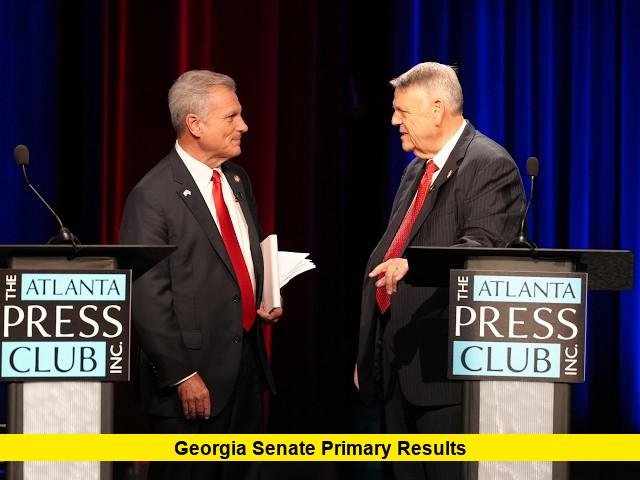

Republican voters are driving intense national attention toward the Georgia Senate Primary Results 2026 as a competitive three-candidate contest reshapes the political landscape in one of America’s most important battleground states. Former football coach Derek Dooley, Congressman Buddy Carter, and Congressman Mike Collins have emerged as the leading Republican contenders hoping to secure the nomination and challenge Democratic Sen. Jon Ossoff in the general election.
The high-profile race has quickly become one of the defining Senate battles of the cycle. With control of Congress expected to hinge on a handful of key states, Georgia once again sits at the center of the national political conversation.
Republicans entered the election season determined to flip the seat after years of razor-thin statewide races. Democrats, meanwhile, are rallying behind Ossoff as he seeks another term representing a state that continues to reflect deep political divisions between urban growth centers and conservative rural communities.
The Republican primary has become especially unpredictable because Georgia law requires a candidate to receive more than half of the vote to avoid a runoff. If no contender crosses that mark, the top two candidates will advance to another election scheduled for June 16.
A Crowded Republican Contest Takes Shape
The GOP field gained momentum early after Gov. Brian Kemp decided not to enter the Senate race himself. That decision created a scramble among Republicans eager to position themselves as the strongest candidate capable of defeating Ossoff.
Derek Dooley immediately attracted attention because of his well-known football background and strong connections inside Georgia political circles. Kemp’s public support gave Dooley credibility with establishment Republicans and major donors.
At the same time, Mike Collins built support among conservative activists by embracing a hardline America First message. Collins consistently aligned himself with Donald Trump’s political movement and appealed to Republican voters focused on immigration and conservative cultural issues.
Buddy Carter also remained competitive throughout the campaign, presenting himself as a dependable conservative with years of congressional experience. Carter emphasized border security, economic policy, and federal spending while attempting to appeal to both traditional Republicans and Trump supporters.
The three-way battle created an intense campaign environment filled with television ads, debates, rallies, and statewide organizing efforts.
Georgia Remains a Political Battleground
Georgia’s rapid transformation into a swing state has made every statewide election a national event.
For decades, Republicans dominated statewide offices across Georgia. But demographic changes, population growth in metro Atlanta, and shifting suburban voting trends have dramatically altered the state’s political balance.
Jon Ossoff’s Senate victory earlier in the decade helped solidify Georgia’s reputation as one of the most competitive states in America. Since then, both political parties have invested enormous amounts of money and energy into organizing voters across the state.
Republicans believe the current political environment gives them a strong opportunity to reclaim the Senate seat. Democrats argue that Ossoff’s fundraising network and statewide recognition make him a difficult opponent regardless of the Republican nominee.
Political analysts across the country continue monitoring Georgia because the state could once again help determine which party controls the Senate after November.
Derek Dooley Leans on Outsider Appeal
Dooley entered the race with one major advantage few political candidates possess: statewide name recognition tied to college football.
As the son of legendary Georgia coach Vince Dooley, Derek Dooley already carried deep connections to many Georgia voters before launching his campaign.
He used that familiarity to present himself as an outsider capable of bringing a different approach to Washington politics. His campaign repeatedly emphasized leadership, discipline, and conservative values.
Support from Gov. Brian Kemp also strengthened Dooley’s standing among establishment Republicans who viewed him as a potentially strong general election candidate against Ossoff.
Dooley focused heavily on economic issues, public safety, border enforcement, and opposition to federal spending policies pushed by Democrats in Washington.
However, some critics questioned whether a candidate without prior elected office experience would be prepared for the demands of a Senate campaign and national political scrutiny.
Despite those concerns, Dooley remained one of the strongest contenders throughout the primary race.
Mike Collins Energizes Conservative Voters
Congressman Mike Collins built his campaign around a direct appeal to conservative grassroots voters.
Collins embraced aggressive messaging on immigration, federal regulations, energy production, and cultural issues. He also frequently highlighted his support for Donald Trump and conservative priorities championed by the Republican base.
That strategy helped Collins gain momentum among voters who wanted a candidate closely connected to the MAGA movement.
Collins argued that Republicans needed a fighter willing to challenge Democratic leadership aggressively in Washington. He often portrayed himself as the candidate best positioned to energize conservative turnout across rural Georgia.
Many political observers noted that Collins performed especially well among voters who remained highly engaged with Trump-era politics.
The campaign’s intensity increased as Collins and his rivals competed for support from influential conservative activists and organizations statewide.
Buddy Carter Pushes Experience and Conservative Credentials
Buddy Carter entered the Senate race emphasizing his years in Congress and his record supporting conservative policies.
Carter argued that experience matters in a high-stakes Senate race and repeatedly highlighted his work on healthcare, national security, and economic legislation.
Throughout the campaign, Carter sought to balance strong support for Trump’s policies while also presenting himself as a candidate capable of attracting independent voters in the general election.
He traveled extensively across Georgia meeting with Republican voters and emphasizing issues such as inflation, public safety, and federal spending.
Carter’s campaign also invested heavily in advertising as he attempted to separate himself from Collins and Dooley in a crowded field.
The competition between the three Republicans became increasingly fierce during the final stretch before voting.
Trump’s Shadow Looms Over the Primary
Even without formally endorsing a candidate before the election, Donald Trump remained one of the most influential figures shaping the Republican race.
Each major GOP contender attempted to connect with Trump voters while also positioning themselves for a potentially difficult statewide general election.
That balancing act reflected a larger debate inside the Republican Party about the future direction of the GOP.
Some strategists argued Republicans should nominate the candidate most likely to appeal to suburban swing voters. Others believed enthusiasm from conservative grassroots voters mattered more than moderation.
Trump’s continued popularity among Republican primary voters ensured that his influence remained central throughout the campaign.
Candidates frequently referenced his policies, campaign themes, and political priorities during rallies and interviews across Georgia.
Jon Ossoff Prepares for General Election Fight
While Republicans focused on the primary contest, Jon Ossoff continued building his statewide campaign operation ahead of the general election.
Ossoff entered the cycle with strong fundraising numbers and national Democratic support. His campaign emphasized healthcare access, voting rights, infrastructure investment, and economic opportunity.
Democrats view Ossoff as one of the party’s strongest Senate incumbents in a competitive state. Republican leaders, however, argue Georgia’s political climate gives them a significant chance to defeat him.
The senator avoided a contested Democratic primary, allowing him to conserve resources while Republicans spent months battling each other for the nomination.
That advantage could become especially important if the Republican race advances to a runoff election.
Runoff Possibility Creates Uncertainty
Georgia’s election rules have made runoff scenarios a major factor in statewide politics for years.
Because candidates must receive more than 50 percent of the vote to win outright, crowded races often continue beyond the initial primary election.
The Republican Senate contest appeared likely to follow that familiar pattern as polling showed support divided among multiple candidates.
A runoff would extend campaigning deep into June and force candidates to continue spending heavily on advertising and voter outreach.
Republican strategists remain concerned that a prolonged internal fight could weaken the eventual nominee before facing Ossoff in November.
Democrats, meanwhile, are closely watching whether divisions inside the Republican field leave lasting political damage.
Suburban Voters Could Decide the Election
One of the biggest questions surrounding the Senate race involves suburban voters around metro Atlanta.
Recent Georgia elections have shown dramatic shifts among suburban communities that once leaned strongly Republican.
Democrats have gained support in several fast-growing counties, while Republicans continue dominating many rural areas across the state.
The candidate who ultimately wins the Senate seat will likely need to perform strongly in both suburban and rural regions.
Republicans believe concerns about inflation, immigration, and economic uncertainty could help them reclaim suburban support.
Democrats argue that Ossoff’s appeal to younger voters and suburban moderates remains a powerful advantage heading into the general election.
National Spending Floods Into Georgia
The Senate race has already attracted enormous outside spending from political organizations nationwide.
Television commercials, digital campaigns, mailers, and grassroots organizing efforts have saturated Georgia voters for months.
Political groups on both sides see the state as one of the most important Senate battlegrounds in the country.
As the campaign moves closer to November, spending is expected to increase dramatically.
The eventual Republican nominee will face immediate national attention and intense pressure from party leaders eager to flip the seat.
What Voters Are Watching Next
Georgia voters now wait to see whether the Republican primary produces a clear nominee or triggers another runoff election.
The outcome will shape the next stage of one of the country’s most competitive Senate contests.
Republicans are hoping to capitalize on voter frustration over economic issues and national politics. Democrats are working to protect one of their most important Senate seats.
The months ahead are expected to bring nonstop campaigning, aggressive advertising, and major turnout operations from both parties.
The battle for Georgia’s Senate seat is no longer just a state contest. It has become one of the defining political fights in America.