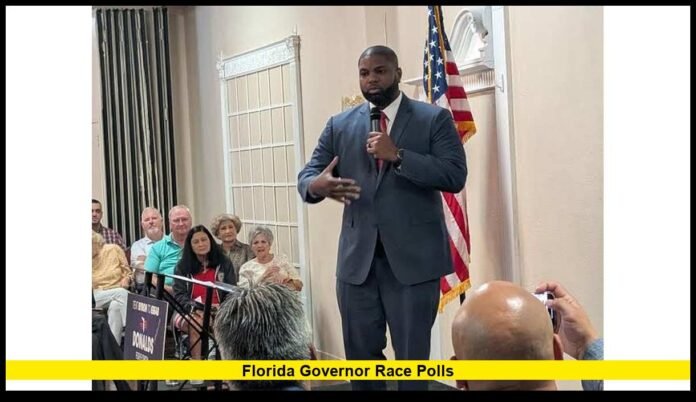

The latest Florida governor race polls show Republican Byron Donalds leading Democratic candidate David Jolly in most recently reported surveys ahead of Florida’s November 3, 2026, gubernatorial election. However, the size of Donalds’ advantage varies across polling organizations, with some surveys indicating a narrow contest and others showing a more comfortable Republican lead.
The race has become an important test of the political environment in Florida, a state that plays a significant role in national elections. Voters are weighing the candidates’ backgrounds, policy priorities, and plans for the state’s future as the campaign reaches its final stage.
Recent surveys offer several different perspectives on the contest. A RedBox Research poll placed Donalds just one percentage point ahead of Jolly, while a Stetson University survey reported a six-point Republican advantage. Other polling averages and individual surveys fall between those figures.
These differences make it important to look beyond a single headline. Polls measure voter preferences during a particular period, and their results depend on factors such as sampling methods, voter participation assumptions, and the timing of fieldwork.
As of November 2, 2026, the election remains undecided. The polling provides a snapshot of the race before Election Day, but only the official vote count and certification process can establish the winner.
Latest Florida Governor Race Polls: Comparing the Numbers
The most recent polling picture suggests that Donalds has an advantage, but the precise margin depends on which surveys an analyst includes and how those surveys are weighted.
The following table summarizes several important findings available before Election Day.
| Polling result | Donalds | Jolly | Reported margin |
|---|---|---|---|
| Late October statewide survey | 47% | 46% | Donalds +1 |
| Final pre-election university survey | 51% | 45% | Donalds +6 |
| Late October likely-voter survey | 49% | 45% | Donalds +4 |
| Late October polling average | 48.5% | 45.2% | Donalds +3.3 |
| Alternative polling average | 48.2% | 43.1% | Donalds +5.1 |
These figures represent different surveys and averaging systems, rather than repeated measurements from one identical sample. Their reported percentages may also reflect different approaches to undecided voters and other candidates.
The table illustrates two important points. First, Donalds leads in all five comparisons. Second, the margin ranges from approximately one percentage point to six points in the individual surveys and averages shown.
The distinction between a candidate’s support percentage and the margin between candidates is important. A candidate can lead while still receiving less than half of the projected vote, particularly when undecided voters and minor-party candidates remain in the calculation.
For election watchers, the most meaningful question is not simply whether Donalds leads. It is whether the advantage remains consistent across different survey methods and whether the margin is large enough to distinguish the candidates confidently.
RedBox Research Poll Shows a Close Contest
One of the most closely watched late-campaign findings placed Donalds at 47% and Jolly at 46% among likely voters. The survey was conducted October 30–31 and released November 1.
The reported difference was small enough to fall within the survey’s uncertainty. Although Donalds held the numerical lead, the result did not establish that he had a statistically meaningful advantage over Jolly.
The survey also examined voters who had already cast their ballots. Within that group, Jolly held a lead over Donalds, even though Donalds was slightly ahead in the overall statewide result.
That distinction is useful when interpreting early voting. People who vote before Election Day may differ from those who wait until Election Day, and their preferences can vary by party, age, geography, and voting habits.
However, an early-voter subgroup cannot independently determine the statewide outcome. The result depends on the number of ballots cast, the preferences of remaining voters, and the final distribution of votes across the state.
The survey also included responses for minor-party candidates and other voting choices. Consequently, the two leading candidates’ percentages should not automatically be interpreted as the entire electorate’s final vote distribution.
The central takeaway is that a close survey deserves attention, but it should be evaluated alongside the wider body of polling rather than treated as a definitive forecast.
Stetson University Survey Finds Donalds Ahead by Six Points
A late-October survey of Florida voters placed Donalds at 51% and Jolly at 45%, giving the Republican a six-point advantage.
The survey incorporated responses from voters who had already voted and those who had not yet cast their ballots. It also used a modeled likely-voter population to estimate the preferences of people expected to participate in the election.
This result showed a larger Republican lead than the one-point difference reported in the late-campaign RedBox survey.
The contrast does not automatically mean that voter preferences changed sharply between the surveys. Pollsters can produce different results because they use different samples, weighting procedures, and turnout assumptions.
Another consideration is the treatment of undecided voters. Some surveys report their choices separately, while others allocate respondents who lean toward a candidate. Such decisions can influence the percentages displayed in a headline.
The university survey nevertheless provides useful evidence that Donalds’ advantage was not limited to a single polling organization. Other late-October surveys also showed him leading by several percentage points.
For anyone tracking the Florida governor race polls, the combination of a close survey and a survey showing a larger lead highlights the uncertainty surrounding the final margin.
How Polling Averages Measure the Florida Governor Race
Polling averages attempt to provide a more stable picture of an election by combining multiple surveys. Instead of relying entirely on one poll, an average summarizes results from several polling organizations.
Different averaging methods can produce different conclusions.
Some averages give equal weight to each eligible poll. Others assign greater weight to larger samples, newer surveys, or pollsters with particular historical performance characteristics.
Averaging systems also differ in how they treat surveys commissioned by campaigns or political organizations, how they handle repeated polls from the same organization, and how far back they look.
These choices matter in Florida’s governor contest because the leading candidates’ margins have varied across individual surveys.
One recent average put Donalds at 48.5% and Jolly at 45.2%, giving Donalds a 3.3-point advantage. Another reported average showed Donalds at 48.2% and Jolly at 43.1%, producing a 5.1-point margin.
Neither figure should be mistaken for an official election forecast. A polling average is a summary of survey results, and it does not eliminate systematic errors shared by several polls.
For example, if multiple surveys underrepresent a particular group of voters, combining those surveys may not fully correct the problem.
Averages also do not directly measure the likelihood that an individual candidate will win. A probability forecast requires additional assumptions about turnout, historical voting patterns, polling uncertainty, and other factors.
The best approach is to examine both the overall average and the individual surveys contributing to it.
Byron Donalds and His Republican Campaign
Byron Donalds enters the general election as the Republican candidate after serving in the U.S. House of Representatives and previously holding a seat in the Florida House of Representatives.
His political background gives him experience in both state and federal government. His campaign is competing to retain Republican control of the governor’s office and build a statewide coalition for the November election.
Donalds’ position in the polling reflects a broader challenge facing both campaigns: converting party support into sufficient votes across Florida’s varied electorate.
Republican voters form an important part of his potential coalition, but statewide elections also require candidates to appeal to independents and voters whose political preferences do not always follow party lines.
Donalds must also maintain support among voters who prioritize economic conditions, public safety, immigration enforcement, education, and the direction of state government.
A poll showing him near or above 50% can suggest a favorable position, but the meaning depends on how the survey handles other candidates and undecided respondents. It is not necessarily equivalent to a projection of the final two-party vote.
His advantage across several late-October polls gives him a stronger position in the available survey evidence. Still, the exact size of that lead remains uncertain.
David Jolly and the Democratic Campaign
David Jolly is the Democratic candidate challenging Donalds. He previously served in the U.S. House of Representatives as a Republican before later becoming associated with the Democratic Party.
His political history distinguishes him from candidates whose careers have remained within a single party. His challenge is to build a coalition that can compete in a state where Republicans have performed strongly in recent statewide and presidential elections.
Jolly’s candidacy also places attention on whether a Democratic campaign can appeal to voters who may be dissatisfied with the direction of state government without losing the support of the party’s traditional electorate.
His standing in the polls shows that he remains a significant competitor. The closest recent survey placed him just one point behind Donalds, while other results put the difference at four to six points.
Those results offer different assessments of his position, but they do not establish that he is certain to win or lose.
To improve his standing, a candidate generally needs to persuade undecided voters, maintain support among existing supporters, and encourage favorable turnout. These are broad electoral considerations, not evidence that any specific shift has already occurred in this race.
The available polling also cannot independently establish which campaign message has been most effective. That would require more detailed research into voter priorities, candidate approval, and issue preferences.
What Matters Most to Florida Voters in 2026
The governor’s election will determine who leads the state’s executive branch for the next term. The contest therefore involves policy questions that affect households, businesses, local governments, and public institutions.
Although candidate polling measures overall preference, the issues behind those preferences are equally important to understanding the political environment.
Housing Costs and Affordability
Housing remains an important consideration in Florida, where population growth, property costs, and demand for homes influence household budgets.
Renters may focus on monthly housing expenses, while homeowners may be more concerned about property taxes, insurance costs, and the long-term affordability of maintaining a property.
Candidates’ approaches to development, regulation, infrastructure, and economic growth can shape how voters evaluate their plans.
However, the available head-to-head polling figures do not establish that housing is the leading reason people support either candidate. That conclusion would require separate polling about voter priorities.
Homeowners Insurance and Hurricane Preparedness
Insurance affordability is another significant issue in Florida because the state faces hurricanes and other severe weather risks.
Homeowners may consider premium costs, coverage availability, insurer participation, and the state’s response to natural disasters when evaluating the next governor.
Disaster preparation and recovery also involve coordination between state agencies, local authorities, insurers, and federal programs.
The candidates’ proposals on these subjects may influence voters, but it is important to distinguish their stated positions from policies that have already been implemented.
Jobs and Economic Conditions
Employment, wages, business conditions, taxes, and the cost of everyday necessities can affect how Floridians judge state leadership.
Voters may evaluate candidates based on their plans for economic development and their approach to the balance between business activity, public spending, and household affordability.
Economic indicators can provide context for the election, but they do not translate automatically into a particular candidate’s vote share.
Individual voters may place different priorities on economic growth, wages, inflation, public services, and the overall cost of living.
Education and Public Services
Education policy is another part of the governor’s responsibilities. Public schools, higher education, school funding, and education regulations can influence the political debate.
Florida’s changing population also affects demands on roads, public facilities, emergency services, and other government programs.
Voters may assess the candidates according to how they propose to manage those responsibilities and whether they believe the state is meeting local needs.
These topics help explain the broader stakes of the governor’s election, although polling on the overall race should not be presented as proof that any one issue determines the contest.
Immigration and Public Safety
Immigration enforcement and public safety remain important subjects in Florida and national politics.
Some voters prioritize cooperation with federal immigration authorities, border enforcement, and law enforcement resources. Others may focus on the practical effects of enforcement policies on families, employers, and local communities.
Candidates’ records and proposals can shape how voters view their leadership, but the direction of the overall governor polling does not reveal every group’s views on these issues.
A complete assessment requires distinguishing statewide candidate preference from specific policy opinions.
Why the Florida Governor Race Could Finish Differently From the Polls
Even with multiple surveys pointing in the same direction, polling does not guarantee an election result.
One reason is turnout. The people who answer surveys are not necessarily identical to those who ultimately vote. Pollsters attempt to account for this by identifying likely voters, but their models can still differ from actual participation.
Another factor is undecided voters. People who have not selected a candidate can make a difference in a close contest, particularly if their preferences become clearer shortly before Election Day.
Some respondents may also change their minds, although a poll by itself cannot determine how many will do so or which candidate they might choose.
Survey methodology introduces additional uncertainty. Pollsters may use different recruitment methods, weighting systems, and definitions of likely voters. These differences can affect the results even when surveys are conducted at approximately the same time.
Finally, the geographical distribution of votes matters. Florida’s counties differ in population, political preferences, and turnout patterns. A statewide survey summarizes preferences across the state, but the official result depends on the ballots actually cast in every county.
None of these factors proves that the polls are wrong. They explain why a lead should be interpreted as an estimate rather than a guaranteed outcome.
Florida Early Voting and Its Importance to the Race
Florida’s early voting period gives eligible voters an opportunity to cast ballots before Election Day. Vote-by-mail ballots provide another way for eligible voters to participate under the state’s election rules.
Early voting can provide useful information about participation, but turnout totals and candidate preferences are different measures.
A high early-voting total does not automatically benefit one party. The political impact depends on which voters participate, how they vote, and how their participation compares with expectations.
The same principle applies to surveys that include people who have already voted. Their reported choices offer information about ballots already cast, but the statewide outcome also depends on voters who have not yet participated and on the final count.
Election officials must follow the applicable procedures for processing and counting ballots. The order in which counties report results may influence how the election appears to develop on election night.
Readers should therefore avoid treating partial returns as a final outcome. A candidate can lead in early reported results without necessarily winning statewide, and the opposite can also occur.
Official results, rather than turnout assumptions or incomplete returns, determine the winner.
Election Day and the Official Results Process
Florida’s general election is scheduled for Tuesday, November 3, 2026.
As of November 2, the governor’s race remains undecided. The latest surveys provide estimates of candidate support, but no polling organization can declare the official winner before the election results establish the outcome.
After voting concludes, county election officials will report results as ballots are processed and counted. The timing of those reports will depend on local election administration and the types of ballots being counted.
Mail ballots and other ballots may be subject to verification, processing, and counting procedures established under Florida law. Preliminary totals can change as additional eligible ballots are included.
The final margin will depend on the actual votes recorded for Donalds, Jolly, and the other qualified candidates.
Election officials will then complete the applicable canvassing and certification procedures. Until those processes establish the outcome, early numbers should be described as preliminary.
This distinction matters because a candidate’s polling lead, a projected election result, and a certified vote total are three different things.
How to Follow the Latest Florida Governor Race Polls
Readers following the election should pay attention to a few basic details when a new survey appears.
- Check the field dates. A recently published poll may have collected responses several days earlier. The interview period matters when assessing how current the results are.
- Review the sample. A survey of likely voters may produce a different estimate from one based on registered voters or adults generally.
- Compare the margin. A lead of one or two points has a different interpretation from a larger advantage, particularly when the reported uncertainty overlaps.
- Look at multiple surveys. A broader set of results helps show whether a finding is consistent or unusual.
- Separate polling from forecasts. A polling average summarizes survey data, while an election forecast may incorporate additional variables.
- Wait for official confirmation. Election-night projections and preliminary counts should not be confused with certified results.
These steps help readers avoid drawing conclusions from a single headline and provide a clearer picture of what the available evidence actually supports.
Final Outlook for the 2026 Florida Governor Election
The latest Florida governor race polls show Byron Donalds ahead of David Jolly in the surveys and averages reviewed before Election Day. The reported Republican advantage ranges from a very close contest to a lead of several percentage points, depending on the polling organization and its methodology.
The broader polling picture favors Donalds, but it does not establish a guaranteed result. Jolly remains competitive in the closest surveys, and the difference between polling estimates and actual voting results remains important.
The election also carries significance beyond the two candidates. It will determine Florida’s next governor and help shape the state’s political direction on economic development, housing, insurance, education, public safety, and other policy matters.
As voters prepare to make their final decisions, the most reliable approach is to evaluate recent surveys carefully and distinguish estimates from confirmed outcomes. The official vote count will provide the decisive answer.
Share your views on the Florida governor race polls in the comments, and keep following the latest verified developments as Florida’s 2026 election results become available.