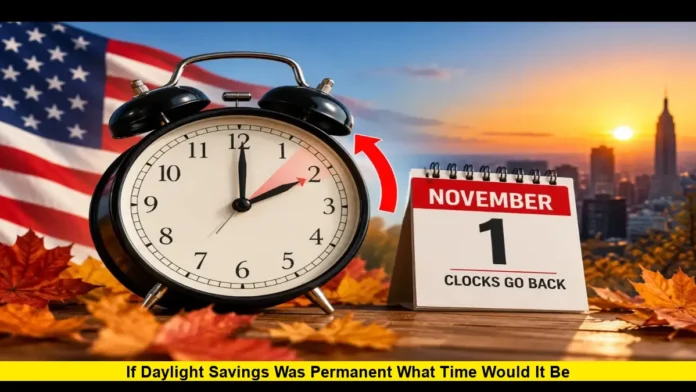

If daylight savings was permanent what time would it be in the United States? The answer depends on the location and the time of year. Under permanent daylight saving time, clocks would remain one hour ahead of standard time throughout the winter, allowing sunset to occur later according to the clock. During the summer, the schedule would remain largely the same as it is today.
The question has gained renewed attention following a major development in Congress. The Sunshine Protection Act of 2025 passed the U.S. House of Representatives on July 14, 2026, by a vote of 308–117. The bill aims to make daylight saving time permanent for most of the country, eliminating the traditional spring and fall clock changes.
However, the proposal has not become federal law. Senate action remains necessary before the nationwide timekeeping system can change. Until then, Americans should continue following the existing daylight saving time schedule.
If Daylight Saving Time Were Permanent, How Would the Clock Change?
Permanent daylight saving time would mean keeping clocks on the daylight saving schedule throughout the year instead of returning to standard time in November.
Under the current system, most participating parts of the United States move their clocks forward one hour in March and backward one hour in November. If permanent daylight saving time became law, the fall clock change would disappear.
The difference would be most noticeable during winter, when clocks currently return to standard time.
For example, if the sun sets at 4:30 p.m. under the current standard-time schedule, the same sunset would occur at approximately 5:30 p.m. on the clock under permanent daylight saving time. Similarly, a sunrise currently occurring at 7 a.m. would appear at approximately 8 a.m.
These examples illustrate the one-hour difference between the two schedules. Actual sunrise and sunset times depend on the location, date, and season.
Permanent daylight saving time would not create additional sunlight. Instead, it would change how daylight hours align with the clock, providing more evening daylight according to local time while delaying winter sunrises.
What Time Would It Be Right Now if Daylight Saving Time Were Permanent?
The answer depends on whether a location currently observes standard time or daylight saving time.
Following the November 1, 2026, clock change, most participating U.S. locations returned to standard time. Under permanent daylight saving time, their clocks would be one hour ahead of the current standard-time schedule.
For example, a clock showing 10 a.m. under Eastern Standard Time would show 11 a.m. under Eastern Daylight Time at the same moment. The same one-hour difference applies to the Central, Mountain, and Pacific time zones where seasonal clock changes are observed.
During the summer, most Americans already use daylight saving time. Consequently, permanent daylight saving time would not require an additional summer adjustment.
Some places follow different rules. Hawaii and most of Arizona do not observe daylight saving time, and several U.S. territories also remain on standard time throughout the year. Their existing arrangements would need to be considered separately under any new federal legislation.
The important distinction is that changing the clock does not change the actual moment of sunrise or sunset. It changes the time displayed on the clock when those events occur.
How Permanent Daylight Saving Time Would Affect Sunrise and Sunset
Sunrise and sunset are central to the debate over permanent daylight saving time because the proposed change would affect when daylight occurs in relation to work, school, and everyday activities.
Later winter sunsets
One of the main arguments in favor of permanent daylight saving time is that it would provide more daylight during the late afternoon and evening.
People who finish work around 5 p.m. could have more opportunities to walk, exercise, shop, or spend time outdoors before sunset. Families might also find it easier to schedule outdoor activities after school and work.
These benefits would depend on location and individual schedules. People who begin work early in the morning could experience a different balance of daylight.
Later winter sunrises
The trade-off is that mornings would remain darker for longer according to the clock.
In some northern parts of the United States, sunrise could occur after 8 a.m. during portions of winter. Children traveling to school and adults commuting to work might therefore begin their journeys before sunrise.
This concern has become an important part of the national debate. Lawmakers must consider the potential effects on school schedules, transportation safety, and people who depend on morning daylight.
No additional hours of sunlight
The length of daylight depends on the Earth’s rotation, its orbit around the Sun, the season, and geographical location.
Permanent daylight saving time would not make winter days longer in an astronomical sense. Instead, it would shift the relationship between daylight and the hours displayed on the clock.
Permanent Daylight Saving Time vs. Permanent Standard Time
The discussion about ending seasonal clock changes involves two distinct options: keeping daylight saving time throughout the year or keeping standard time throughout the year.
Both approaches would eliminate the need to change clocks twice annually, but their effects on daily routines would differ.
| Feature | Permanent daylight saving time | Permanent standard time |
|---|---|---|
| Winter clock schedule | One hour ahead of current standard time | Same as the current winter schedule |
| Winter sunrise | Later according to the clock | Earlier according to the clock |
| Winter sunset | Later according to the clock | Earlier according to the clock |
| Seasonal clock changes | None | None |
| Evening daylight | More daylight later in the day | Earlier evening darkness compared with permanent daylight saving time |
| Morning daylight | Less daylight earlier in the morning | More daylight earlier in the morning |
Supporters of permanent daylight saving time emphasize evening activities, recreation, and the convenience of maintaining a consistent clock schedule.
Supporters of permanent standard time emphasize morning daylight and its relationship to sleep-wake patterns and daily routines.
The choice involves trade-offs. Eliminating the clock changes may simplify scheduling, but the effect of the new schedule would depend on where people live and when they need daylight.
Latest U.S. Bill Update for 2026
The latest major legislative development is the House passage of the Sunshine Protection Act of 2025, a proposal designed to make daylight saving time permanent for most participating areas of the United States.
The House passed H.R. 139 on July 14, 2026, by a bipartisan vote of 308–117. The official tally recorded 308 votes in favor and 117 against, with six members not voting.
The bill would eliminate the current requirement to return to standard time during the winter. If enacted, it would establish daylight saving time as the year-round schedule for most of the country, subject to the legislation’s provisions and existing exemptions.
However, House approval does not automatically change federal law. The bill was sent to the Senate and referred to the Senate Committee on Commerce, Science, and Transportation. As of the latest available legislative information, the proposal has not completed the process required to become law.
The next major step is Senate action. The legislation would need to clear the remaining congressional requirements and receive presidential approval before its provisions could take effect.
The debate includes competing views about the benefits of later evening sunsets and the disadvantages of darker winter mornings. Some lawmakers support the change because it could simplify daily schedules and provide more evening daylight. Others have raised concerns about children traveling to school before sunrise and potential effects on transportation and agricultural routines.
For now, permanent daylight saving time has not been adopted nationwide. Americans should not assume that the House vote means the seasonal clock changes have ended.
Why States Cannot Independently Adopt Permanent Daylight Saving Time
State governments have an important role in the debate, but their authority is limited by federal law.
Under the Uniform Time Act of 1966, states may exempt themselves from observing daylight saving time and remain on standard time throughout the year. However, states generally cannot independently adopt permanent daylight saving time without federal authorization.
Nineteen states have enacted legislation supporting permanent daylight saving time if federal law permits it. They include Alabama, Colorado, Delaware, Florida, Georgia, Idaho, Louisiana, Maine, Minnesota, Mississippi, Montana, Oklahoma, Oregon, South Carolina, Tennessee, Texas, Utah, Washington, and Wyoming.
These laws and measures do not mean that all 19 states currently follow daylight saving time year-round. Their implementation depends on the applicable federal requirements.
Hawaii and most of Arizona already remain on standard time throughout the year. Several U.S. territories also do not follow the regular seasonal clock-change schedule.
If Congress enacts a permanent daylight saving time law, the effects on states and territories would depend on the final legislation and the exemptions it provides.
How Permanent Daylight Saving Time Could Affect Everyday Life
A permanent clock schedule could affect work, school, travel, recreation, and sleep routines.
Work and commuting: People who finish work in the late afternoon might appreciate having more evening daylight during winter. Early-morning workers could face darker commutes.
Schools and families: Later winter sunrises could mean that some students travel to school before sunrise. School transportation and pedestrian safety would remain important considerations.
Outdoor recreation: More daylight later in the day, according to the clock, could make after-work exercise and outdoor activities easier to schedule.
Travel and business: Eliminating seasonal clock changes could simplify calendar planning and reduce confusion around appointments and travel schedules. However, time-zone differences between regions would remain.
Sleep and daily routines: A consistent clock schedule could remove the disruption associated with changing clocks twice a year. Nevertheless, the timing of morning and evening light would change, and the effects would vary among individuals.
These considerations explain why the issue remains controversial. The potential convenience of a permanent schedule must be weighed against the consequences of shifting daylight later on the clock.
When Will Daylight Saving Time Begin Again in 2027?
Under the existing federal schedule, daylight saving time is set to begin again on March 14, 2027, in participating parts of the United States.
On that date, clocks will move forward one hour, provided no new law changes the schedule before then. The next scheduled fall transition would occur on November 7, 2027, when clocks would return to standard time.
The Sunshine Protection Act could change this arrangement if it completes the legislative process and takes effect in time. However, no nationwide transition to permanent daylight saving time has been confirmed.
Americans should distinguish between a bill being introduced, passing the House, advancing through the Senate, and becoming law. Each is a separate step, and the current clock-change rules remain in effect until a legally effective change is made.
Final Thoughts on If Daylight Savings Was Permanent What Time Would It Be
If daylight saving time were permanent, clocks in most participating U.S. locations would remain one hour ahead of the current standard-time schedule throughout winter. During summer, the clock schedule would remain largely the same as it is today.
The biggest difference would be the timing of daylight. Winter sunsets would occur later according to the clock, but sunrises would also occur later, potentially leaving some morning commutes and school journeys in darkness.
The Sunshine Protection Act of 2025 passed the House on July 14, 2026, by a vote of 308–117, but it has not become federal law. Senate action and the remaining legislative requirements are still necessary before the United States can adopt permanent daylight saving time.
Until then, Americans should continue following the existing seasonal clock-change schedule.
Share your thoughts in the comments: Would you prefer permanent daylight saving time or permanent standard time? Stay updated for the latest developments on the U.S. daylight saving time debate.