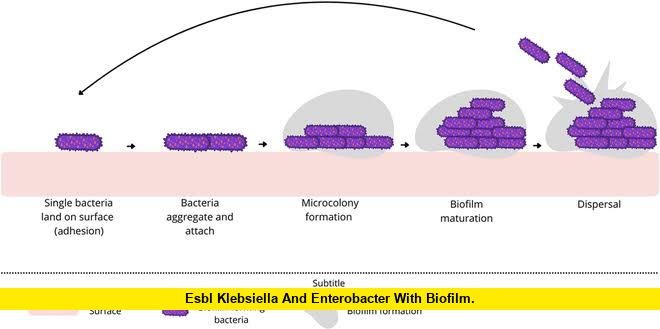

ESBL Klebsiella and Enterobacter with biofilm can present a difficult antimicrobial-resistance problem because ESBL enzymes limit important antibiotics while biofilm growth can make bacterial communities harder to eradicate. The latest U.S. guidance from the Infectious Diseases Society of America (IDSA), updated in July 2026, continues to distinguish ESBL-producing Enterobacterales from organisms with AmpC resistance and emphasizes susceptibility testing when selecting treatment.
The combination of extended-spectrum beta-lactamase (ESBL) production and biofilm formation has attracted continued attention in clinical microbiology. Recent research published in July 2026 also found a relationship between stronger biofilm formation and greater antimicrobial resistance among Klebsiella isolates studied in urinary tract infections.
However, biofilm formation and ESBL production are not the same biological process. A bacterium can produce an ESBL without producing a strong biofilm, and biofilm-forming bacteria do not automatically carry an ESBL. Understanding that distinction is important when interpreting a laboratory report.
What ESBL Means in Klebsiella and Enterobacter
ESBL stands for extended-spectrum beta-lactamase. These enzymes can break down many commonly used beta-lactam antibiotics, including penicillins and several cephalosporins. ESBL-producing organisms can therefore leave clinicians with fewer effective treatment options.
Klebsiella pneumoniae is one of the organisms most commonly associated with ESBL production. IDSA identifies ESBL-producing Enterobacterales as an important category of antimicrobial-resistant infections and provides specific treatment recommendations for them.
Enterobacter species require additional consideration. The Enterobacter cloacae complex and certain related organisms can carry inducible AmpC beta-lactamases. Some isolates can also acquire ESBL genes. This means an Enterobacter isolate may have more than one mechanism affecting antibiotic susceptibility.
The distinction matters because ESBL and AmpC enzymes behave differently. IDSA’s 2026 guidance specifically addresses both groups and recommends different approaches depending on the organism, resistance mechanism, infection site and susceptibility results.
Why Biofilm Changes the Picture
A biofilm is a structured community of microorganisms attached to a surface and surrounded by a self-produced matrix. That matrix can contain polysaccharides, proteins and extracellular DNA.
Klebsiella pneumoniae is particularly well studied for its ability to form biofilms. Research has linked biofilm formation with adhesion to surfaces, persistence and reduced susceptibility to antimicrobial treatment.
Biofilm-associated bacteria behave differently from free-floating, or planktonic, bacteria. The extracellular matrix can interfere with antibiotic penetration and create an environment where bacterial cells have different metabolic states. Some cells can also persist despite antimicrobial exposure.
This does not mean that every biofilm is impossible to treat. Instead, biofilm formation can make eradication more challenging, particularly when bacteria grow on a medical device or another persistent surface.
Klebsiella Pneumoniae Is a Major Biofilm Concern
Klebsiella pneumoniae has several characteristics that can contribute to biofilm development. Adhesins, fimbriae, capsule-associated factors and other bacterial components can help the organism attach to surfaces and maintain a microbial community.
Studies have identified biofilm-associated genes and virulence factors in K. pneumoniae. Research has also examined the relationship between biofilm production and antimicrobial resistance.
A systematic review and meta-analysis involving clinical ESBL-producing bacteria found that biofilm formation was more common among ESBL-producing isolates than among non-ESBL isolates. Across the studies included in that analysis, the estimated prevalence of biofilm formation was 72.4% among ESBL-producing isolates compared with 40.5% among non-ESBL isolates. The analysis also found an association between biofilm formation and antibiotic resistance.
Those findings do not prove that ESBL production itself causes biofilm formation. Instead, they support the observation that resistance and biofilm-associated characteristics can occur together.
The Latest 2026 Klebsiella Research
A study published online in July 2026 provides newer evidence about the interaction between biofilm formation and resistance in Klebsiella species.
Researchers examined 718 clean-catch midstream urine samples collected at a hospital in Bangladesh. Twenty-two isolates were confirmed as Klebsiella species, including 20 K. pneumoniae and two K. oxytoca isolates. The researchers assessed antimicrobial resistance, ESBL and carbapenemase genes, virulence factors and biofilm formation.
The study reported that 95% of the Klebsiella isolates were multidrug resistant. It also detected ESBL-associated blaSHV and blaTEM genes, along with carbapenemase-associated genes in some isolates.
Importantly, the researchers found that moderate and strong biofilm producers showed significantly greater resistance than isolates with weaker or no biofilm production. Several virulence-related genes were also associated with biofilm formation.
The study was conducted outside the United States, so its percentages should not be interpreted as U.S. prevalence figures. Still, it adds current scientific evidence to the broader understanding of how biofilm formation and antimicrobial resistance can coexist in Klebsiella.
Where Enterobacter Fits Into the Picture
Enterobacter species are also capable of forming biofilms. Enterobacter cloacae and related organisms have been associated with healthcare-associated infections, including urinary and respiratory infections.
Research has identified bacterial structures involved in attachment and biofilm development in Enterobacter. Recent reviews have highlighted the roles of curli fimbriae and other systems in adhesion to biological and non-biological surfaces.
Enterobacter also has an important resistance characteristic that separates it from many ESBL-focused discussions: AmpC beta-lactamase.
The Enterobacter cloacae complex and several other Enterobacterales are considered organisms at moderate risk for clinically significant inducible AmpC production. IDSA’s 2026 guidance lists Enterobacter cloacae complex and Klebsiella aerogenes among the organisms for which AmpC considerations can influence antibiotic selection.
An Enterobacter isolate may therefore require evaluation for both its organism-specific resistance mechanisms and any separately identified ESBL mechanism.
ESBL and AmpC Are Not Interchangeable
This distinction is especially important when the laboratory report mentions Klebsiella and Enterobacter together.
ESBL-producing Klebsiella is generally approached under the ESBL-E framework. Enterobacter cloacae complex, meanwhile, can have clinically significant inducible AmpC production even when an ESBL has not been identified.
The 2026 IDSA guidance recommends cefepime for infections caused by organisms at moderate risk of clinically significant AmpC production when the cefepime minimum inhibitory concentration falls within the recommended susceptible or susceptible dose-dependent range and an ESBL gene has not been identified.
For confirmed or presumed ESBL infections, the recommendations differ. This is why a simple statement such as “the bacteria are resistant” does not provide enough information to select treatment.
How Biofilm Can Complicate Treatment
Biofilm can make treatment more complicated through several mechanisms.
The surrounding extracellular matrix can reduce antimicrobial access. Bacteria within the community can also enter physiological states that make them less vulnerable to antibiotics. In addition, biofilms can provide a setting where resistant organisms persist and where genetic material may be exchanged.
Klebsiella research has linked biofilm formation with antibiotic resistance, although the strength of that relationship varies among bacterial strains and experimental settings.
Importantly, biofilm does not create an automatic rule that a particular antibiotic will fail. Antibiotic selection still depends on the organism, infection site, susceptibility results, resistance mechanisms and clinical condition.
What Current U.S. Treatment Guidance Says
The most recent IDSA antimicrobial-resistance guidance was updated in July 2026. For complicated urinary tract infections caused by ESBL-producing Enterobacterales, IDSA lists trimethoprim-sulfamethoxazole, ciprofloxacin or levofloxacin as preferred options when laboratory susceptibility is demonstrated.
When those options cannot be used because of resistance, intolerance or toxicity concerns, the guidance identifies cefepime-enmetazobactam or carbapenems such as ertapenem, meropenem or imipenem as preferred alternatives for ESBL-E complicated urinary tract infections.
For ESBL-E infections outside the urinary tract, IDSA lists ertapenem, imipenem and meropenem as preferred agents. Imipenem or meropenem are preferred for critically ill patients or those with hypoalbuminemia.
These recommendations are not a substitute for an individual patient’s culture and susceptibility results. A clinician must determine whether an isolate is actually susceptible to the proposed drug and whether the medication is appropriate for the specific infection.
Why the Laboratory Report Matters
A report mentioning ESBL, Klebsiella, Enterobacter and biofilm can contain several different pieces of information.
The most important elements usually include:
- The exact bacterial species identified
- The site from which the specimen was collected
- Whether ESBL production was confirmed or suspected
- Whether AmpC or carbapenemase mechanisms were identified
- The antimicrobial susceptibility profile
- Whether a medical device or other surface is involved
- The patient’s clinical condition and infection site
Biofilm testing may be performed in research or specialized laboratory settings, but routine clinical treatment decisions do not rely on a generic assumption that every resistant Klebsiella or Enterobacter isolate has a clinically significant biofilm.
That distinction helps prevent overinterpreting a laboratory finding.
What Patients Should Understand About the Combination
The phrase ESBL Klebsiella and Enterobacter with biofilm can sound like a single diagnosis, but it actually combines several microbiological concepts.
ESBL describes an antibiotic-resistance mechanism. Klebsiella and Enterobacter describe bacterial groups or species. Biofilm describes a growth state in which microorganisms organize within a protective matrix.
The combination can be clinically important because each characteristic can complicate management. Yet the presence of one feature does not automatically establish the presence or severity of the others.
Recent research continues to investigate exactly how these characteristics interact. The 2026 Klebsiella study strengthens evidence that stronger biofilm formation can accompany higher antimicrobial resistance, while other research has shown that ESBL production does not always predict stronger biofilm formation.
That mixed evidence is one reason clinicians continue to rely on organism identification, susceptibility testing and the clinical context rather than a single laboratory characteristic.
The Bottom Line
ESBL Klebsiella and Enterobacter with biofilm represent an important intersection between antimicrobial resistance and bacterial persistence. Klebsiella pneumoniae is well recognized for both ESBL-associated resistance and biofilm formation, while Enterobacter species add the additional consideration of inducible AmpC resistance. Current IDSA guidance, updated in 2026, provides organism- and resistance-mechanism-specific recommendations rather than treating all resistant Enterobacterales in the same way.
The newest research also continues to show why biofilm deserves attention. A July 2026 study found that stronger biofilm-producing Klebsiella isolates had significantly greater antimicrobial resistance, although those findings came from a non-U.S. hospital population and should not be treated as U.S. prevalence data.
As research continues to clarify the connection between ESBL resistance, Enterobacterales and biofilm formation, staying current with laboratory findings and updated treatment guidance remains essential.