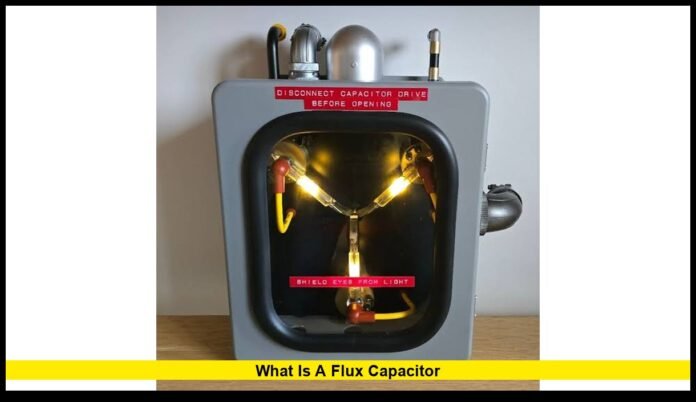

What is a flux capacitor? It is one of the most recognizable fictional inventions in science-fiction history, best known for making time travel possible in the Back to the Future movie franchise. Designed as the central component of Doc Brown’s famous DeLorean time machine, the flux capacitor allows characters to travel between different points in history by combining advanced fictional technology, an enormous energy supply, and a vehicle traveling at a specific speed.
The device has attracted attention from movie fans, science enthusiasts, engineers, and curious readers for decades. Its distinctive three-pronged design, flashing lights, and connection to the famous 1.21-gigawatt power requirement have made it an enduring symbol of futuristic invention.
However, the flux capacitor is more interesting than just a memorable movie prop. Its name combines terminology associated with real electrical and physics concepts, and researchers have even used the expression in connection with genuine experimental technology.
There is an important distinction between the fictional device and scientific research. The flux capacitor that powers a time machine does not exist as a proven technology. Nevertheless, real electrical components and scientific experiments involving magnetic flux and capacitors offer interesting ways to understand why the name continues to attract attention.
This article explains what a flux capacitor is, where it originated, how it supposedly works in the movies, what its connection to real science means, and whether scientists could ever develop technology capable of traveling through time.
What Is a Flux Capacitor?
A flux capacitor is a fictional time-travel device introduced in the 1985 science-fiction adventure film Back to the Future. In the movie, it is the essential invention that makes it possible for a modified DeLorean sports car to travel through time.
The device was invented by the fictional scientist Dr. Emmett Brown, commonly known as Doc Brown. He installs it inside a DeLorean DMC-12 and connects it to the vehicle’s other systems to create a functioning time machine.
The flux capacitor is presented as a specialized piece of technology that generates or enables the conditions necessary for movement through time. When the DeLorean reaches 88 miles per hour and receives the required energy, the time-travel sequence begins.
Unlike an ordinary mechanical component, the fictional flux capacitor does not simply improve the car’s performance. Its purpose is to allow the vehicle and its occupants to move between different historical periods.
The device has a distinctive appearance. It consists of a central enclosure containing three illuminated branches arranged in a Y-shaped configuration. The lights become especially important during the time-travel sequence, creating the visual impression that the machine is activating.
Although the films provide a basic explanation of its purpose, they never establish a scientifically detailed mechanism that would explain how the device manipulates time.
In practical terms, the flux capacitor belongs to science fiction rather than established engineering. It is a creative invention designed to make the movie’s time-travel concept understandable and visually memorable.
The Origin of the Flux Capacitor in Back to the Future
The history of the flux capacitor begins with the development of Back to the Future, a film directed by Robert Zemeckis and released in 1985.
The movie follows Marty McFly, a teenager who accidentally travels from 1985 to 1955 using a time machine created by Doc Brown.
The filmmakers needed a recognizable invention that could explain how a conventional-looking automobile could become a vehicle capable of traveling through time.
Instead of using a traditional laboratory machine or a futuristic spacecraft, they chose a DeLorean DMC-12. Its unusual appearance, stainless-steel body, and distinctive gull-wing doors made it an appropriate vehicle for the story.
The flux capacitor became the central technological explanation behind the transformation.
Who Created the Flux Capacitor?
Within the movie’s fictional storyline, Doc Brown invented the flux capacitor on November 5, 1955.
He explains that the idea came to him after an accident in his bathroom. During the incident, he struck his head and experienced an imaginative revelation involving the device.
The scene establishes the flux capacitor as the invention that eventually makes his time machine possible.
Outside the fictional storyline, the concept was developed by the film’s creative team.
Production designer Larry Paull, conceptual artist Ron Cobb, illustrator Andrew Probert, director Robert Zemeckis, and other members of the production team contributed to the visual development of the DeLorean time machine.
Michael Fink, who worked as a special-effects consultant on the production, later discussed how the name emerged during the design process.
The terminology combined the scientific expression neutron flux with the idea of a temporal field capacitor. The resulting name was memorable, easy to recognize, and appropriate for the film’s imaginative technology.
Why the Name Became So Popular
The name flux capacitor sounds technical without requiring viewers to understand advanced physics.
Both words have connections to scientific terminology. Flux is used in physics to describe the passage or distribution of a quantity through a surface, while a capacitor is a real electronic component that stores electrical energy.
Combining these concepts created a name that sounded believable within a science-fiction story.
The distinctive appearance also contributed to its popularity. Rather than presenting the invention as an invisible computer system, the filmmakers gave it a recognizable physical form.
As a result, audiences could immediately identify the device whenever it appeared on screen.
The flux capacitor eventually became one of the most memorable inventions associated with the entire movie franchise.
How Does a Flux Capacitor Work in Back to the Future?
In the Back to the Future universe, the flux capacitor is responsible for enabling the DeLorean to travel through time. It works as part of a larger system involving the car’s power supply, time circuits, and speed.
Although the movies provide several explanations, the device’s exact operating principles are fictional. The following description explains how the technology is presented within the story.
1. The Flux Capacitor Creates the Time-Travel Effect
The flux capacitor is described as the essential component that makes time travel possible.
When the system activates, its three illuminated branches begin flashing. The device is connected to the DeLorean’s internal equipment and works alongside the vehicle’s time circuits.
The movie does not provide a mathematical explanation of how the device creates a connection between different points in time. Instead, it establishes the flux capacitor as the central invention responsible for the extraordinary result.
2. The DeLorean Must Reach 88 Miles Per Hour
One of the most recognizable requirements of the time machine is its speed.
The DeLorean must reach 88 miles per hour, approximately 141.6 kilometers per hour, before the time-travel sequence can occur.
This speed requirement becomes a recurring part of the franchise. The vehicle’s dashboard displays its speed, while the characters attempt to reach the required threshold.
The importance of 88 mph is primarily a storytelling device. There is no established scientific principle demonstrating that a vehicle must reach this particular speed to travel through time.
The filmmakers selected the number as part of the movie’s memorable technological concept.
3. The Machine Requires 1.21 Gigawatts of Electricity
Another important detail is the energy requirement.
Doc Brown explains that the DeLorean needs 1.21 gigawatts of electricity to activate its time-travel system.
A gigawatt is a unit of power equal to one billion watts. Therefore, 1.21 gigawatts represents an enormous rate of energy transfer.
In the first movie, Doc Brown uses a nuclear reactor powered by plutonium to generate the necessary electricity.
The machine’s energy requirement becomes a major obstacle when Marty travels to 1955. Because the characters cannot easily obtain the required power source, they eventually develop a plan involving a lightning strike.
The lightning bolt provides the enormous electrical energy needed for the DeLorean’s return journey to 1985.
4. The Time Circuits Select the Destination
The flux capacitor is not the only important component of the DeLorean.
The vehicle also contains time circuits, which allow its operator to select a destination date.
The dashboard displays three different time settings:
- Destination time: The date and time the traveler wants to reach.
- Present time: The time from which the journey begins.
- Last time departed: The most recent point in time from which the vehicle traveled.
These settings make it possible for the characters to identify their intended destinations and understand their movements between historical periods.
The time circuits provide the navigation element of the fictional machine, while the flux capacitor serves as its central time-travel component.
5. The Time-Travel Sequence
Once the necessary conditions are satisfied, the DeLorean begins its time-travel sequence.
The vehicle accelerates toward 88 mph, the flux capacitor activates, and the car becomes surrounded by an intense visual effect.
A distinctive trail of flames appears behind the vehicle as it disappears from its original time period.
The same visual language is used throughout the trilogy, helping audiences recognize when the characters are moving between different historical periods.
The movies never establish a real engineering explanation for this process. Its presentation is designed to communicate a fictional technological event rather than demonstrate a reproducible scientific experiment.
What Is the Connection Between a Flux Capacitor and a DeLorean?
The DeLorean DMC-12 is inseparable from the popularity of the flux capacitor.
In the movie franchise, the automobile is transformed into a time machine through extensive modifications made by Doc Brown.
The original DeLorean was a real sports car manufactured by the DeLorean Motor Company. It became widely recognized for its stainless-steel exterior panels and gull-wing doors.
However, the production vehicle used in Back to the Future was substantially modified for the movie.
The fictional time machine features additional equipment, wiring, lighting, external components, and a nuclear-powered system that does not belong to an ordinary production DeLorean.
The flux capacitor is installed inside the vehicle, where it becomes the visual centerpiece of the time machine.
Its placement and appearance help distinguish the movie automobile from an ordinary DeLorean.
Why Did the Filmmakers Choose a DeLorean?
The filmmakers wanted a time machine that could move around naturally within the story.
An automobile was more practical for the characters than a stationary laboratory device. It also allowed the movie to incorporate high-speed driving sequences, vehicle-based action, and memorable visual effects.
The DeLorean’s unusual design made it particularly suitable.
Its appearance suggested something futuristic without requiring the filmmakers to create an entirely imaginary vehicle.
The combination of a real automobile and fictional technology gave the time machine a distinctive identity that audiences could remember.
What Does Flux Mean in Science?
Understanding the scientific meaning of the word flux helps explain why the fictional invention sounds convincing.
In physics, flux generally describes the amount of a physical quantity passing through a specified surface or area.
Different forms of flux are used in different scientific fields.
For example, magnetic flux describes the magnetic field passing through a particular surface. Electric flux relates to an electric field and a surface.
The term appears in several areas of physics, engineering, and electronics.
However, the scientific meaning of flux does not automatically establish a connection to time travel.
A magnetic field can influence electrical systems, and electrical systems can store and transfer energy, but those properties do not demonstrate that a device can move an object into the past.
The filmmakers used familiar scientific terminology to create a believable fictional invention.
What Is a Capacitor in Real Life?
A capacitor is a genuine electronic component used in electrical circuits.
Its primary function is to store electrical energy in an electric field and release that energy when needed.
A typical capacitor contains two conductive surfaces separated by an insulating material known as a dielectric.
When voltage is applied, electrical charges accumulate on the conductive surfaces. This creates an electric field that stores energy.
Capacitors are widely used in modern electronics, including:
- Computers and laptops.
- Smartphones and communication equipment.
- Power supplies and electrical circuits.
- Audio equipment.
- Industrial control systems.
- Electric motors and automotive electronics.
- Signal-processing equipment.
Different capacitors have different characteristics depending on their design, materials, capacitance, voltage rating, and intended application.
Some are designed to handle small amounts of electrical energy in electronic circuits, while others are engineered for larger electrical applications.
Despite sharing the word capacitor, the real component should not be confused with the fictional flux capacitor.
Can an Ordinary Capacitor Store Enough Energy for Time Travel?
No established capacitor technology can create the time-travel effect shown in Back to the Future.
A capacitor can store and release electrical energy, but this function does not provide a mechanism for changing the direction of time or transporting an object into another historical period.
The movie’s 1.21-gigawatt requirement also should not be interpreted as a scientifically established threshold for time travel.
Power and energy are different measurements. Power describes how quickly energy is transferred or used, whereas energy measures the total amount available over a period.
Even an extremely powerful electrical system would not automatically produce the ability to travel through time.
Does a Flux Capacitor Really Exist?
The answer depends on which meaning of the term is being considered.
The iconic flux capacitor from Back to the Future does not exist as a functioning time-travel machine.
There is no officially demonstrated device that can reproduce Doc Brown’s invention, activate a DeLorean, and transport passengers between historical periods.
However, the name has also been used in discussions of real scientific research.
In 2018, physicists from the University of Queensland, RMIT University, and ETH Zurich proposed a device involving magnetic flux and a capacitor. The research attracted attention because the scientists used the expression flux capacitor to describe a concept that had a visual and technological connection to the famous movie invention.
This research is an important distinction because it demonstrates how terminology from science fiction can sometimes overlap with genuine scientific ideas.
The Real Flux Capacitor Research of 2018
The 2018 research focused on a proposed electronic device designed to break time-reversal symmetry.
The researchers explored how quantum tunneling of magnetic flux around a capacitor could help control the direction in which microwave signals travel through an electronic circuit.
The proposed technology was associated with electronic circulators.
An electronic circulator is a component that directs signals through different ports in a controlled direction. This can help prevent unwanted signals from traveling backward into sensitive equipment.
The proposed design involved superconducting circuits, which can carry electrical current without ordinary electrical resistance under appropriate conditions.
One of the suggested circuit arrangements resembled the three-pointed-star configuration of the movie’s flux capacitor.
That visual similarity helped attract public attention.
However, the research did not create a machine capable of sending people, vehicles, or objects into the past.
Instead, it addressed a practical problem in advanced electronics and quantum technology.
What Is Time-Reversal Symmetry?
Time-reversal symmetry is a concept in physics that examines how physical processes behave when the direction of time is mathematically reversed.
In simplified terms, physicists can examine whether a description of a physical process remains valid when the time variable is changed from forward to backward.
Breaking time-reversal symmetry means that a system behaves differently under this mathematical reversal.
It does not mean that the system can reverse the actual passage of time.
This distinction is particularly important when discussing the real scientific flux capacitor.
The research concerned the behavior and direction of electromagnetic signals in electronic systems. It did not demonstrate a way to reverse history or move into an earlier date.
How Could This Research Be Useful?
The proposed technology may have applications in several advanced areas.
Quantum Computing: Quantum computers depend on highly controlled signals and sensitive components. Electronic circulators can help isolate different parts of an experimental system and reduce unwanted interference.
Wireless Communication: Directional signal control may contribute to improvements in communication equipment, including systems used in wireless networks.
Radar Technology: More effective control of microwave signals may be useful in certain radar applications.
Advanced Electronics: Superconducting circuits and specialized electronic components may help researchers develop more sophisticated systems for managing signals.
The research demonstrates that the expression flux capacitor is not exclusively associated with movie entertainment. Nevertheless, the scientific application is fundamentally different from the fictional invention.
Is Time Travel Scientifically Possible?
The idea of traveling through time has fascinated scientists and audiences for generations. Although the flux capacitor remains fictional, modern physics does provide some interesting explanations of how time behaves.
Albert Einstein’s theories of relativity changed the scientific understanding of time by demonstrating that it is not experienced identically under every physical condition.
Two important concepts are time dilation and gravitational effects on spacetime.
Time Dilation and Traveling Into the Future
According to Einstein’s special theory of relativity, time passes differently for observers moving at different speeds.
An object traveling at a speed close to the speed of light experiences less elapsed time than an observer who remains relatively stationary.
For example, an astronaut traveling through space at an extremely high speed could experience a shorter journey than people remaining on Earth.
If the astronaut eventually returned, more time might have passed on Earth than during the astronaut’s journey.
This phenomenon is called time dilation.
It is a scientifically established effect, not simply a theoretical idea from science-fiction movies.
However, achieving the enormous speeds required for substantial human time displacement remains beyond current spacecraft capabilities.
Can Gravity Affect Time?
Gravity also influences the passage of time.
According to general relativity, clocks located in different gravitational environments can measure different amounts of elapsed time.
Near extremely massive objects, such as black holes, gravitational effects can become particularly significant.
In principle, a spacecraft traveling near a black hole without crossing its event horizon could experience a different passage of time compared with observers far away.
However, this does not provide a practical method for traveling into the past.
Is Traveling Backward in Time Possible?
Traveling into the past presents much greater scientific difficulties.
Some mathematical solutions to general relativity involve unusual spacetime structures, including closed timelike curves. Certain theoretical discussions also examine wormholes and other possible configurations of spacetime.
However, these possibilities do not establish that people can travel backward through time.
There is no experimentally verified machine capable of transporting humans or objects into the past.
Most importantly, no scientific evidence demonstrates that the fictional flux capacitor provides a solution to these challenges.
Why Is the Flux Capacitor So Famous?
The flux capacitor has become much more than a fictional electronic component.
Its popularity comes from the success of Back to the Future and the memorable relationship between Doc Brown, Marty McFly, and the DeLorean time machine.
The device represents the idea that an extraordinary scientific invention could transform an ordinary automobile into something capable of exploring history.
Several factors explain its continued cultural importance.
A Recognizable Design
The three illuminated branches give the flux capacitor an appearance that is immediately recognizable to fans.
Unlike many fictional inventions that appear only as computer-generated effects, the device has a physical design that can be reproduced as a prop, collectible, or display model.
A Memorable Scientific Explanation
The combination of 88 mph and 1.21 gigawatts gives the invention specific requirements.
These details make the fictional technology feel more structured than an unexplained machine that simply allows characters to travel through time.
A Connection to an Iconic Movie Franchise
The flux capacitor appears throughout the Back to the Future trilogy.
Its role connects the three films and provides a consistent explanation for the DeLorean’s extraordinary capabilities.
Continued Interest Among Collectors
The device has inspired numerous replicas, decorative models, costumes, toys, and other fan collectibles.
Its distinctive shape makes it a popular subject for movie memorabilia enthusiasts.
The Flux Capacitor in All Three Back to the Future Movies
The device remains central to the time-travel concept throughout the original trilogy.
Back to the Future (1985)
The first movie introduces the flux capacitor and establishes its importance to Doc Brown’s invention.
Marty McFly accidentally travels from 1985 to 1955 after using the DeLorean.
His journey creates a major problem because he interferes with events that influence his parents’ future relationship.
The flux capacitor becomes essential to his attempt to return home.
The movie also establishes the 88-mph requirement and the need for 1.21 gigawatts of electricity.
Back to the Future Part II (1989)
The second movie expands the time-travel story by taking Marty, Doc Brown, and Jennifer Parker into the future and back to the past.
The DeLorean continues to use the flux capacitor as its central time-travel component.
The vehicle also receives an important upgrade involving Mr. Fusion Home Energy Reactor.
Instead of relying on the original plutonium-based power arrangement, the fictional upgrade allows the machine to generate the necessary energy using household waste.
This change adds another imaginative element to the technology.
Back to the Future Part III (1990)
The third movie takes the story into the American Old West.
The DeLorean remains the time machine, and the flux capacitor continues to play its essential role.
The characters encounter additional challenges involving the vehicle’s power supply and ability to reach the necessary speed.
The film concludes the original trilogy while preserving the device’s central importance to the franchise.
Latest Updates on the Flux Capacitor and Scientific Research
Latest information checked through November 12, 2026.
The flux capacitor continues to attract interest because it sits at the intersection of popular entertainment and real scientific terminology.
However, it is important to separate verified developments from fictional claims.
One of the most significant scientific developments associated with the name remains the 2018 research involving the University of Queensland, RMIT University, and ETH Zurich.
That work proposed a superconducting electronic circulator using magnetic flux and quantum tunneling to achieve directional microwave signal movement.
Its potential applications included quantum computing, communications equipment, and other sensitive electronic systems.
The research did not demonstrate time travel.
As of November 12, 2026, there is no verified announcement establishing that scientists have developed a working time-travel flux capacitor resembling the device in Back to the Future.
There is also no official scientific confirmation that a DeLorean or another vehicle can travel between historical periods using such a component.
The distinction matters because headlines occasionally use the expression real flux capacitor when discussing advanced electronics.
A device with that nickname may involve genuine physics, but that does not mean it performs the same function as Doc Brown’s invention.
For now, the famous time-travel machine remains a fictional creation, while research into superconducting circuits and quantum electronics continues to explore practical applications of advanced physics.
Fictional Flux Capacitor vs. Real Scientific Technology
The following comparison explains the major differences between the movie invention and genuine electronic technology.
| Feature | Movie Flux Capacitor | Real Scientific Technology |
|---|---|---|
| Main purpose | Enables time travel | Controls electrical or microwave signals |
| Origin | Back to the Future | Physics and electrical engineering |
| Time manipulation | Travels between historical periods | No demonstrated backward time travel |
| Energy | Requires 1.21 gigawatts in the movie | Depends on the specific electronic system |
| Design | Three illuminated branches | Various circuit configurations |
| Applications | Fictional time machine | Quantum computing and communications research |
| Scientific status | Fictional invention | Real scientific concepts and proposed devices |
The most important difference is functionality.
The movie device changes when and where the DeLorean exists in the story. Real electronic systems manipulate electrical signals, magnetic fields, and energy without transporting objects through time.
Why Do People Still Search for What Is a Flux Capacitor?
The search interest surrounding what is a flux capacitor reflects the continued popularity of science-fiction entertainment and curiosity about scientific inventions.
People encounter the expression in several different situations.
Movie References: Fans watching Back to the Future may want to understand the technology behind the DeLorean.
Science and Engineering: Students and technology enthusiasts may encounter the term while learning about capacitors, magnetic flux, superconductors, and quantum circuits.
Popular Culture: The expression frequently appears in conversations, entertainment references, merchandise, and discussions about fictional inventions.
Scientific Headlines: Articles about research involving magnetic flux and superconducting electronics may use the familiar name to explain complicated concepts.
Collectibles and Replicas: Fans may search for the device because they want to identify movie props, display models, or replicas.
These different interests explain why the term remains relevant long after the original movie premiered.
Final Thoughts
So, what is a flux capacitor? It is primarily a fictional time-travel device created for the Back to the Future franchise. Invented within the story by Doc Brown, it allows the DeLorean to move between different periods in history when the required speed and energy conditions are satisfied.
Its popularity comes from its memorable appearance, the 88-mph requirement, the famous 1.21-gigawatt power figure, and its central role in one of cinema’s best-known science-fiction adventures.
There is also a genuine scientific connection involving magnetic flux, capacitors, superconducting circuits, and electronic circulators. However, these technologies serve practical electronic purposes rather than enabling time travel.
Modern physics confirms that time can pass at different rates under certain conditions, but traveling backward into the past remains an unresolved scientific challenge.
The bottom line is that the flux capacitor is a brilliant example of how science fiction can inspire curiosity about real science, even when the fictional technology itself remains beyond modern engineering.
Did you enjoy learning about the flux capacitor? Share your thoughts in the comments and stay updated for more interesting explanations of science, technology, and popular culture.