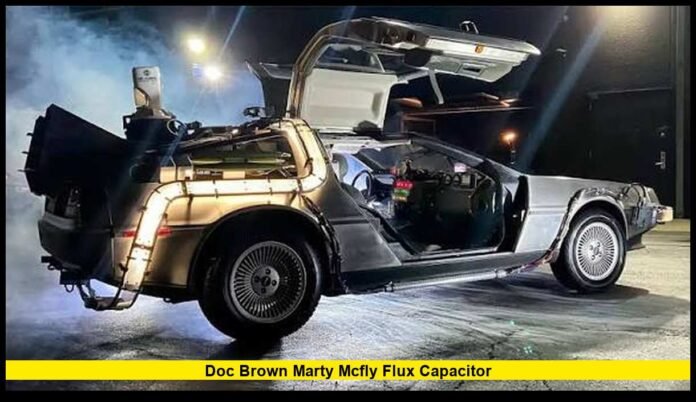

The Doc Brown Marty McFly flux capacitor remains one of the most recognizable inventions in entertainment history. Introduced in the 1985 science-fiction adventure Back to the Future, this unusual piece of fictional technology makes it possible for Dr. Emmett Brown to transform a DeLorean automobile into a time machine. Its distinctive three-branch design, glowing components, and connection to the famous 88 miles per hour requirement have helped establish it as an unforgettable part of movie history.
Created through the imagination of filmmakers Robert Zemeckis and Bob Gale, the flux capacitor represents the technological heart of a story about friendship, family, scientific curiosity, and the consequences of changing the past. Christopher Lloyd’s eccentric portrayal of Doc Brown and Michael J. Fox’s performance as Marty McFly helped bring the invention to life, making the device just as memorable as the characters themselves.
The original movie introduced audiences to a time machine that could move between different historical periods using a specially modified DeLorean DMC-12. The invention became central to two successful sequels, merchandise collections, video games, theatrical productions, and decades of fan discussions.
Even in 2026, interest in the flux capacitor continues through anniversary celebrations, collector releases, and stage adaptations. Understanding its fictional operation, production history, and cultural influence explains why Doc Brown’s creation continues to attract attention from audiences across generations.
What Is the Flux Capacitor and Why Is It Important?
The flux capacitor is a fictional scientific device that makes time travel possible in the Back to the Future universe. Dr. Emmett Brown develops the invention as the central component of his experimental time machine, which he eventually installs inside a DeLorean automobile.
The device is responsible for allowing the vehicle to move between different points in time. It works alongside other fictional systems, including the time circuits and the DeLorean’s specialized power equipment.
The invention first receives a memorable introduction when Doc Brown demonstrates his time machine to Marty at Twin Pines Mall in 1985. During the demonstration, Doc explains that the flux capacitor is what makes time travel possible.
Its physical appearance immediately separates it from ordinary automobile equipment. The device features three illuminated branches arranged around a central structure, with wires, electronic-looking components, and a protective housing.
This recognizable design creates the impression of an advanced experimental machine assembled by an inventor working outside conventional scientific institutions.
The flux capacitor also provides a consistent explanation for the events that follow. Whenever Marty and Doc travel through time, the audience understands that the device remains essential to the DeLorean’s operation.
Without the flux capacitor, the fictional vehicle would not have its defining ability.
Doc Brown: The Inventor Behind the Famous Device
Dr. Emmett Lathrop Brown is the scientist responsible for creating the flux capacitor. Christopher Lloyd portrays Doc Brown in the original trilogy, delivering a performance that combines humor, intelligence, enthusiasm, and eccentric behavior.
Doc lives in Hill Valley, California, where his scientific experiments frequently attract curiosity and concern. Although many people consider him unusual, his dedication to scientific discovery eventually produces an invention that changes the course of his fictional world.
According to the story, Doc conceives the flux capacitor on November 5, 1955.
The moment occurs after he suffers a head injury while working in his bathroom. During the incident, he experiences a vision involving the device and realizes that it may provide the foundation for time travel.
This event becomes an important part of the franchise’s fictional history.
Doc spends years developing his idea before successfully incorporating it into the DeLorean. His work requires considerable experimentation, mechanical modifications, and the creation of supporting technology.
The original movie establishes that Doc’s invention is not the result of a conventional research program. Instead, it emerges from his personal ambition and unconventional approach to science.
His achievement also demonstrates why he becomes such an important character in Marty’s life.
Doc does more than build an unusual automobile. He creates the technology that allows Marty to experience different historical periods and discover unexpected connections between his past and future.
Marty McFly’s Connection to the Flux Capacitor
Marty McFly is the teenager whose life changes after he becomes involved in Doc Brown’s experiment.
Michael J. Fox plays Marty as an energetic young musician who enjoys spending time with friends and dreams of achieving something meaningful.
Before discovering the DeLorean’s true capabilities, Marty knows Doc as an eccentric inventor who frequently works on unusual projects.
However, his understanding of the scientist changes during the demonstration at Twin Pines Mall.
Doc reveals that his modified DeLorean can travel through time. He demonstrates the machine using Einstein, his dog, and successfully sends the animal into the future.
Marty records the demonstration, but the experiment takes an unexpected turn when armed individuals attack Doc.
During the resulting escape, Marty enters the DeLorean and activates the time machine. He reaches the required speed and finds himself transported from 1985 to 1955.
This journey creates the central problem of the first film.
Marty must locate the younger version of Doc Brown, explain what happened, and find a way to return to his original time.
The flux capacitor becomes the most important part of that mission because the DeLorean cannot make another time jump without its essential technology and sufficient power.
Marty’s relationship with the invention develops throughout the trilogy. He learns to operate the vehicle, understand its limitations, and depend on Doc’s scientific knowledge when unexpected problems arise.
The device therefore connects the two characters throughout their adventures.
How the Flux Capacitor Works in the Movie
The movies establish a fictional operating system for the DeLorean time machine. Although the films use scientific terminology, the technology follows rules created specifically for the story.
The flux capacitor functions alongside three important elements: the time circuits, the vehicle’s power supply, and the required speed.
The Flux Capacitor
The central component enables the DeLorean to travel through time. Its illuminated structure becomes especially noticeable when the vehicle prepares for a temporal jump.
The Time Circuits
The time circuits allow the driver to choose a destination.
The dashboard displays three important settings:
- Destination Time: The date and time the driver wants to reach.
- Present Time: The vehicle’s current date and time.
- Last Time Departed: The previous departure time recorded by the system.
These displays help Doc and Marty understand the DeLorean’s temporal position.
The 88 MPH Requirement
The DeLorean must reach 88 miles per hour before its time-travel sequence activates.
This requirement creates one of the most recognizable moments in the franchise. As the vehicle approaches the required speed, the flux capacitor begins glowing and the surrounding visual effects indicate that the time jump is about to happen.
The Power Supply
The machine requires an enormous amount of energy.
In the original movie, Doc uses plutonium to provide the power necessary for the first version of his invention. Later, the story introduces a lightning strike as an alternative source of energy.
These elements work together within the fictional system to make time travel possible.
The movies do not establish a complete engineering explanation for the device. Its operation depends on the fictional science of the franchise rather than a real-world technical design.
Why 1.21 Gigawatts Became an Iconic Back to the Future Detail
One of the most memorable elements of Doc Brown’s invention is its extraordinary electricity requirement.
The original film establishes that the DeLorean needs 1.21 gigawatts of power to activate the time-travel mechanism.
When Marty first learns about this requirement, he struggles to understand how such an enormous amount of energy could be obtained.
Doc explains that the original machine uses plutonium to generate the necessary power.
This arrangement creates an immediate problem when Marty travels to 1955. He cannot easily find the materials required to reproduce the original power source.
The situation leads to the discovery that a lightning strike could provide the energy needed for another time jump.
The solution becomes the foundation of the famous Hill Valley clock tower sequence.
Doc studies the predicted lightning strike and develops a plan to connect the electrical discharge to the DeLorean.
Marty must coordinate his actions with the younger Doc, reach the correct location, and accelerate the vehicle at precisely the right moment.
The sequence creates suspense because a single mistake could prevent Marty from returning home.
The 1.21-gigawatt requirement became one of the franchise’s most recognizable pieces of dialogue and fictional technology.
Although the number helps make the machine sound scientifically convincing, it does not represent a demonstrated energy requirement for real-world time travel.
The Famous 88 Miles Per Hour Time-Travel Rule
The 88 mph requirement gives the DeLorean a simple operating condition that audiences can easily remember.
Doc Brown establishes that the vehicle must reach this speed before the time-travel mechanism activates.
The filmmakers use several visual effects to communicate the process.
As the DeLorean accelerates, the flux capacitor begins glowing more intensely. Electrical effects appear around the vehicle, followed by flames along its path.
At the required speed, the car disappears from its original location and arrives at the selected destination.
This sequence becomes a recurring feature throughout the trilogy.
The speed requirement also creates practical challenges for the characters. They must find enough room to accelerate, avoid obstacles, and coordinate their actions with the destination settings.
The movies repeatedly use these challenges to build excitement.
The 88 mph rule also makes the DeLorean’s time-travel system different from fictional machines that can move through time without any visible operating requirements.
For fans, the speedometer and illuminated flux capacitor have become inseparable images associated with the franchise.
Who Designed the Original Flux Capacitor Prop?
Although Doc Brown is the fictional inventor, the actual movie prop required the work of several creative professionals.
The DeLorean time machine was developed through collaboration between production designers, conceptual artists, special-effects specialists, and construction personnel.
Michael Fink played an important role in designing the flux capacitor and helping establish the interior appearance of the vehicle.
An official interview with Fink explains that the design team initially considered different locations for the device.
Andrew Probert considered placing it on the overhead console, while Ron Cobb had explored an exterior roof-mounted arrangement.
The production ultimately needed a design that worked visually and practically inside the DeLorean.
Fink helped resolve the placement question and developed the recognizable device.
He also discussed how the name emerged during a conversation involving director Robert Zemeckis and other members of the production team.
The earlier screenplay terminology included the name Temporal Field Capacitor. The filmmakers wanted something shorter and more memorable for the finished movie.
The expression flux capacitor emerged during the design discussions.
Fink drew inspiration from scientific terminology involving neutron flux and the concept of a temporal field capacitor.
The final name proved much easier to remember and became one of the franchise’s most recognizable terms.
Michael Scheffe subsequently helped complete the construction of the DeLorean time machine.
The production team used a combination of electrical components, specially selected objects, lighting, and custom construction to create the finished prop.
This production history demonstrates how practical design choices helped turn an imaginary invention into a convincing cinematic object.
Why the Flux Capacitor Has Three Illuminated Branches
The flux capacitor’s three-branch appearance is one of the most important elements of its visual identity.
Its unusual shape separates it from conventional electronic equipment and makes it immediately recognizable inside the DeLorean.
The three illuminated branches connect to a central structure housed within a protective enclosure.
The arrangement gives the device an experimental appearance that fits Doc Brown’s character.
Rather than looking like a polished product from a major technology company, it resembles something an imaginative inventor might assemble in a garage laboratory.
The filmmakers also benefited from the design because its lighting could communicate the machine’s operating condition.
When the DeLorean prepares to travel, the glowing components help audiences understand that the time-travel sequence is beginning.
The movies do not provide a detailed scientific explanation for why the device requires three branches.
Its configuration should therefore be understood as a production design choice rather than an established engineering requirement.
Nevertheless, its appearance has become one of the most recognizable visual elements in science-fiction entertainment.
How the Flux Capacitor Changes in Back to the Future Part II
The second movie introduces several new developments while keeping the flux capacitor at the center of the DeLorean’s operation.
Released in 1989, Back to the Future Part II sends Marty and Doc into the future, where they encounter an unfamiliar version of Hill Valley.
The film introduces the upgraded DeLorean, including its flying capability.
This modification allows the vehicle to travel above the roads and creates new opportunities for the characters.
Another major addition is Mr. Fusion, a fictional home-energy reactor installed at the rear of the vehicle.
Mr. Fusion changes the DeLorean’s power arrangements by allowing it to use household waste as fuel within the movie’s fictional technology.
The development is important because the original time machine depends on plutonium.
The upgraded vehicle offers a different power solution while preserving the flux capacitor’s central function.
These components should not be confused.
Mr. Fusion provides energy for the machine, while the flux capacitor makes temporal displacement possible.
The second movie also expands the story’s exploration of changing historical events.
Marty encounters an alternate version of 1985 after events in the past create unexpected consequences.
The DeLorean’s time circuits and flux capacitor become essential to correcting the altered timeline.
The Flux Capacitor in Back to the Future Part III
The third installment takes Marty and Doc into the American Old West in 1885.
Released in 1990, Back to the Future Part III gives the franchise a Western adventure while continuing the story of the DeLorean time machine.
The flux capacitor remains essential, but the characters face new difficulties because they are operating in a historical period without modern infrastructure.
The DeLorean develops mechanical problems, making it difficult to reach the required speed.
Marty and Doc must find an alternative way to accelerate the vehicle.
Their solution involves using a locomotive to push the DeLorean toward the necessary velocity.
The sequence becomes one of the most memorable moments in the trilogy.
The third movie also gives Doc Brown a more personal storyline, particularly through his relationship with Clara Clayton.
The conclusion provides a meaningful ending to the adventures of Marty and Doc while reinforcing the importance of their friendship.
The flux capacitor remains the central invention that connects all three films.
Is the Flux Capacitor Scientifically Possible?
The flux capacitor does not exist as a working time-travel device.
No scientifically verified technology can reproduce the type of temporal transportation shown in Back to the Future.
The films use scientific terminology and recognizable electrical concepts to make their fictional invention sound believable.
However, real physics does not establish that reaching 88 mph or generating 1.21 gigawatts can send a vehicle into another historical period.
Modern science does investigate the relationship between time, motion, gravity, and spacetime.
Einstein’s theory of relativity demonstrates that time does not pass identically for every observer under all conditions.
One example is time dilation, in which differences in motion or gravitational conditions affect how time passes.
These effects have been measured experimentally and must be considered in certain modern technologies.
However, time dilation is not the same as traveling freely into the past or selecting a historical destination using a dashboard.
The fictional flux capacitor operates according to the storytelling rules established by the movies.
Can someone build a working replica?
Yes. Hobbyists, engineers, and prop builders can create impressive replicas using electronic components, LED lighting, wiring, switches, and custom housings.
Some models reproduce the original prop’s appearance, while others include interactive displays and simulated activation effects.
However, these creations reproduce the visual characteristics of the device rather than its fictional time-travel ability.
There is currently no verified evidence of a functioning flux capacitor capable of transporting a vehicle through time.
Why the DeLorean Became the Perfect Time Machine
The DeLorean DMC-12 provides the physical identity of Doc Brown’s invention.
Its stainless-steel exterior, gull-wing doors, and unusual design already made it stand out from ordinary automobiles.
The filmmakers used these characteristics to create a vehicle that looked futuristic without losing its connection to the real world.
The production team considered several possibilities during development, including an earlier concept involving a refrigerator.
However, the filmmakers ultimately chose a vehicle because it provided more opportunities for movement, action, and storytelling.
The DeLorean also suited Doc Brown’s personality.
Its unusual appearance suggested an experimental machine assembled by someone who cared more about scientific discovery than conventional automotive design.
The finished vehicle included the flux capacitor, time circuits, external modifications, and special-effects equipment.
Three DeLoreans were purchased for the original production and modified for filming.
The vehicle became so closely associated with the story that it developed an identity of its own.
For many movie enthusiasts, the DeLorean represents time travel just as strongly as the flux capacitor.
Why Doc Brown and Marty McFly Remain Popular
The enduring appeal of the franchise comes from more than its fictional technology.
Doc Brown and Marty McFly create a memorable partnership based on friendship, trust, and their shared willingness to face unexpected challenges.
Christopher Lloyd gives Doc an unforgettable personality through his energetic performance and unusual mannerisms.
Michael J. Fox balances the character with Marty’s curiosity, humor, and determination.
Their contrasting personalities make the story entertaining.
Doc approaches problems through scientific experimentation, while Marty often responds through practical decisions and quick thinking.
The relationship also gives the fictional technology emotional meaning.
The DeLorean is not simply a machine that moves characters between historical periods. It becomes the vehicle through which they experience personal discoveries and learn important lessons.
The flux capacitor therefore represents the partnership between two characters whose adventures continue to attract audiences decades after the original release.
The Flux Capacitor’s Influence on Popular Culture
The flux capacitor has become one of the most recognizable fictional inventions in entertainment.
Its appearance in the original trilogy helped establish a visual identity that audiences immediately associate with Back to the Future.
The device has inspired several forms of fan creativity, including:
- Detailed DeLorean time-machine replicas.
- Collectible flux capacitor models.
- LED-powered display pieces.
- Movie costumes and accessories.
- Fan-made electronic projects.
- Artwork and decorative collectibles.
- Science-fiction merchandise.
The invention also appears in discussions about fictional technology and time-travel concepts.
Its name is familiar even to people who may not remember every detail of the movies.
That recognition demonstrates the power of strong production design and memorable storytelling.
The device has also helped keep the franchise connected to younger audiences who discover the films through home entertainment, theatrical screenings, and stage adaptations.
Latest Back to the Future Updates in November 2026
Interest in Doc Brown, Marty McFly, and the flux capacitor continues through several confirmed franchise activities.
The latest official announcements provide a useful picture of how the original movie continues to reach audiences.
40th Anniversary Celebrations
The original film marked its 40th anniversary in 2025.
The celebration brought renewed attention to the trilogy through theatrical screenings, home-entertainment releases, collectibles, and promotional activities.
The anniversary also encouraged renewed interest in the DeLorean and the fictional technology that made the story famous.
Back to the Future: The Musical UK Tour
The first UK touring production of Back to the Future: The Musical opened at Bristol Hippodrome on October 8, 2026.
Its Bristol engagement runs through November 21, 2026.
The production brings the familiar story of Marty McFly and Doc Brown to the stage through live performances, music, and theatrical effects.
The official casting announcement identified Roger Bart as Doc Brown for the Bristol engagement, with Australian performer Axel Duffy playing Marty McFly.
Additional performances are scheduled for Edinburgh and other UK locations during the 2026–2027 touring period.
A New Collector Edition of the Complete Screenplay
Another development arrived on April 30, 2026, when the official franchise announced a limited edition of Back to the Future: The Complete Screenplay.
The publication celebrates the film’s creation through material associated with co-creator Bob Gale.
The edition is limited to 500 numbered copies, making it particularly relevant to collectors and enthusiasts interested in the production history.
November 2026 Collector Giveaway
On November 5, 2026, the official franchise announced a giveaway featuring the limited-edition screenplay and a poster signed by Bob Gale.
The announcement highlights the continued interest in original movie memorabilia and collectible material.
Back to the Future Day Theatrical Return
October 21, 2026, brought another nationwide theatrical return of the original film.
The official event listing promoted screenings in standard, D-Box, and 4DX formats for one night.
The date holds special significance because October 21, 2015, was the future destination visited by Marty and Doc in the second movie.
Is a New Back to the Future Movie Confirmed?
As of November 12, 2026, there is no officially confirmed new feature film continuing the original Doc Brown and Marty McFly storyline in the latest franchise announcements.
The confirmed activities center on theatrical productions, special screenings, collectibles, and celebrations of the existing films.
Fans should distinguish official announcements from unconfirmed online discussions about possible future movies.
Frequently Asked Questions About Doc Brown, Marty McFly, and the Flux Capacitor
1. What is the Doc Brown Marty McFly flux capacitor?
It is the fictional device that allows Doc Brown’s modified DeLorean automobile to travel through time. The invention is central to the original trilogy and connects the adventures of Doc Brown and Marty McFly.
2. When did Doc Brown invent the flux capacitor?
According to the fictional storyline, Doc Brown conceived the device on November 5, 1955, after hitting his head and experiencing a vision of the invention.
3. Who plays Doc Brown in Back to the Future?
Christopher Lloyd portrays Dr. Emmett Brown in the original three movies. His energetic performance helped make Doc Brown one of the most recognizable scientists in movie history.
4. Who plays Marty McFly?
Michael J. Fox plays Marty McFly in the original trilogy. Marty becomes involved in Doc Brown’s experiments and travels between different historical periods using the DeLorean.
5. Why does the DeLorean need 88 mph?
The fictional time machine requires the vehicle to reach 88 miles per hour before the temporal displacement sequence activates.
Final Thoughts
The Doc Brown Marty McFly flux capacitor represents one of the most successful fictional inventions ever created for a movie. Its unusual design and imaginative operating rules helped establish the identity of the Back to the Future trilogy.
The invention also connects the personalities of Doc Brown and Marty McFly. Doc provides the scientific ambition, while Marty brings the curiosity and determination needed to navigate the consequences of time travel.
From the original 1985 adventure to the events of the third movie, the flux capacitor remains central to the franchise’s storytelling.
Its influence extends beyond the screen through replicas, collectibles, theatrical productions, and continued audience interest.
Although real science has not produced a working version of Doc Brown’s invention, the fictional device continues to inspire curiosity about technology, time, and the possibilities of scientific discovery.
More than four decades after its introduction, the flux capacitor remains a powerful reminder that a memorable movie invention can become an enduring part of popular culture.
Share your favorite Doc Brown and Marty McFly moment in the comments, and stay tuned for more updates about classic movies, entertainment history, and the world of Back to the Future.